

P400e · P440e · P510e · Dubai
Range Rover Hybrid Service Dubai
Configuration-aware PHEV diagnosis and maintenance for charging concerns, electric-range changes, warning messages, cooling, low-voltage stability and the petrol engine that works with the high-voltage system.
Begin with the operating state
A hybrid symptom changes meaning with charge, temperature and drive mode
A Range Rover PHEV does not have one isolated power source. The petrol engine, traction motor, high-voltage battery, power electronics, charging equipment, cooling circuits, 12-volt system and control software exchange information and requests. A warning seen during charging may need a different test route from a warning that appears under acceleration, after a long park or when the engine starts.
Before booking, record the exact model, model year and powertrain badge. P400e, P440e and P510e do not represent one identical installation. Vehicle generation, market specification, charging equipment and fitted software matter. Photograph the first warning, the charge level shown, ambient conditions, selected drive mode and whether the petrol engine started normally.
Do not judge battery health from one displayed range figure. The estimate can respond to recent driving, climate-control demand, temperature, route and energy use. A repeatable change still deserves investigation, but the workshop needs charging history and comparable conditions before describing it as capacity loss.
Badge alone does not define the charging system
P400e, P440e and P510e need different charging assumptions
Range Rover plug-in hybrids changed substantially between generations, so the first test should confirm the exact model, model year and charging hardware before charge time or component behaviour is judged. Jaguar Land Rover recommends VIN-based owner information because model-year guidance can include derivatives that are not fitted to the individual vehicle.
2.0 litre petrol PHEV architecture
Earlier Range Rover and Range Rover Sport P400e models combine a 2.0 litre Ingenium petrol engine with an electric motor and vehicle-side AC charging. A charging complaint on this generation should not be compared with later extended-range PHEV charging expectations.
Extended-range 3.0 litre PHEV architecture
Later Range Rover and Range Rover Sport P440e and P510e systems use a 3.0 litre six-cylinder petrol engine with a larger plug-in hybrid battery. Supported configurations add DC rapid charging capability, so AC and DC charging faults should be separated from the start.
The same badge can appear on different installations
P400e naming also appears on other Range Rover models with different battery and charging arrangements. Confirm the VIN and actual charging capability before comparing another vehicle’s range, charge time, connector behaviour or repair path.
One complaint, three starting routes
Separate supply, vehicle and operating-condition evidence
Charging does not begin
Confirm the supply and cable safely, then inspect the inlet, locking response, low-voltage state, communication, settings, temperature and stored vehicle evidence. A wall-box message alone does not identify a failed vehicle component.
Charging stops early
Record the percentage and elapsed time. Compare supply interruptions, scheduled charging, temperature management, cable or inlet connection, software state and repeatability before condemning the onboard charger or battery.
The engine runs unexpectedly
Climate demand, temperature, charge state, power request and system protection can influence engine operation. A genuine fault is possible, but engine start by itself is not proof that electric drive has failed.
The charger is part of a chain
Test the complete charging handshake
Start with the owner’s real charging environment. Note whether the concern occurs at one location or several, with one cable or every compatible cable, immediately or after energy begins to flow. A safe comparison can distinguish an external supply issue from a repeatable vehicle-side event without opening high-voltage components.
The vehicle-side route may include the charge inlet and lock, connector condition, low-voltage supply, network communication, scheduled-charge settings, thermal state, relevant modules and stored event data. Inspection must follow the exact vehicle and approved procedures. A connector that looks normal can still require circuit or communication testing.
If charging works elsewhere, document the original supply, wall box and message rather than assuming the vehicle is fault-free. If it fails everywhere, do not repeatedly reconnect equipment when there is heat, damage, odour or arcing evidence. Preserve the state for qualified diagnosis.
After repair or correction, verify more than a dashboard icon. Confirm connection, lock response, energy transfer, stable operation, charge progression and safe disconnection. Where the original event happened only after time or temperature changed, the verification plan should reproduce that condition safely.
Two electrical systems, different jobs
A weak 12-volt supply can imitate a high-voltage failure
Low-voltage evidence
The 12-volt system supports computers, communication, contactor control, locks and start-up logic. Test battery capacity, terminals, grounds, charging support, power distribution and sleep behaviour when symptoms justify it. A resting-voltage reading alone does not prove capacity.
High-voltage evidence
Battery state, isolation safety, temperature, module communication and energy-flow information require vehicle-specific tools and approved precautions. Owners should not remove covers, probe orange circuits or use generic electrical methods.
Shared warning patterns
Multiple messages at start-up, intermittent no-ready state, screen resets or communication codes can begin with unstable low voltage. Similar messages can also have separate causes. Test the shared foundations first, then follow evidence into the affected system.
After battery work
Confirm the correct specification, installation, vehicle procedure and stored evidence. A new battery does not repair poor terminals, excessive sleep current, charging-control issues or wiring damage.
Temperature controls performance
Cooling diagnosis must include the hybrid operating condition
A PHEV manages heat across the engine, cabin and electrified components. The exact arrangement varies by model and generation, so a generic cooling-system conclusion is unsafe. Record whether the concern appears while plugged in, during EV driving, after the engine joins, in traffic, under load or after parking.
Warning messages, reduced performance, fan behaviour, coolant loss, cabin-heating changes or charging interruptions may provide useful context. Inspect visible leakage and fluid condition only when safe and cool. Do not open a hot pressurised system. Trace any loss to its source rather than assuming that the first damp area is the failed component.
Diagnosis can involve pressure integrity, temperature plausibility, pump or valve control, airflow, heat exchangers, wiring, communication and actual fluid routing for that vehicle. A fault code may describe a consequence of poor temperature control, not the component that caused it.
Dubai heat increases cooling demand and makes blocked airflow, weak low-voltage support and marginal components easier to notice. It does not justify a universal replacement interval or a fixed diagnosis. Evidence must still come from the exact vehicle and event.

Software and configuration
Confirm configuration before updates or module replacement
Software is part of the hybrid system, but an update should follow vehicle identity, stable electrical supply and a clear fault pattern. A warning that involves charging, start-up or energy flow can be caused by physical, electrical or communication evidence that programming alone will not correct.
Confirm the exact vehicle configuration
Use the VIN, model year, PHEV derivative and installed module identity before software level or replacement compatibility is compared. Similar-looking modules do not prove the same hardware or calibration.
Stabilise the low-voltage foundation
Programming and module communication depend on stable 12-volt supply, sound terminals, grounds and power distribution. Low voltage can create communication faults that look like a module problem.
Find the source of the missing information
A module reporting a lost message may only be the receiver. Compare current, pending and historic faults with live data, then test the sender, network path, power and ground before replacement is approved.
Treat updates as a controlled repair step
Use compatible equipment, correct vehicle identity and stable power. After programming, repeat the original charging, start-up or drive condition rather than treating a cleared warning as proof of repair.
Verification matters after every update. The same charge connection, engine transition, drive request or warning condition that triggered the complaint should be repeated safely so the owner receives evidence that the original problem has changed.
The petrol engine still needs engine-specific care
Hybrid diagnosis does not stop at the battery
Poor starting, rough running, fluid loss, smoke, overheating, misfire or unusual mechanical noise may come from the combustion engine or its supporting systems. The hybrid control system can change when and how the engine runs, so reproduce the symptom under the relevant charge state and operating request.
Short engine run periods and frequent transitions can make owner observations difficult to compare. Record whether the concern occurs at the first engine start, after EV driving, during hard acceleration, at idle or as the engine stops. Scan information should be supported by ignition, fuel, air, compression, lubrication and cooling evidence where appropriate.
Do not replace engine parts simply because an electrified warning accompanied the event. Equally, do not ignore a mechanical symptom because the vehicle can still move electrically. Heavy knock, smoke, major leakage, high temperature or severe loss of power requires a safety-led decision.
If the petrol engine is shaking, hesitating or repeatedly logging cylinder-specific faults, an engine misfire diagnosis may be needed before coils, injectors or hybrid components are blamed. Any deeper mechanical work should still follow measured compression, leakage, lubrication, cooling and timing evidence.
Regeneration and friction brakes
Brake feel should be checked with energy recovery in mind
Range Rover PHEVs can recover energy when the vehicle slows, so the driver’s deceleration request can involve both regenerative and conventional braking. A change in pedal feel, coast-down behaviour or displayed energy recovery should be recorded with drive mode, charge state, warnings and road conditions rather than treated as a pad or disc fault from the description alone.
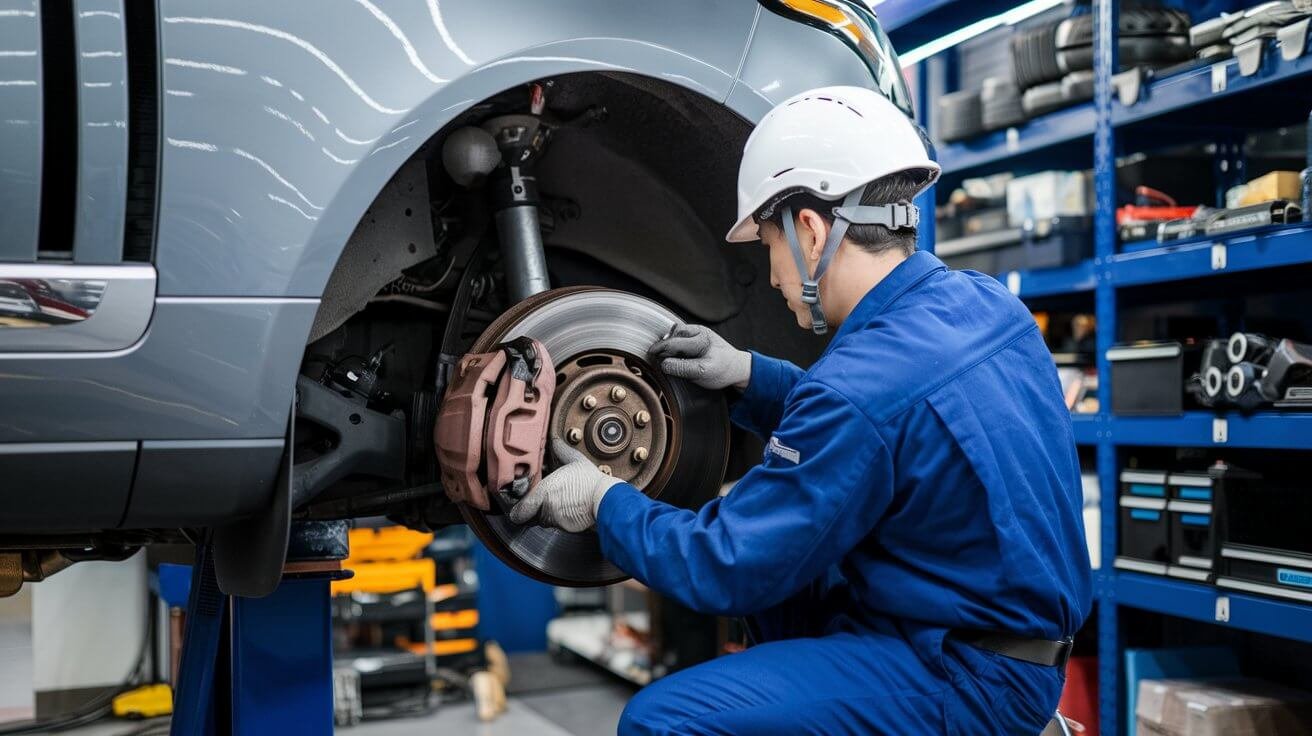
The friction brakes still need normal physical inspection. Disc condition, pad wear, corrosion, hydraulic performance, wheel-speed information and stability-system faults can exist alongside normal regeneration. If the vehicle has grinding, a wear warning, vibration or visible disc and pad deterioration, a brake pad and disc inspection can be coordinated with the hybrid diagnosis rather than assuming the energy-recovery system is responsible.
Verification should compare safe low-speed and road braking with the original complaint, then confirm that warning status, pedal response and conventional brake condition agree after repair.
Service planning by identity and use
Match maintenance to the exact PHEV and recorded history
Use the official maintenance requirements for the vehicle identification number, model year, engine and market specification. P400e, P440e and P510e naming alone is not enough to set a universal parts list or interval. Confirm history, mileage, time, dashboard information and previous invoices before deciding what is due.
A useful PHEV service review covers the petrol-engine requirements, low-voltage condition, charging equipment, visible high-voltage safety items, cooling, tyres, brakes, fluids, software or campaign context and stored warnings. Regenerative braking can change how friction brakes are used, but it does not remove the need to inspect discs, pads, corrosion, fluid and conventional braking performance.
Tyre specification and rolling circumference matter to a heavy all-wheel-drive vehicle with integrated control systems. Record uneven wear, pressure loss, vibration and any recent single-tyre replacement. Inspect all four corners before attributing driveline or stability behaviour to software.
Dubai use can include high ambient temperature, dust, short urban journeys, long parked periods and repeated cabin cooling demand. These conditions should influence inspection and the owner discussion, not create invented service intervals. Evidence from the vehicle remains the basis for recommendations.
Displayed range needs context
Compare like with like before judging battery performance
Record the displayed charge percentage and estimated electric range after a consistent charging session. Compare similar routes, temperatures, climate settings, traffic and driving style. A single morning-to-evening difference cannot isolate battery capacity because the estimate responds to recent energy use and predicted demand.
If the vehicle consistently accepts less energy, stops at the same point, loses charge unusually while parked or shows a warning, preserve dates and charger records. Confirm scheduled charging, departure settings, cabin preconditioning and connected services. Separate an app display problem from an in-vehicle charging event.
Workshop evaluation may compare stored data, temperature, cell or pack information available through approved diagnostics, charging behaviour and road energy flow. The interpretation must be specific to the system. Do not promise a battery replacement, module repair or capacity figure before testing.
Handover should explain what was measured, the conditions used, whether the behaviour was reproduced and which change should prompt follow-up. That record gives the owner a baseline for later seasonal or route comparisons.

Repair approval should be layered
Separate the confirmed fault from supporting and advisory work
The estimate should identify the evidence-backed failure, the work required to complete that repair, any related damage and items that remain observations. This is especially important on an integrated hybrid because one warning can cross several systems without proving that several expensive assemblies have failed.
Parts must match the exact vehicle and installed system. Physical fit does not guarantee correct software, cooling connections, electrical rating or configuration. Some work may require coding, programming, calibration, fluid procedures or controlled energisation before the vehicle is ready.
Verification should follow the original event. That can mean a charging session, cold or warm start, engine transition, road load, climate demand or parked-state check. Scan status, physical integrity and owner-visible operation should agree. A reset that hides the message without reproducing the condition is not a complete handover.
Keep warning photographs, charger messages, invoices, test results and update records with the vehicle. A clean evidence trail helps future diagnosis and supports used-vehicle decisions without relying on guesswork.
Questions PHEV owners actually ask
Range Rover hybrid service FAQs
Why will my Range Rover hybrid not charge?
The supply, cable, inlet, locking response, settings, 12-volt state, temperature, communication or vehicle charging system may be involved. Note whether another compatible charger works and preserve the exact message.
Why did charging stop before 100 percent?
Scheduled settings, supply interruption, temperature management, connector issues, software state or a vehicle fault can interrupt charging. Record the repeatable stopping point and charger evidence before parts are approved.
Why does the petrol engine start when charge remains?
Power demand, climate control, temperature and system protection can request engine operation. If it is new, repeatable or accompanied by warnings, diagnose it in the exact operating condition.
Does lower displayed electric range mean the battery has failed?
No. The estimate also responds to recent driving, climate demand, route and temperature. Compare similar conditions and investigate a consistent change with charging and diagnostic evidence.
Can a normal workshop work on high-voltage parts?
High-voltage diagnosis and repair require appropriate training, procedures and equipment. Owners should never probe orange cables or dismantle protected components.
What should I send before booking?
Send model year, PHEV variant, warning photos, charge percentage, charger type, the point at which the issue occurred, recent repairs or updates and any heat, smell, impact or leakage evidence.
Do P400e, P440e and P510e use the same charging system?
No. Charging hardware and capability vary by model and generation. Earlier P400e installations and later extended-range P440e or P510e systems should not be compared from the badge alone. Confirm the VIN, model year and whether the exact vehicle supports AC only or AC and DC charging before diagnosis.
Why can brake feel or energy recovery change on a PHEV?
Regenerative braking can contribute to deceleration while conventional friction brakes remain responsible for normal braking performance. Charge state, drive mode, system warnings and road conditions can change the energy-recovery contribution, while pads, discs, hydraulics, ABS and wheel-speed inputs still need normal inspection.
Book a Range Rover PHEV assessment in Dubai
Share the exact variant, charging environment, warning sequence and operating conditions. The service route will be based on measured low-voltage, high-voltage, charging, cooling, software and engine evidence.