

Starting and electrical power in Dubai
Range Rover Battery Replacement in Dubai
Slow cranking, repeated jump-starts, battery warnings or unstable electronics can point to a weak battery, but the same symptoms can come from charging faults, parasitic drain, poor connections or a vehicle that is not entering sleep mode. We test the complete power path before selecting and fitting a replacement battery.
Confirm why the vehicle lost power
A flat battery does not automatically mean the battery is the only failed part
The battery stores energy for starting and supports the vehicle while electrical demand changes, but it depends on the charging system, cables, grounds and control modules. A battery can be discharged because lights or accessories remained active, the alternator did not restore charge, a control module stayed awake, a connection created voltage loss or the battery itself lost capacity. Replacing the battery without identifying the cause can lead to another no-start.
A useful assessment starts with the exact symptom. A vehicle that cranks slowly every morning needs a different test path from one that dies after several parked days, shows a warning only while driving or becomes unstable after a jump-start. The age written on a battery is useful history, but it does not replace testing under the conditions that produced the complaint.
This page owns the main vehicle-battery testing and replacement intent. Repeated parked discharge belongs on the battery-drain page. A charging-output concern belongs on the alternator page. Key-fob battery replacement remains a separate service.
The symptom pattern guides the first test
Four battery conditions owners commonly report
Slow or uneven cranking
The starter turns more slowly than normal, lights may dim and the engine may need several attempts. Battery output, cable voltage loss and starter demand should be compared.
Battery becomes flat after sitting
The battery may be weak, insufficiently charged or repeatedly discharged by a module or circuit. The parked time and recent driving pattern are important evidence.
Battery warning appears while moving
A warning during engine operation can involve charging output, belt drive, wiring, grounds or battery acceptance. Replacing only the battery may not restore charging.
Multiple warnings or resets
Low or unstable voltage can affect several control modules at once. Fault records should be preserved before the battery is disconnected or codes are cleared.
A battery decision needs six readings
What the battery and power-system test should prove
The test should explain whether the battery can store and deliver energy, whether the vehicle restores charge and whether power reaches the starter and modules without excessive loss.
State of charge
A discharged battery and a failed battery are not the same. Charge level must be considered before capacity is judged.
Starting output
The battery should support the starting event without voltage collapsing beyond the expected behaviour for the vehicle.
Alternator response
Charging output and control should be checked under relevant electrical demand, not only at one idle reading.
Voltage loss
Positive cables, grounds and connections must carry current without creating a hidden restriction.
Sleep and drain behaviour
When repeated discharge is reported, the vehicle must be allowed to enter its intended parked state before current draw is interpreted.
Battery management
Some vehicles require the replacement battery to be recognised or configured so charging strategy matches the fitted battery.
Test the complete power path before fitting
How the workshop confirms a Range Rover battery fault
A battery decision should explain why the vehicle lost starting power, whether the battery can recover and whether charging, cables or parked current draw will damage the replacement.
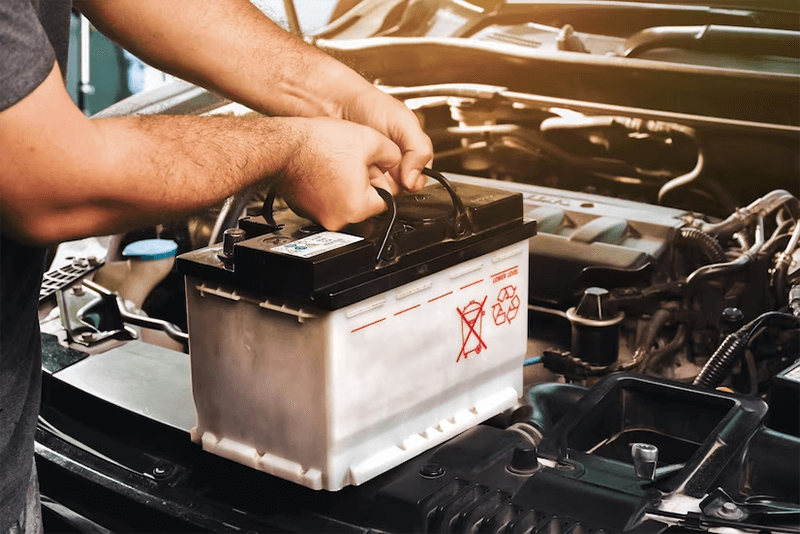
The first failed layer determines the repair
A flat battery may be the failed part, the result of another electrical problem or both. The workshop follows the power path from stored energy to starter delivery, charging recovery and parked behaviour before approving replacement.
Battery condition
Establish charge level, physical condition and whether the battery can provide dependable starting output after its state is considered.
Starting delivery
Compare battery output with voltage loss through terminals, positive cables, grounds and the starting circuit during demand.
Charging recovery
Confirm that the charging system responds under relevant electrical demand and restores energy through a dependable cable path.
Repeat-discharge cause
When the vehicle becomes flat after parking, separate a weak battery from limited use, poor sleep behaviour or an active circuit.
Define the failure pattern
Record whether the vehicle cranks slowly, clicks, starts after assistance, becomes flat after parking or shows a warning while driving.
Gate result: the complaint is assigned to starting, parked discharge, charging or unstable-voltage investigation.
Inspect the battery installation
Check the case, hold-down, terminals, cables, grounds and signs of heat, leakage, damage or previous incorrect fitment.
Gate result: physical danger or connection faults are identified before electrical testing continues.
Establish charge and capability
Assess the battery using a method appropriate to its state and vehicle application. A deeply discharged battery may require controlled charging before capability is judged.
Gate result: low charge is separated from loss of dependable battery output.
Prove charging and cable delivery
Check charging response under relevant demand and compare voltage through positive and ground paths during the reported condition.
Gate result: alternator, cable or ground faults are either found or excluded before replacement.
Investigate parked discharge where needed
When the complaint occurs after parking, allow the vehicle to enter its intended state before interpreting current draw and module activity.
Gate result: repeated discharge is linked to battery weakness, vehicle use or an active circuit.
Choose the repair and verify
Recharge, replace or repair the failed electrical layer. After the approved work, retest starting, charging, warnings and the original failure condition.
Gate result: the final report proves why the chosen repair addresses the complaint.
Battery replacement approval rule
Replacement is supported when the battery cannot provide dependable output, has unacceptable physical condition or fails the appropriate assessment after charge state is considered. Charging, cable and parked-drain findings must be recorded separately.
Choose the route supported by the evidence
Recharge, replace or diagnose another system
Recharge and retest
A serviceable battery that was discharged by limited vehicle use or a one-time event may need controlled charging and a repeat test. The cause of the discharge still needs to be understood before the vehicle is returned.
Replace the battery
Replacement is supported when the battery cannot provide dependable output, has physical damage or fails the appropriate capacity and starting assessment after charge state is considered.
Repair the charging or drain fault
If the alternator, cable path or parked current draw is responsible, replacing the battery alone is incomplete. The battery may also require replacement if repeated discharge has damaged it, but both decisions should be explained separately.
A controlled installation protects the replacement
Battery replacement sequence and quality controls
The job is divided into three stages. Each stage has two controls that must pass before the vehicle moves to the next part of the replacement.
Confirm the vehicle and protect the electrical state
Battery application
Use the VIN, engine, equipment and fitted battery to establish the required physical layout, capacity class and battery technology.
Pass requirement: the replacement is supported by the exact vehicle and existing application, not a generic model list.
Electrical preparation
Record the vehicle condition before disconnection and plan for systems that can be affected by power interruption.
Pass requirement: the replacement process does not create avoidable warning, memory or configuration problems.
Inspect the mounting and restore dependable current delivery
Tray, cables and terminals
After safe removal, inspect the tray, hold-down, terminals, positive cable and grounds for leakage, heat, impact, corrosion or strain.
Pass requirement: no damaged mount or poor connection is hidden beneath the replacement battery.
Position and retention
Install the correct battery securely, connect it without cable strain and confirm that terminal contact and routing are dependable.
Pass requirement: the battery is physically stable and current can travel through clean, secure connections.
Match vehicle management and repeat the original condition
Vehicle recognition where required
Complete the battery recognition or configuration procedure required by the exact vehicle and fitted battery application.
Pass requirement: vehicle energy management recognises the replacement according to the applicable repair procedure.
Starting and power-system verification
Retest starting response, charging behaviour, warning status and affected electrical functions. Repeat-discharge cases receive the additional test agreed during diagnosis.
Pass requirement: the original complaint is addressed rather than only clearing the immediate no-start.
Installation completion rule
The replacement is not complete until the correct battery is secured, the terminal and cable path is dependable, required vehicle recognition is addressed and the starting and charging results are recorded.
Battery technology must match the vehicle
Main battery, auxiliary battery and electrified systems are different scopes
Main starting battery
The main low-voltage battery supports starting and vehicle electronics. Its physical size, terminal position, capacity class and battery technology must match the exact Range Rover or Land Rover application.
Auxiliary or support battery
Some vehicles use an additional low-voltage battery or support arrangement for specific systems. A warning must be linked to the correct battery and circuit before replacement.
Hybrid or high-voltage system
A high-voltage traction battery is not the same service as a conventional 12-volt replacement. High-voltage concerns require a separate safety-controlled diagnostic route.
A battery should not be selected only because it fits the tray. The vehicle can require a specific battery construction and electrical capability. The existing battery, VIN, fitted equipment and service information should be checked together. Substituting a different technology or capacity without evidence can affect starting, charging strategy and battery life.
Avoid replacing the battery for every electrical complaint
Problems that can look like battery failure
Alternator or charging fault
The vehicle may start after a jump but lose power again because the charging system is not restoring energy. A warning while driving often needs charging tests.
Parasitic battery drain
A healthy battery can become flat when a module, accessory or circuit remains active after parking. The vehicle must reach its intended sleep state before draw is judged.
Starter or cable voltage loss
Clicking or slow cranking can come from starter demand, corroded connections or poor grounds. Battery output and cable delivery should be compared during the starting event.
Key or authorisation problem
A vehicle that does not respond to the key may have a key battery, key recognition or security concern rather than a discharged main battery.
Software or module wake-up issue
Repeated resets and warning messages can follow a voltage event, but a module or communication fault may continue after the battery is restored.
Limited driving pattern
Repeated short journeys and long parked periods can leave the battery undercharged. The condition still needs assessment because a weak battery and low charge can exist together.
Battery location and management vary across the range
Range Rover battery replacement depends on model, engine and equipment
Range Rover, Range Rover Sport, Evoque, Velar and Land Rover models use different battery locations, access arrangements, support batteries, charging strategies and cable paths. Petrol, diesel, mild-hybrid, plug-in hybrid and other electrified applications can use different low-voltage systems. The correct decision therefore begins with the VIN and the battery actually fitted to the vehicle.
Previous battery replacement also matters. An incorrect battery, loose hold-down, strained cable, missing vent arrangement or skipped vehicle recognition can create repeat concerns. Accessories, trackers, dash cameras and aftermarket wiring can influence parked current draw. These details should be documented rather than hidden inside a generic battery quote.
Full-size Range Rover and L322
Battery location, access and management differ across generations and engines. Older cable condition and previous repairs can influence starting performance.
Range Rover Sport and Discovery
Electrical equipment, towing accessories and long parked periods can change load and drain patterns. Main and support battery roles should be separated.
Evoque and Velar
Compact packaging and modern energy management make correct battery identification and post-installation verification important.
The battery and vehicle system determine the quotation
What affects Range Rover battery replacement cost
The final scope depends on the model, engine, fitted battery technology, capacity, location, access, main or auxiliary role, terminal and tray condition, battery-management requirements and whether charging or drain diagnosis is needed. A generic battery price does not describe every vehicle or every no-start concern.
A useful quotation should identify the exact battery application, explain the test result, state whether fitting and vehicle recognition are included and separate battery replacement from alternator, cable or parasitic-drain work. It should also explain any physical damage or previous incorrect installation found during removal. Prices and completion times should be confirmed from the exact vehicle and approved scope rather than invented online.
- VIN, model year, engine and fitted equipment
- Main, auxiliary or other low-voltage battery role
- Battery state, starting output and physical condition
- Charging and cable test findings
- Battery location and access requirements
- Registration or configuration requirement where applicable
- Final starting, charging and warning verification
Dubai conditions can expose battery weakness
Heat, short trips, long parking and electrical load change the failure pattern
High ambient temperature can accelerate battery wear and increase under-bonnet stress. Repeated short journeys may not restore the energy used during starting, especially when air conditioning and electrical systems are active. A vehicle parked for long periods can also become undercharged or reveal a parasitic draw that is less obvious during daily use.
These conditions do not prove the battery by themselves. Tell the workshop how long the vehicle sits, whether it starts after a jump, whether a warning appears while driving and whether accessories or trackers were recently fitted. Avoid clearing warnings or repeatedly disconnecting the battery before the fault record is preserved.
Battery replacement questions
Frequently asked questions
Does a flat Range Rover battery always need replacement?
No. A serviceable battery can become discharged because of limited driving, a charging fault, a light or accessory left active or a parasitic drain. The battery should be charged and tested before replacement is decided.
Can a bad alternator damage or repeatedly flatten a new battery?
Yes. If charging output is inadequate or unstable, a replacement battery can remain undercharged or be stressed. Charging behaviour should be tested when the symptom supports it.
Does a Range Rover battery need registration or programming?
Some vehicles require the replacement battery to be recognised or configured by the vehicle. The requirement depends on the exact model, year and battery-management system.
Why does the battery become flat after the vehicle is parked?
The battery may be weak or insufficiently charged, or a module, accessory or circuit may remain active. A parasitic-drain test must allow the vehicle to enter its intended sleep state.
Can I keep jump-starting the vehicle?
Repeated jump-starting does not correct the cause and can add risk when cables, the battery or charging system are damaged. Arrange testing if the vehicle repeatedly needs assistance.
How is the correct replacement battery selected?
Use the VIN, engine, fitted equipment, existing battery and vehicle information to confirm size, terminal layout, capacity class and battery technology.
What information should I send before booking?
Send the VIN or registration-card photo, exact warning, whether the engine cranks, how long the vehicle was parked, jump-start history and details of recent battery, alternator or accessory work.
Book battery testing in Dubai
Confirm the battery, charging system and discharge cause before replacement
Send the VIN, warning photo, starting behaviour, parked time and recent electrical work. We will advise which battery and power-system checks are needed before fitting a replacement.