
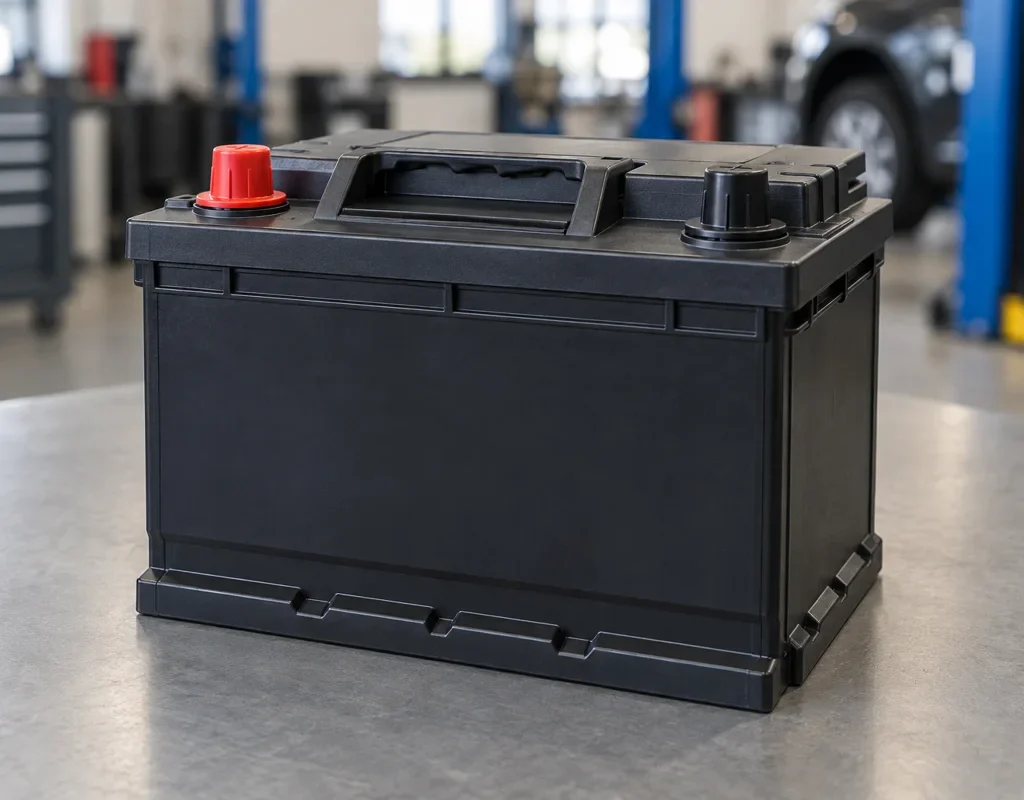
A slow start, flat battery, or electrical warning does not automatically mean your Range Rover needs a new battery. The useful decision is whether the 12-volt battery has failed, is not receiving enough charge, or is losing energy while parked. Testing those conditions before replacement helps avoid paying for another battery while the original fault remains. Physical damage, overheating, or signs of escaping gas need urgent professional help before any test or charging attempt.
When to stop using the vehicle and get professional help
Do not start, jump-start, or charge a battery that is swollen, cracked, leaking, unusually hot, hissing, or giving off a strong unusual odor. Stop safely and switch the vehicle off if you can do so without approaching the hazard. Keep people away and avoid flames, smoking, sparks, and contact with leaked material.
Do not loosen terminals, remove the battery, open its case, or try to neutralize a leak yourself. Isolate the area from people and ignition sources. Electrical isolation and removal belong to qualified personnel using the correct vehicle procedure. If there is smoke, fire, or immediate danger, move away and call emergency services.
Do not lean toward the battery to identify a smell. An odor is not a reliable way to distinguish a leak, overheating, or another source. Lead-acid batteries contain corrosive material and can release flammable gas. VARTA's battery safety guidance explains the need to avoid ignition sources and exposure during battery work.
If a charging warning appears while driving, stop in a safe place and seek assistance. Arrange recovery if electrical systems shut down, warnings multiply, the engine stalls, steering or braking assistance changes, or there is overheating, smoke, a burning smell, or damaged wiring. There is no dependable remaining driving distance once charging is lost.
The red battery icon is a charging warning
A red battery-shaped warning that stays on after starting or appears while driving generally indicates a charging-system fault. It is not a reminder that battery replacement is overdue. On conventional systems, possible causes include the alternator, belt drive, control circuit, main cables, grounds, or related electrical connections. The battery itself still needs assessment.
Land Rover's archived vehicle-battery handbook section distinguishes the normal bulb check from a warning during engine operation and calls for urgent qualified assistance. Use the handbook for your exact vehicle for current messages and actions. The old document's battery sizes, locations, and removal instructions must not be applied across the range.
Some electrified vehicles use a different charging architecture, so “battery light” does not automatically mean an alternator is fitted or defective. Record the exact symbol and wording, including whether it appeared before starting, with the engine running, or while the vehicle was in its ready state.
A low-battery message while parked is a different observation from a red charging warning while driving. A key-fob battery warning is different again. Photograph the message when safely parked rather than ordering a main vehicle battery from a general description.
Battery condition, charging, and parked drain need different tests
Start with when the problem occurs. These patterns help select the next check, but none identifies a failed part by itself. More than one problem can exist, especially after repeated deep discharge.
| What you notice | What needs separating | Useful next test |
|---|---|---|
| Slow cranking or clicking | Low charge, poor battery capability, cable losses, or starter demand | Battery assessment plus starting-circuit and voltage-drop checks under the relevant conditions. |
| No response to a start request | Low-voltage supply versus key recognition, start authorization, or starter control | Confirm supply and the starting sequence before condemning the battery. |
| Red charging warning while driving | Generation, conversion, control, wiring, or battery-related faults | Inspect and test the fitted charging system. Follow warning and recovery guidance first. |
| Flat after parking overnight or for several days | Reduced capacity, insufficient charging, normal standby load, or excessive parked draw | Establish battery condition and charge, then observe the vehicle's shutdown and sleep behavior. |
| Multiple warnings or screen resets | A voltage event versus an independent module or communication problem | Preserve codes and event history, check supply stability, then investigate remaining faults. |
| A new battery also becomes flat | Original charging/drain fault, incorrect fitment, low initial charge, or installation concern | Review the installation and test all relevant energy paths before another replacement. |
A successful jump-start only shows that assistance changed the starting conditions. It does not prove that the original battery is defective, that the charging system works, or that there is no parked drain.
What a useful 12-volt battery test should tell you
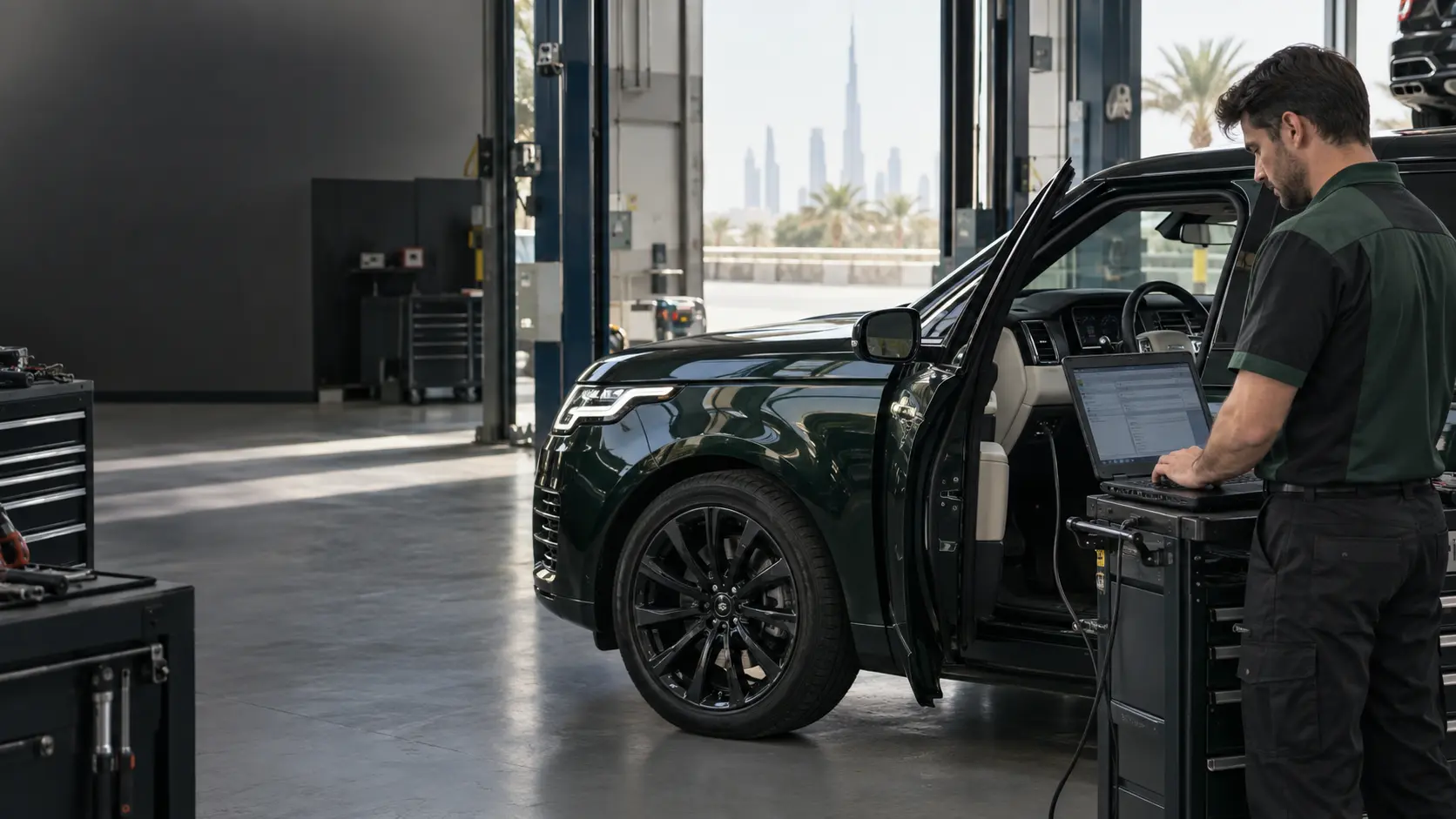
A useful test explains three things: how much charge the battery has, what it can still deliver, and whether power reaches the starter properly.
Ask the workshop to connect its findings to your starting complaint. The result should make the next step clear: recharge and retest, replace a confirmed weak battery, or investigate the charging system, cables, or parked drain.
Separate charge level from battery health
State of charge describes how much energy is available now. Battery health concerns its remaining ability to perform its job. A serviceable battery can be discharged, while a deteriorated battery can briefly show a reasonable voltage after charging.
The workshop should identify the battery technology and rated specification before selecting a compatible test method. If it is safe and appropriate, a discharged battery may need controlled charging and retesting. A “charge and retest” result should not be presented as a confirmed failure without completing the required assessment.
Understand what the tester measured
A starting-performance estimate is not automatically a direct measurement of remaining amp-hour capacity or charge acceptance. VARTA's explanation of battery-test results highlights these limitations for start-stop batteries. The result should be interpreted alongside the complaint and discharge history.
Ask for the test result, entered battery type and rating, relevant conditions, and the reason for the recommendation. A single voltage number or a percentage on a handheld tester should not be treated as a universal replacement threshold for every Range Rover.
Check the connections and starting circuit
High resistance at a terminal, cable, or ground can reduce power reaching the starter even when the battery has usable capacity. Starter demand may also need assessment. Voltage-drop testing under load can help separate these conditions; simply looking at a cable or measuring unloaded voltage may miss the problem.
Charging-system checks should follow the fitted powertrain
On an alternator-equipped vehicle, the workshop may inspect the drive belt and connections, review control data, and measure charging response under relevant load and temperature conditions. Managed charging can vary its output, so one idle-voltage reading does not prove that the system is healthy or faulty.
On an electrified vehicle, the 12-volt supply may involve a DC-to-DC converter and other power-management components. Testing must follow that architecture. A conventional alternator checklist should not be copied onto a different system.
Low output at the battery can reflect a charging-source fault or a loss along the cable path. Overcharging, unstable output, poor connections, and an unsuitable battery can also require investigation. A fresh battery may temporarily restore starting while leaving the underlying charging problem unresolved.
Never disconnect a battery while the engine is running to “test the alternator.” Do not bridge terminals or bypass protective devices. These shortcuts can create electrical damage and injury risks without producing a reliable diagnosis.
A battery that goes flat while parked needs a sleep test
Some electrical activity after locking is normal. Control modules may finish tasks before entering a lower-power state. Measuring too early can make normal shutdown activity look like a fault, while opening a door or repeatedly operating the key can disturb the test.
A controlled investigation establishes the battery's starting condition, prepares the vehicle correctly, and records current over the relevant parked period. The correct waiting time and acceptable current pattern depend on the model and fitted systems. There is no single sleep-time or milliamp limit suitable for every Range Rover.
Dash cameras, trackers, chargers, aftermarket audio, latch signals, water ingress, and modules that remain awake are possible lines of investigation. Their presence does not prove they caused the discharge. Circuit isolation must show which activity is excessive and whether the repair restores the expected shutdown behavior.
Tell the workshop how long the vehicle can stand, whether the problem happens after every journey, where the keys are stored, and what accessories were recently fitted. An intermittent drain may need longer observation than a quick scan. If the battery repeatedly goes flat while parked, battery drain testing can help identify what remains active after the vehicle should be asleep.
When recharge, replacement, or another repair makes sense
| Finding | Reasonable next step | What still needs checking |
|---|---|---|
| Safe, serviceable battery discharged by a known one-time event | Controlled recharge and retest using an approved method | That the battery performs adequately and the discharge cause is resolved. |
| Battery fails the applicable assessment after charge state is considered | Correctly specified replacement | Charging performance and any recurring reason for discharge. |
| Swelling, leakage, abnormal heat, or other unsafe physical condition | Professional isolation, assessment, and safe replacement/disposal as required | The cause of damage. Do not charge or load-test a suspect damaged battery first. |
| Charging fault, cable resistance, or excessive parked draw is confirmed | Repair the identified fault | Whether the battery remains serviceable or was also damaged by repeated discharge. |
A marginal test can justify discussion of reliability and planned use, but the uncertainty should be stated. For example, extended parking or an essential journey may influence an owner's choice after assessment. That is different from declaring that every battery must be replaced on its third birthday.
Select a replacement by VIN and verified specification
“Range Rover Sport battery” is not a complete parts specification. Engine, generation, equipment, battery role, and electrical architecture can change the required unit. The same applies to Evoque, Velar, and full-size Range Rover models.
- Vehicle identity: VIN, model year, engine, and fitted systems.
- Battery role: main 12-volt supply, auxiliary/support battery where fitted, or a separate electrified-system component.
- Technology: the approved construction, such as AGM or EFB where specified.
- Electrical rating: required capacity and starting rating using the correct rating standard.
- Physical fit: case dimensions, hold-down, terminal layout, cable clearance, and vent arrangement where required.
- Vehicle setup: replacement recognition, registration, or configuration if the applicable procedure requires it.
The existing label is useful, but a previous owner may have fitted the wrong battery. Cross-check it against vehicle information instead of copying it blindly. VARTA's application finder also distinguishes vehicle configuration and start-stop requirements; a model-name-only table cannot do that reliably.
Do not assume that AGM is automatically a suitable upgrade for every application or that an ordinary flooded battery can replace a specified start-stop battery. A physically larger battery or higher advertised starting rating does not override the approved technology, mounting, and management requirements.
Keep 12-volt work separate from hybrid battery systems
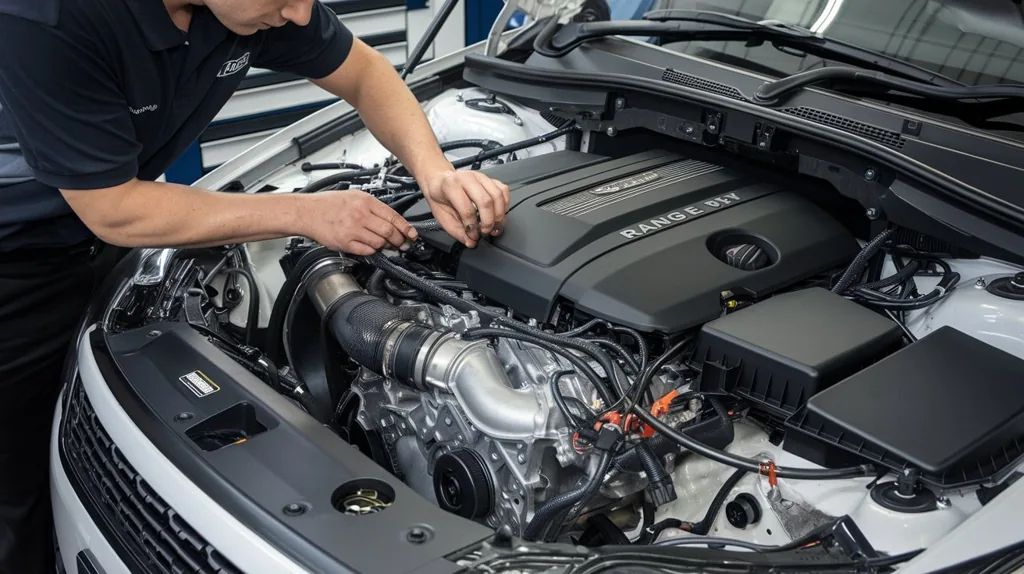
A plug-in hybrid can have charge in its traction battery yet still have a 12-volt supply problem that prevents normal startup. Conversely, replacing a 12-volt battery does not establish that a hybrid-system warning has been repaired.
Some mild-hybrid systems include a separate 48-volt system. Other hybrids have a high-voltage traction system. Neither should be treated as an ordinary 12-volt battery swap. Warning identification, test equipment, and isolation procedures differ.
Do not touch orange cables, open battery housings, remove service disconnects, or attempt to isolate an electrified system yourself. Switching the vehicle off or disconnecting the 12-volt battery is not proof that the traction system is safe. Qualified personnel must follow the exact procedure.
What a completed replacement should include
A replacement should address more than the immediate no-start. The workshop should confirm the correct part, secure mounting, sound terminals and cables, and the required vent connection. Damaged connections or an insecure hold-down should not be concealed by the new battery.
Battery-management registration or reset is application-specific. It is not a universal ECU update, and “coding included” should describe the actual required operation. The correct procedure may also call for checking affected functions after a power interruption.
Ask for a quote that identifies the battery and its specification, testing, installation, any required setup, VAT, and written warranty conditions. Charging-system repair or a longer parked-drain investigation should be identified separately. Do not assume those services are included in a battery-only price.
At handover, the starting or ready-state check, charging behavior, and relevant warnings should be reviewed. If the original complaint was overnight discharge, immediate successful starting does not verify the whole repair. Agree on the required parked-period check and any follow-up.
Dubai heat and vehicle use affect condition, not a fixed expiry date
Heat, repeated discharge, short journeys, and long parked periods can affect battery performance and charging needs. They do not establish a universal UAE lifespan or prove that a battery ages three times faster. There is no basis here for assigning a percentage of electrical complaints to battery failure.
Keep the installation date and service history, respond to changing starting behavior, and arrange assessment when symptoms recur. Do not wait for a routine service if the battery is damaged or a charging warning appears. Equally, age alone should not replace a proper test.
For long storage, follow the vehicle's approved maintenance-charging guidance and use equipment compatible with the battery and connection points. A brief idle or short drive is not a dependable way to restore a deeply discharged battery. Do not connect a charger if the battery's condition is unsafe or uncertain.
Range Rover Battery Replacement FAQs
Does the red battery light mean I need a new battery?
No. A persistent warning after starting or during driving points to a charging-system concern. The fitted charging source, controls, cables, grounds, and battery need assessment. Follow the exact vehicle warning and seek assistance.
Can a flat battery recover without replacement?
Sometimes. A safe, serviceable battery may need controlled charging and retesting after a known discharge. A damaged battery must not be charged, and a recurring charging or parked-drain fault still needs repair.
Should I replace the battery automatically after three years?
No. Age is useful history, not a universal failure threshold. Consider physical condition, the appropriate test results, previous discharge, and the vehicle's use before deciding.
Why does my new battery keep going flat?
The original charging fault or parked drain may remain. Incorrect specification, low charge before installation, poor connections, or missed setup may also matter. Recheck the system before fitting another battery.
Can I remove a swollen or leaking battery myself?
No. Keep people away, avoid ignition sources, and arrange professional assistance. Do not jump-start, charge, disconnect, move, or open the damaged battery. Electrical isolation and removal need trained personnel.
Do all Range Rover batteries need registration?
No single rule covers the whole range. The workshop should check the exact battery-management system and complete the prescribed replacement recognition or configuration where required.
Does a hybrid battery warning refer to the 12-volt battery?
Not necessarily. Main 12-volt, auxiliary, 48-volt, and high-voltage systems have different roles. Use the exact message and vehicle specification to identify the system before any replacement.
Does a normal voltage reading prove the battery is healthy?
No. Voltage depends on charge state and measurement conditions. It does not, by itself, establish dependable starting output, remaining capacity, or the absence of an intermittent drain.
Confirm why power was lost before replacing the battery
Treat damage and charging warnings first. Then separate battery capability, charging performance, cable delivery, and parked consumption. Replace the battery when its condition justifies it, and address any fault that could discharge or damage the replacement.
For battery testing and replacement at our Al Quoz 4 workshop, send the VIN, exact warning, starting behavior, parked time and recent electrical-work history. These details help determine whether the battery itself or another fault needs attention.
Workshop support
Need help with your Range Rover?
Tell us your model, year and what you have noticed. Speak with the workshop about maintenance, an inspection or a repair.