
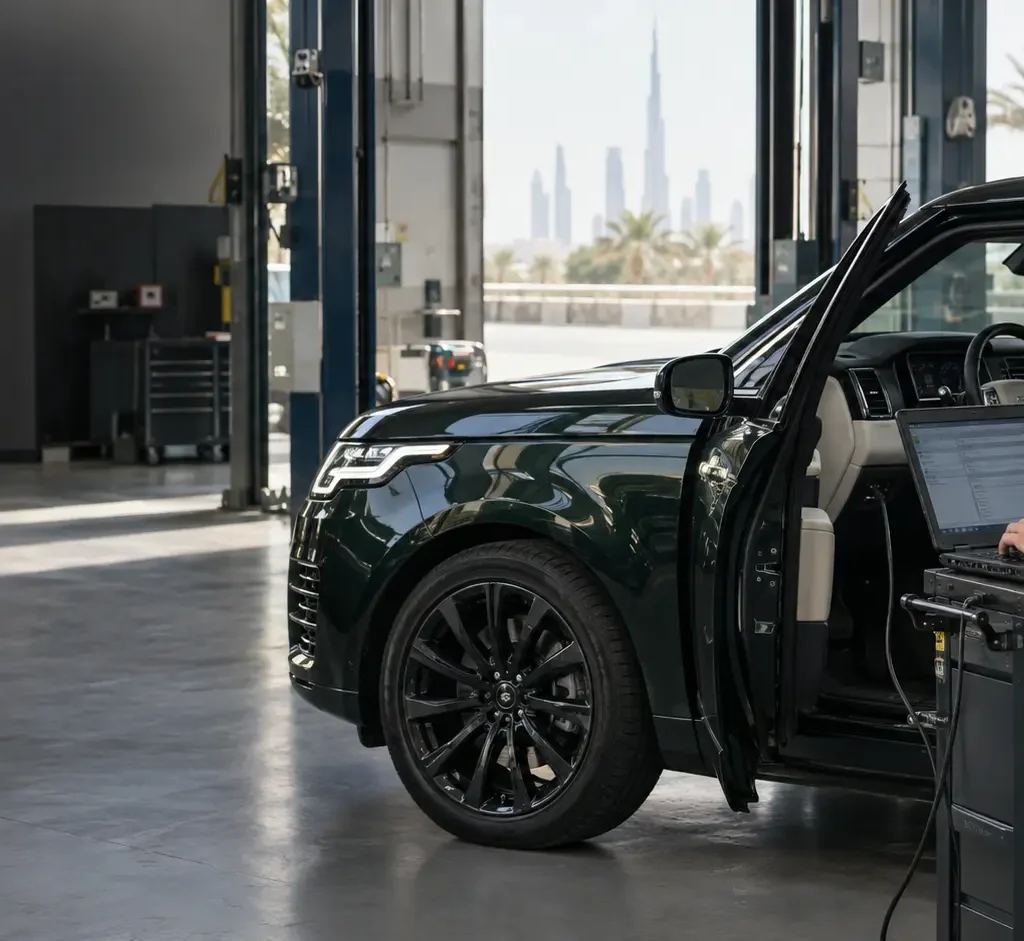
Shaking at idle, a clunk during gear selection or a new vibration through the seat can involve a worn Range Rover engine mount. The same symptoms can also come from a misfire, exhaust contact, a transmission support or another drivetrain fault. Replacement should follow a confirmed finding, not the number of symptoms you recognize.
This guide explains what mounts do, which observations help a workshop, and how to decide whether one mount, several supports or a different repair is justified. Loaded Drive/Reverse tests and engine-support work belong in a trained workshop using the exact vehicle procedure.
When engine vibration means stop and arrange recovery
Stop safely and arrange recovery if the vehicle develops severe banging, sudden major shaking, obvious component contact or a loss of control. A flashing engine warning with rough running, fuel leakage, an oil-pressure warning, overheating or smoke also needs a safe stop. These symptoms may involve more than the mounts. Switch off when safe, follow the warning instructions and do not keep restarting or accelerating to demonstrate the problem.
A mild, stable vibration without other symptoms still needs assessment, but it does not automatically mean immediate mount replacement. Describe the symptoms to the workshop and ask whether a trip for inspection is appropriate. This article cannot establish a safe driving distance.
Use the instructions for your exact vehicle in Land Rover iGuide. Tell the recovery operator if the vehicle is a hybrid. Do not assume the same towing or loading method suits every Range Rover.
Range Rover engine mount symptoms and their look-alikes
The timing of a vibration is more useful than simply calling it “rough.” Note whether it occurs at engine start, at warm idle, during ordinary gear selection or only while moving. Do not deliberately create a harsh event to obtain evidence.
| What you notice | Possible explanations | Useful workshop check |
|---|---|---|
| Seat or steering-wheel vibration at idle | Mount isolation, uneven combustion, accessory load or exhaust contact | Compare engine running quality with the vibration transmitted to the body |
| A clunk during ordinary Drive or Reverse selection | Mount movement, transmission engagement, driveline play or a contact point | Locate the movement and sound under an approved controlled test |
| Vibration changes when the AC operates | Changing engine load, idle control, compressor behavior or weak isolation | Compare the same temperature and operating conditions with relevant engine data |
| Shaking mainly at a particular road speed | Wheels, tires, driveshafts or other drivetrain components as well as supports | Separate road-speed effects from engine-speed effects |
| A new vibration immediately after engine, exhaust or gearbox work | Mount position, wrong part, disturbed control connection or nearby contact | Review the work performed and inspect the affected installation |
| A visibly low or displaced engine position reported during inspection | Collapsed support, bracket damage or installation issue | Check the correct reference position and surrounding clearances |
The severe symptoms above take priority over this table. There is no “two symptoms equals failure” rule. A clunk and vibration can share a cause elsewhere, while one clearly separated or collapsed mount can justify repair after proper inspection.
Is the engine misfiring or transmitting vibration through a mount?
A misfire concerns combustion inside a cylinder. A mount supports and isolates the powertrain. An uneven-running engine can shake sound mounts, and a damaged mount can make normal engine pulses feel much stronger inside the cabin. Both faults can exist together.
The technician should review running quality, relevant fault records and available cylinder or smooth-running data before blaming the mounts. A code is a clue to a detected condition, not a parts order. No recorded misfire does not prove the engine is fault-free, especially if the event was intermittent or the relevant monitor was not active.
If engine running is uneven, investigate that cause and reassess the remaining vibration. If running is consistent but vibration reaches the body abnormally, inspect the supports, contact points and control system where fitted. A steady dashboard tachometer alone is not a complete combustion check.
Engine misfire diagnosis differs between gasoline and diesel engines. Spark-plug and ignition-coil checks do not apply to diesel engines in the same way, so establish the engine type before selecting tests.
Match the mount design to the engine and vehicle
Engine mounts carry the engine's static load and limit movement while isolating vibration. Transmission supports and torque restraints have related roles in the mounting system. They are not the suspension components that carry the vehicle body and road load.
ZF's explanation of powertrain mounts distinguishes conventional rubber mounts, fluid-damped hydraulic mounts and switchable designs. A hydraulic mount is not automatically electronically controlled.
- Conventional mount: a resilient element provides support and isolation.
- Hydraulic mount: internal fluid movement contributes to damping. An external oil stain still needs tracing before it is called a mount-fluid leak.
- Controlled mount: its behavior changes through the fitted control arrangement. A vacuum-operated design can also use an electrically commanded valve, so “vacuum” and “electronic” do not necessarily describe separate mount families.
Model badges and generation names are not enough to order parts. Confirm the model year, engine, transmission, market configuration, mounting position and current part applicability from the VIN. Similar-looking mounts can have different dimensions, damping characteristics or control connections.
For a narrow example, JLR bulletin LTB01287NAS4 documents active mounts and vacuum plumbing on specified 2018–2020 North American Velar vehicles with 2.0-liter Ingenium gasoline or diesel engines. That confirms those applications, not every Velar, Sport, Evoque or full-size Range Rover. Current VIN-specific service information must determine applicability to a UAE vehicle.
A hybrid's engine-start transition can be useful symptom history, but it does not prove faster mount wear. The traction battery's weight is not a load placed directly on the engine mounts. The same caution applies to claims that a heavier body automatically explains failed engine mounts.
What you can safely record before inspection
You can help without opening the hood beside a running engine. Record the symptoms from normal use, then make notes while parked safely.
- Model year, engine if known and current mileage in kilometers.
- Cold start, hot restart or fully warm idle, and whether the symptom disappears later.
- Whether it occurred in Park, Neutral, Drive or Reverse during ordinary operation.
- Whether AC operation, engine stop/start or a hybrid engine-start transition coincided with it.
- Warning text, recent impact, fluid leaks, prior mount replacement and recent engine, gearbox or exhaust work.
- A short cabin recording, made safely while stationary, showing the sound or visible interior vibration.
Do not hold the vehicle against the brakes while applying throttle, have a helper stand in front of it, reach toward moving components or loosen a mount to see what changes. Do not crawl beneath a vehicle supported only by a jack. On a hybrid, a quiet engine does not establish that the vehicle cannot start or move.
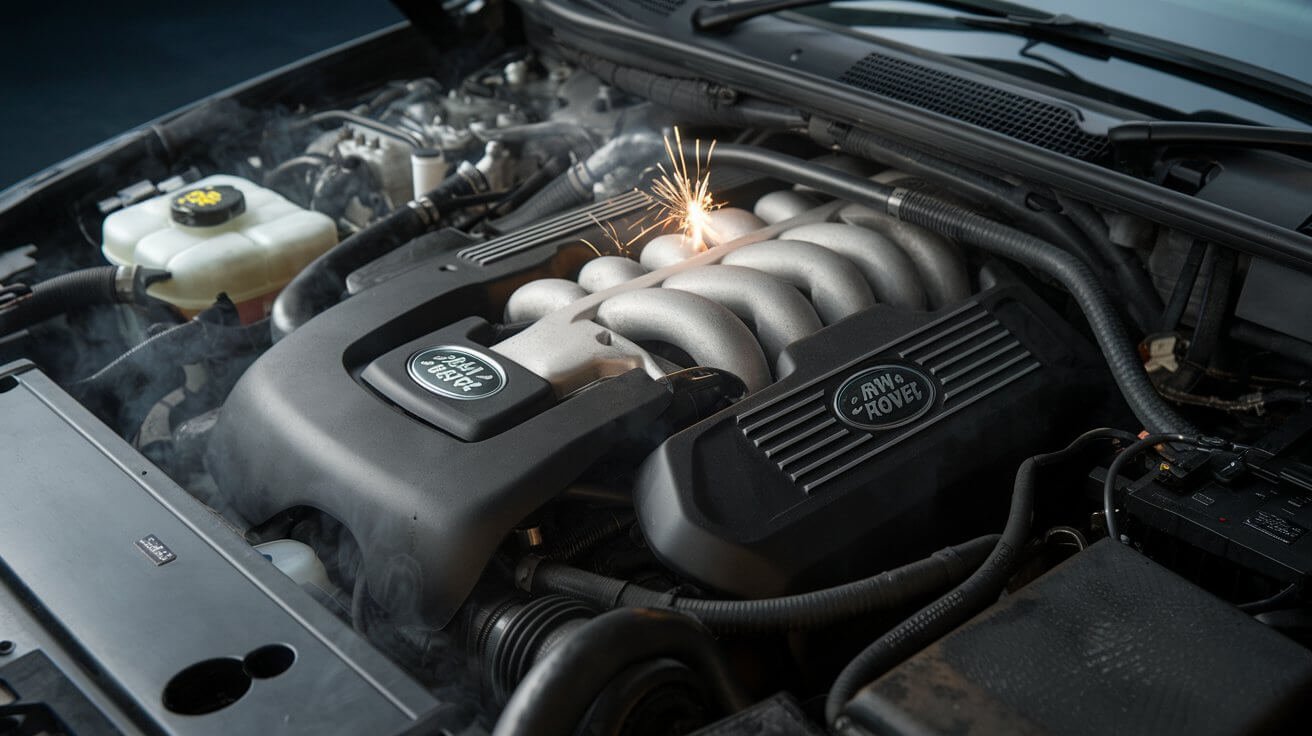
How a workshop should confirm an engine mount fault
Start with the complaint and engine running quality
The technician identifies the exact configuration, reviews previous repairs and checks whether the original condition can be reproduced safely. Relevant scan data can help distinguish an engine problem from vibration isolation, but mechanical mount condition is not established by a scan alone.
For intermittent symptoms, the report should state the conditions tested and whether the complaint occurred. “No fault reproduced today” is different from proof that every mount is healthy. Further observation may be more appropriate than replacing a set of supports on suspicion.
Inspect the mounts, brackets and surrounding parts
Inspection should assess separation, collapse, damaged brackets, installation position, control connections and evidence of abnormal contact. Where a hydraulic mount appears wet, identify whether fluid originated inside it or arrived from another leak. Surface appearance alone cannot establish every internal damping fault.
Keep the nearby checks: hoses, wiring, exhaust joints, heat shields and transmission supports can be strained or displaced when movement is excessive. They can also create their own vibration if routed or positioned incorrectly. A rubbing shield may need correction without a mount replacement; a hose damaged by a collapsed support may require both repairs.
Keep loaded testing and engine support in trained hands
If the applicable diagnostic procedure calls for loaded Drive/Reverse testing, a trained technician must control the vehicle, test area, operating conditions and observation method. The result must be interpreted against the exact powertrain design. Visible movement is not automatically excessive, and a universal movement limit is not supplied here.
Supporting or lifting the engine is a separate workshop operation. Use the specified equipment, support points and isolation procedure before releasing a mount. A generic instruction to place a jack and rubber block underneath the engine is not sufficient. Do not improvise a support point or pry the engine into position.
Test the control circuit only where fitted
For a controlled mounting system, check the applicable supply, hoses, valve, wiring and commanded response. A disconnected or leaking vacuum line may affect the system without proving the mount body has failed. Conversely, a working control valve does not prove the mount's mechanical condition is acceptable.
Testing requires the vehicle's specified connections and limits. Do not bypass the valve or disconnect a hose as an owner experiment. The finding should identify whether the confirmed problem is the mount, its control circuit, its installation or a separate vibration source.
Why mounts deteriorate without a universal lifespan
Time, repeated movement, operating temperature, contamination and damage can affect mount condition. A missing heat shield, an unresolved leak or an incorrect installation is relevant because the same issue can remain after a new part is fitted. These possibilities need inspection, not assumptions based on Dubai weather.
There is no verified universal mileage interval in this guide for replacing Range Rover engine mounts. Follow the applicable maintenance information and investigate changed symptoms. Do not convert an unsupported miles-based estimate into kilometers and present it as a service requirement.
There is also no sound basis here for saying the left mount always fails first because it sits beside a turbocharger. Engine layouts differ, and some Range Rovers use a different forced-induction arrangement. Identify the actual mount and heat exposure before making a cause claim.
Report leaks and new vibration promptly, maintain the engine correctly and keep required shields and connections in place. These are useful care measures, but they cannot guarantee mount life or eliminate the need for diagnosis. A sudden onset after an impact or repair should be treated differently from a slowly developing idle vibration.
Should one engine mount or several supports be replaced?
Assess the remaining engine mounts, transmission support and relevant restraints when one fault is confirmed. Assessment does not mean automatic replacement. The recommendation should explain the condition of each support and any vehicle-specific requirement.
| Finding | Reasonable decision | What to ask |
|---|---|---|
| One failed mount; others assessed as serviceable | Replace the confirmed part if the applicable procedure permits | What was checked on the remaining supports? |
| More than one support has a confirmed fault | Include the affected supports in the repair | Which finding supports each replacement? |
| An applicable manufacturer procedure specifies a paired update | Follow the current procedure for that vehicle | Does the VIN, engine and observed condition match? |
| Vibration comes from engine running, exhaust contact or a control connection | Address that confirmed cause and reassess | Is a new mount needed at all? |
| No clear finding or symptom not reproduced | Agree on further diagnosis or a defined monitoring plan | What information or test would change the decision? |
The Velar bulletin linked above is an example of a defined paired replacement: it directs further diagnosis when neither mount shows the specified deterioration, and paired replacement when its inspection criteria are met. That exception must not become a rule for every Range Rover. A current applicable bulletin can justify a wider scope even when only one mount shows obvious damage.
Shared access can make additional work economical, but it is a cost consideration, not proof that another component has failed. Separate required repairs from optional preventive work and obtain agreement on each.
Choose compatible parts and a clear repair scope
Ask for the manufacturer, part number, application and warranty terms for the proposed mount. “OEM,” “genuine,” “OE supplier” and “upgraded” should not replace those details. A supplier label alone does not prove that two parts have identical damping, and aftermarket sourcing alone does not prove inferiority.
A firmer mount can change how much vibration reaches the cabin. Do not assume a stiffer part lasts longer, improves road safety or suits towing simply because it is marketed as heavy duty. Any alternative must match the installation and the owner's comfort requirements, with its trade-offs explained.
A failed bonded or sealed mount is normally addressed through a compatible replacement assembly. Repairing a separate hose, connection or serviceable bracket is a different job. Do not present improvised rubber filling, fluid refilling or control deletion as an equivalent repair.
The written estimate should identify the affected position, number of parts, diagnostic work, labor, required fasteners and any access-related items. It should also state exclusions, VAT treatment and the approval process if further damage is found. Access varies by engine, so this symptom guide does not promise one universal price or same-day completion.
Fastening must follow the exact procedure, including replacement of bolts or nuts marked for one-time use. Do not routinely loosen and re-torque fasteners after a road test because “the mounts settle.” A historical Land Rover V8 workshop manual already specifies discarded nuts and new mount fasteners for its covered applications. It illustrates why instructions matter; its lifting method and torque values must not be transferred to a different engine.
What should be checked after the repair?
The workshop should compare the repaired vehicle under the conditions that produced the original complaint, where safe. That can include cold or warm idle, relevant accessory load and ordinary gear selection, along with an appropriate road check.
- Confirm the fitted parts and any required control connections or setup.
- Check engine position, accessible brackets and nearby hose, wiring and exhaust clearance.
- Verify fastening through the applicable procedure, without inventing an extra tightening step.
- Record what changed and identify any separate engine-speed or road-speed vibration that remains.
If the symptom persists, review the original diagnosis, correct part fitment, installation position, control system and alternative causes. Do not automatically blame the unreplaced mount or promise that fitting another one will cure it.
Before approving the job: ask what confirms the failed component, whether another source has been excluded, why the proposed number of mounts is needed and how the original symptom will be checked afterward.
Questions about Range Rover engine mount replacement
Can a mount be faulty without a dashboard warning?
Yes. Mechanical deterioration may not produce a dedicated warning. A clean fault scan is not a substitute for inspection, while an engine warning needs its own interpretation.
Does smoother running in Neutral prove the mounts are bad?
No. Changing gear changes operating load and vibration behavior. The observation helps the technician, but it does not rule out engine, transmission or contact-related causes.
Does oil on the outside mean a hydraulic mount has leaked?
Not necessarily. Fluid may have come from another component. The source and mount condition need checking before the stain is used to approve replacement.
Can a mount fail suddenly?
Yes, damage or separation can cause a sudden change. Gradual deterioration is also possible. New severe banging or shaking needs a safe stop and assessment, regardless of mileage.
Are engine mounts covered by a universal replacement interval?
No universal interval is established here. The correct maintenance information, symptoms and inspection findings determine the next step. Mileage alone does not identify a failed mount.
Does a hybrid start-up shudder always mean a mount fault?
No. Record the operating mode and when it happens. Engine starting quality, the powertrain transition, supports and related control conditions need assessment. Do not work near a system that may start automatically.
Will new mounts fix every vibration in the vehicle?
Only vibration attributable to the repaired fault should be expected to improve. A separate wheel, drivetrain, exhaust or combustion issue can remain and needs its own finding.
Book an engine mount inspection in Al Quoz 4
Share your Range Rover's model year, engine if known, mileage and when the vibration or clunk occurs. Include warning photos and recent engine, gearbox or exhaust work. Our Al Quoz 4, Dubai workshop can assess the concern and explain the recommended repair scope. For severe symptoms, ask about recovery before traveling.