

Looking at a used Range Rover Sport and wondering which problems deserve more than a quick test drive? Start with the generation and engine. An older V6 diesel, a supercharged petrol model and a newer plug-in hybrid do not share one fault list.
Common problems with Range Rover Sport models are best assessed through suspension behaviour, cooling leaks, engine-specific mechanical concerns, electrical warnings and driveline performance, with charging checks added for plug-in hybrids. Some concerns below are documented in manufacturer bulletins. Others are important inspection areas, not a claim that every vehicle develops the same faults.
For a buyer, the goal is to identify unresolved risks before committing. For an owner, it is to recognise which changes need investigation and which warnings mean the drive should stop.
Match the generation first
The generation code is more useful than a trim badge when comparing problem lists. These are broad production eras; a registration year alone can be ambiguous around a changeover.
| Generation | Engine distinction | Inspection emphasis |
|---|---|---|
| L320, 2005–2013 | Earlier petrol engines differ from the later 5.0-litre V8. The older 3.0 V6 diesel is another separate application. | Age-related suspension and underbody condition, cooling leaks, parking-brake operation and the specific engine's history. |
| L494, 2013–2022 | Petrol V6/V8 and older V6 diesels must be distinguished from later inline-six engines. The P400e pairs a 2.0-litre petrol engine with plug-in-hybrid equipment. | Engine identity, suspension, cooling, electrical equipment and, on a P400e, both charging and combustion-engine operation. |
| L461, from 2022 | The newer generation includes inline-six mild hybrids and 3.0-litre inline-six plug-in hybrids, alongside 4.4-litre V8 versions. | Current warning and campaign history, charging or voltage concerns, cabin electronics and fitted chassis equipment. Do not transfer old-engine fault lists to it. |
Engine availability varies by market and model year. This matters in the UAE, where a used-car advert may describe a GCC-specification vehicle or an import. Confirm the fitted powertrain rather than treating all “3.0” or “hybrid” Sports as equivalent.
Checks that change the decision
A symptom tells you what needs attention, not which replacement part to order. During a viewing or inspection, the following observations deserve a clear explanation.
| Observation | Useful next check |
|---|---|
| One corner drops or height changes are slow | Record the parked stance and test air retention, pressure supply and height information. A low corner alone does not identify a failed compressor. |
| Coolant loss, residue or a rising temperature | Locate the leak and assess temperature control. Stop safely for an overheating warning rather than extending the test drive. |
| Persistent engine rattle or knocking | Identify the engine and investigate the noise. A red oil-pressure warning or heavy knocking is a reason to stop safely and switch off, not continue testing. |
| Several electrical warnings appear together | Check battery, charging and diagnostic evidence together. Do not assume that every named control module has failed. |
| Jerking, shuddering or driveline noise | Establish whether it follows engine speed, road speed, shifting or turning before blaming the gearbox or transfer box. |
| A plug-in hybrid will not charge normally | Distinguish the supply and cable from a vehicle fault, then investigate the charging system. A successful short charge does not establish battery capacity. |
Check the Sport before buying
Send our Dubai team the advert link, or the model year and approximate mileage, to arrange a Range Rover pre-purchase inspection before you commit to the vehicle.
We will confirm the inspection work and seller access, then explain the findings and any important limits. A VIN and previous invoices help when available, but you do not need complete records to start the conversation. Specialist testing or repair estimates are agreed separately when needed.
Engine problems are not interchangeable
L320 petrol engine checks
The later 5.0-litre V8 deserves a different assessment from the earlier petrol engines. JLR bulletin LTB00474NAS3 describes timing-chain-area rattling or clicking on specified North American 2010–2012 L320 vehicles with the 5.0-litre V8. It identifies wear of the tensioner lever as a possible cause of reduced chain tension.
That is a documented concern for the listed application, not proof that every 5.0-litre Sport needs timing work. It also does not apply automatically to an earlier 4.2-litre petrol engine, a diesel or a newer V8. A persistent rattle needs identification and testing, rather than being dismissed as a normal cold start.
For a viewing, ask for a genuinely cold start where practical. Note when the noise occurs and review invoices for previous timing or cooling repairs. An already warm engine leaves part of that assessment unanswered.
Older 3.0 V6 diesels
JLR's SSM72578 technical message documents crankshaft and bearing failure on applicable 3.0 TDV6 vehicles, including L320 and L494 Sports. It describes main-bearing-shell movement and symptoms including rumbling or knocking and an oil-pressure warning.
This is a serious engine-specific concern, but the document does not provide a failure rate for every vehicle on the used market. A later 3.0-litre inline-six diesel is not the same engine, and petrol V6 or inline-six models should not inherit this warning simply because their capacity also says 3.0.
A quiet engine and a clean scan cannot rule out all future internal damage. A non-invasive inspection can assess present noise, leakage, operating behaviour and records; it cannot certify the remaining life of hidden bearings. Heavy knocking or a red oil-pressure warning calls for stopping safely and switching off.
L494 petrol and hybrid versions
Keep the supercharged petrol V6/V8, later inline-six and P400e requirements separate. With a petrol model, persistent misfiring, cooling loss or unusual noise needs its own explanation; the diesel crankshaft bulletin is not the explanation.
The L494 P400e is a 2.0-litre four-cylinder plug-in hybrid. Assess its petrol-engine operation as well as charging, electric operation and cooling. A drive performed only in electric mode can leave combustion-engine behaviour untested. Conversely, running on petrol does not demonstrate that its charging system works correctly.
Newer Sport electrical and hybrid checks
When comparing a newer vehicle, check the Range Rover Sport specifications and buying checks against the exact build and equipment being advertised.
The L461 is not simply an L494 with updated bodywork. Its 3.0-litre plug-in-hybrid versions use an inline-six engine, rather than the L494 P400e's 2.0-litre four-cylinder. The later 4.4-litre V8 is also a different application from the older 5.0-litre supercharged V8.
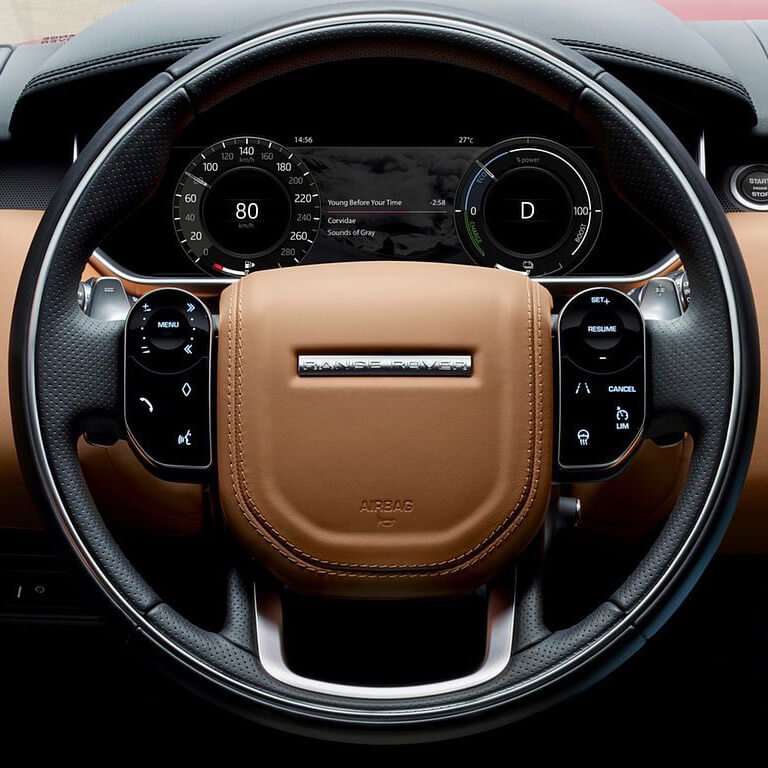
Check the equipment actually fitted: displays, cameras, locks, seat functions and any advanced chassis features. A frozen screen is an observation, not proof that a software update will repair it. Record repeatable behaviour and any recent electrical work before deciding whether further diagnosis is needed.
A specific mild-hybrid campaign
JLR's April 2026 US filing for recall 26V248 includes certain 2019–2024 Range Rover Sport mild hybrids. It concerns a DC–DC converter fault that can interrupt 12-volt charging, leading to loss of drive power and eventually exterior lighting. A red instruction to stop safely is not a warning to postpone until the next service.
The filing covers specified US-market vehicles and is not evidence that every UAE Sport, every hybrid or every model year is included. For an import in particular, ask an authorised retailer to check the VIN for applicable campaigns and completion records. A recall record and a mechanical inspection answer different questions.
For a plug-in hybrid, distinguish battery charge level from battery condition. Displayed electric range changes with use and conditions. A capacity or health assessment needs an appropriate method and report; it should not be implied by a dashboard photograph or a brief charging demonstration.
Suspension, cooling and driveline checks
Air suspension and chassis
A Sport that sits unevenly after parking needs more than a quick height reset. Air springs, pipework, valves, pressure supply and height information can produce different symptoms. Record whether one corner or a whole axle drops and whether the behaviour returns after standing.
Slow raising does not identify the compressor by itself: air loss elsewhere can affect the system's behaviour. Suspension knocks also need locating, because an air-suspension warning and worn suspension joints are different concerns. Never work beneath an air-suspended vehicle without the required physical support.
Cooling loss and overheating
A low coolant level, dried residue or repeated topping up deserves investigation, even when the temperature looks normal during a short viewing. The engine and its cooling arrangement determine where to look. Leak checks and temperature observations are more useful than assuming a water pump or head gasket has failed.
For an active temperature warning or steam, stop safely and switch off. Do not open a hot coolant cap. Have the cause of overheating established before approving repairs.
Gearbox, tyres and braking
During a safe, permitted road test, note engagement from Park, shift quality, braking response and whether vibration follows speed, load or turning. Check the fitted tyres and wear pattern too. A shudder is not enough evidence to name a failed transmission, transfer box or differential.
On an older L320, include parking-brake operation and underbody condition in the assessment. On any generation, distinguish measured brake and tyre wear from an unresolved mechanical fault. The former may be clearly identifiable maintenance; the latter may require diagnosis before a useful repair estimate is possible.
Before committing to a used Sport
A useful viewing checks the car against the seller's claims, then leaves technical questions for testing rather than guesswork.
- Identify the vehicle. Compare the advert, VIN and available records. Confirm engine, market specification and any significant replacement or modification.
- Observe it cold and warm. Ask when it last ran. Record unusual starting noise, smoke, warnings and temperature behaviour. A road test requires permission and a vehicle that is safe to drive.
- Test the fitted equipment. Check climate-control functions, screens, cameras, windows, locks and seats. Inspect accessible cabin areas for dampness or water marks without assuming their cause.
- Read diagnostic information in context. Preserve the findings rather than clearing codes to produce a clean display. Some mechanical faults produce no code; intermittent problems may not recur during the visit.
- Review repair evidence. An invoice naming the repaired part, date and mileage is more useful than “fully maintained”. Unexplained cooling loss, knocking or restricted inspection access should remain visible in the buying decision.
In the UAE, inspect climate performance under the conditions actually available, and check the history of an imported vehicle against its original market. Heat or a GCC badge does not, by itself, prove the cause of a fault or the quality of previous maintenance.
Read the findings, not just codes
Separate what was observed, what testing established and what remains unknown. A photographed leak is an observation. A test locating its source supports a repair decision. An inaccessible area or missing cold start is a limitation, not a pass.

Known tyre wear and an unexplained engine knock should not carry equal weight. Resolve a significant mechanical or safety uncertainty before treating the vehicle as ready to buy. A satisfactory inspection describes the condition tested that day; it is not a guarantee against every future failure.
Questions Sport buyers ask
Which Range Rover Sport years should I avoid?
A blanket year list is not reliable enough to judge an individual Sport. Start with its generation and engine, then consider documented concerns, current condition, repair records and unresolved findings. A well-presented later vehicle is not automatically free of faults, and an older car should not be judged only by its age.
Do all 3.0-litre Sports have the same engine problems?
No. Older V6 diesels, supercharged petrol V6 engines and later inline-six petrol or diesel engines are different applications. Newer 3.0-litre plug-in hybrids add further equipment. Identify the engine before applying a technical bulletin or another owner's experience.
Can an inspection rule out future engine failure?
No. A non-invasive inspection can assess current symptoms, accessible condition, diagnostic evidence and records. It cannot certify the remaining life of hidden bearings or rule out every intermittent or future fault. Ask what was tested and what remains uncertain.
Does a clean dashboard mean the Sport has no problems?
No. Some mechanical, body and water-entry concerns do not create warning messages, while an intermittent fault may be absent during the visit. Combine the scan with inspection, records and a permitted road test rather than relying on the dashboard alone.
Written by Range Rover Specialist Team
Range Rover Specialist Team publishes practical buying and ownership guidance for UAE drivers. This article separates generation-specific checks, documented engine concerns and the limits of a used-vehicle inspection.
Manufacturer references. The linked JLR technical messages and recall filing support the specific concerns identified above; they are not failure-rate statistics. Land Rover iGuide provides vehicle-specific owner information. The L461 powertrain specifications distinguish the newer engines. Market and VIN applicability must be checked before applying any campaign or repair procedure. Photographs are representative images, not records of a specific customer job. Featured photograph by Vauxford via Wikimedia Commons, used under CC BY-SA 4.0 and resized for display. The other photographs are from the site's existing media library.

Workshop support
Need help with your Range Rover?
Tell us your model, year and what you have noticed. Speak with the workshop about maintenance, an inspection or a repair.