
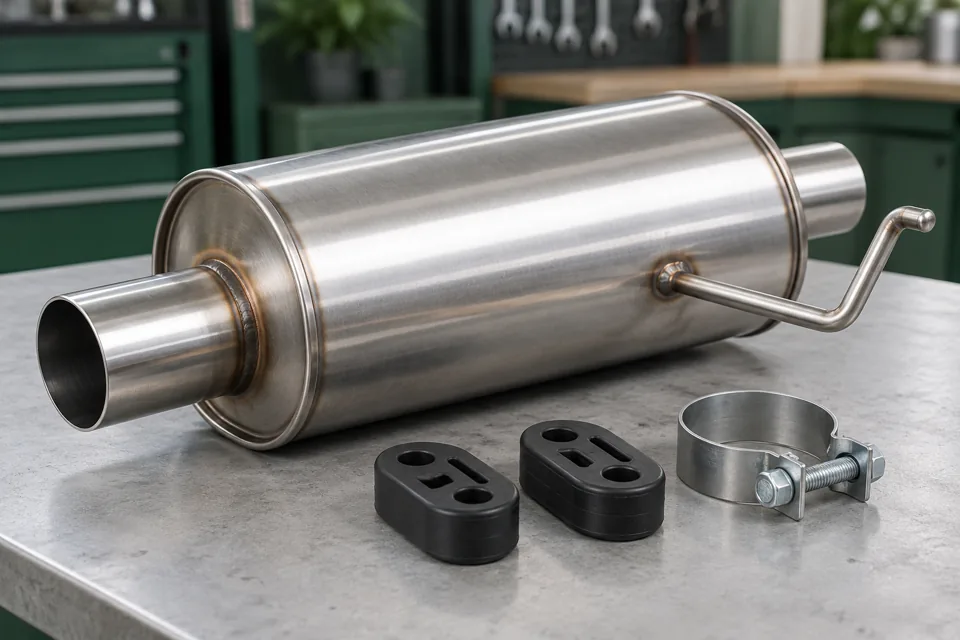
A louder exhaust, a dashboard warning, or reduced power does not identify one failed part. Range Rover exhaust diagnosis starts by separating a gas leak, loose support, engine-running fault, sensor problem, and emissions-treatment fault. The right repair may be a gasket or hanger, a confirmed failed sensor, or an affected exhaust assembly. Replacing parts from a noise, smell, or fault code alone can leave the actual cause unresolved.
The right exhaust repair depends on which component has failed and why. Equipment differs by engine, model year and market specification, so the diagnosis must match your vehicle.
Cabin exhaust fumes mean stop and get out safely
If exhaust fumes are entering the cabin, stop in a safe place, switch off the engine, and get everyone into fresh air away from traffic. Arrange recovery rather than driving to the workshop. Opening windows or switching the air conditioning to recirculation does not establish that the vehicle is safe.
Carbon monoxide is odorless and colorless. A small exhaust leak can allow it to accumulate inside a vehicle, so the strength or absence of a smell is not a reliable safety test. If anyone develops headache, dizziness, nausea, weakness, confusion, or chest pain after suspected exposure, seek urgent medical assistance. Do not drive yourself if affected. The CDC identifies these among the symptoms of carbon monoxide poisoning.
Stop safely for smoke or burning beneath the vehicle, severe engine shaking, or an exhaust section hanging loose or dragging. Follow any dashboard instruction to stop. Never idle the vehicle in a garage to investigate fumes, block the tailpipe, or crawl underneath a vehicle supported only by a jack or its air suspension. Exhaust parts remain hot after shutdown.
What each Range Rover exhaust component does
The exhaust carries combustion gases away from the engine. Separate components reduce noise, monitor operation, or treat particular pollutants. A muffler does not perform the same job as a catalytic converter or particulate filter. The table describes functions, not a universal parts layout.
| Component | Main function | Important distinction |
|---|---|---|
| Manifold, pipes, flex sections, and joints | Carry exhaust gases through a sealed route. | A crack or sealing fault needs location-specific inspection. |
| Muffler and resonator | Reduce exhaust noise and control sound characteristics. | A rear rattle may instead come from a hanger or heat shield. |
| Catalytic converter | Uses catalytic reactions to reduce specified pollutants. | Catalyst type and operation depend on the engine and emissions system. |
| Oxygen or lambda sensors | Measure exhaust oxygen for control or monitoring functions. | Upstream and downstream positions have different roles; identify the exact sensor. |
| Diesel particulate filter, where fitted | Traps particulate matter and uses regeneration to address accumulated soot. | A DPF warning is different from a muffler fault or DEF-level message. |
| SCR and DEF/AdBlue equipment, where fitted | Uses a separate fluid-dosing system to help reduce nitrogen oxides. | Adding DEF does not repair a blocked DPF. |
| Temperature, pressure, and other exhaust sensors | Provide information for the fitted monitoring and treatment system. | A sensor reading must be checked against the operating conditions and its circuit. |
Tailpipe appearance does not prove that these components work correctly. A clean outlet cannot rule out a leak, sensor fault, or ineffective catalyst. Soot is a clue to investigate in context, not proof of DPF blockage. Some vehicles have different particulate-filter arrangements, and not every engine uses a diesel DPF.
Match the symptom to the right diagnostic question
Describe when the problem occurs: the first cold start, only when warm, under acceleration, at idle, or over bumps. That timing often helps more than deciding in advance which part has failed. Record the exact warning message while safely parked.
| Symptom | Possible checks | Next step |
|---|---|---|
| Exhaust fumes inside the cabin | Gas leakage and possible entry routes. | Stop, switch off, exit safely, and arrange recovery. |
| Ticking or hissing near the engine | Manifold, gaskets, turbo-side joints, and other possible noise sources. | Arrange diagnosis. A noise that changes with temperature is a clue, not a confirmed crack. |
| Metallic rattle over bumps | Shields, supports, contact points, valves where fitted, and internal damage. | Check security and clearance before approving a muffler or catalyst. |
| Warning light without an obvious noise | Stored faults, operating data, wiring, leaks, and engine condition. | Follow the handbook warning guidance and have the cause checked. |
| Reduced power or hesitation | Engine, fuel, air/boost, electrical, and exhaust-restriction possibilities. | Do not assume a blocked filter. Severe symptoms or stop messages require stopping safely. |
| DPF or exhaust-filter message | Exact message, fitted system, regeneration conditions, and relevant faults. | Use the vehicle-specific instructions; seek assistance for a full-filter or persistent warning. |
Higher fuel consumption also has several possible causes. Compare similar journeys and note recent maintenance or changes in use. Fuel consumption alone does not justify oxygen-sensor replacement, and a sulfur-like smell does not prove that the catalytic converter is the failed component.
Why an oxygen-sensor code is not a replacement instruction
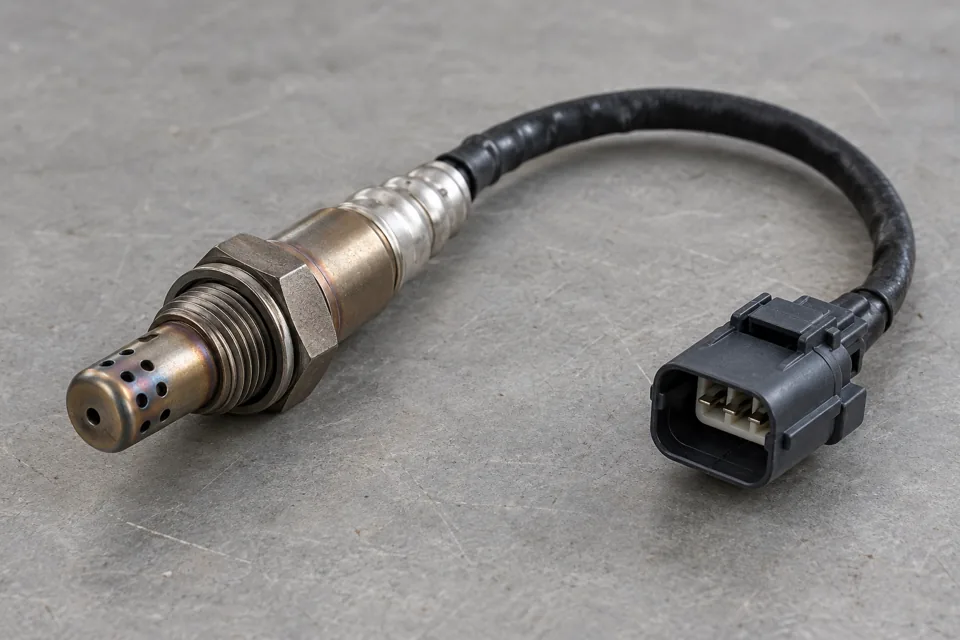
A fault mentioning an oxygen sensor may involve the sensor, its heater circuit, connector, wiring, or the exhaust gases it is measuring. The workshop should identify the bank, sensor position, and complete fault description before ordering a replacement.
Ask whether the technician checked circuit integrity and plausible sensor response using the correct procedure. An exhaust leak or mixture fault may affect the readings. Different sensor technologies must not be judged against one universal voltage rule. Triscan explains why oxygen-sensor fault codes can be misleading.
Use the maintenance requirements for the exact vehicle and confirm a fault before replacing an oxygen sensor. There is no universal replacement mileage for every Range Rover in Dubai. Replacing upstream and downstream sensors together needs a stated reason for each part.
Separate catalyst efficiency from an exhaust restriction
A catalyst-efficiency warning and a physically restricted exhaust are different findings. For example, P0420 concerns catalyst-system efficiency on bank 1; it does not by itself prove that the exhaust is blocked. A restriction needs an appropriate test that locates the affected section.
Before approving a converter, ask whether relevant engine faults, exhaust leaks, sensor operation, and contamination have been investigated. Correcting a cause such as a misfire or abnormal oil consumption may be necessary to protect the replacement. Clearing a warning without addressing its cause does not confirm a repair.
Walker recommends several checks before replacing a catalytic converter. Its general diagnostic guidance is useful, but any numeric test limits must come from information applicable to your engine and sensor arrangement. Do not buy a converter solely because the symptom resembles another owner's experience.
DPF regeneration depends on the warning and vehicle condition
On a diesel with a DPF, regeneration addresses accumulated soot when the required conditions are met. Repeated short journeys can limit those opportunities, but journey length alone does not diagnose a failed or blocked filter. Read the actual message and use the handbook for the exact vehicle.
Land Rover distinguishes between DPF regeneration and full-filter warnings; the latter requires assistance. Do not transfer a speed, duration, or dashboard color sequence from another model or market without checking applicability.
- If the handbook permits a regeneration drive: follow its conditions only when the vehicle is otherwise safe and traffic and road limits allow it.
- If the warning persists or returns: arrange diagnosis rather than repeating highway drives indefinitely.
- If the filter is reported full, power is significantly reduced, or other faults are present: seek advice on inspection and recovery before attempting a driving remedy.
- If cabin fumes, smoke, or a stop warning occurs: the safety instructions take priority over regeneration advice.
Do not schedule forced regeneration as a routine preventive service. A workshop-controlled procedure needs diagnosis, suitable filter loading, correct sensor information, and the manufacturer's prerequisites. It produces high temperatures and is not a driveway experiment. Ask why it is appropriate and which fault, if any, prevented normal regeneration.
Regeneration, specialist cleaning, and replacement are separate decisions. Burning soot does not remove accumulated ash or restore a cracked or melted filter. Pressure measurements, sensor and hose checks, relevant operating data, and filter condition help determine the route. Cleaning must suit the component and cannot guarantee that damaged filter material will recover.
Model and engine details matter more than trim names
Range Rover, Sport, Velar, and Evoque span different generations, engines, and emissions configurations. Autobiography is a trim designation, not one exhaust architecture. A gasoline plug-in hybrid also requires identification of its combustion-engine exhaust equipment rather than assumptions based on the hybrid badge.
Provide the model year, engine or fuel type, mileage, market specification if known, and any exhaust modifications. Share the VIN privately with the workshop for parts identification. GCC and imported vehicles should be matched to their actual fitted equipment.
A service bulletin or software update should be checked against the VIN, engine, symptoms, software level, and bulletin applicability. Ask for the document reference and explanation before approving related work. A bulletin for another configuration is not proof that your vehicle has the same fault.
What a useful exhaust inspection should establish
- The original complaint. Record warning wording and when the symptom occurs, including recent engine or exhaust repairs.
- The fitted components. Identify the gas route, sensors, catalysts, filters, and valves actually present.
- Mechanical condition. Inspect joints, flex sections, shields, supports, clearances, and impact damage using suitable lifting equipment.
- Relevant fault information. Save codes and available operating records before clearing anything.
- The test that separates likely causes. Use controlled leak testing, circuit checks, or restriction and emissions-system tests where justified.
- The repair boundary. Explain what has failed, what remains serviceable, and whether another fault caused the damage.
- Verification after repair. Check sealing, mounting, connections, and the original symptom under suitable conditions.
You can help by describing a rattle or sharing a safely recorded video. Do not reach under a running vehicle, touch hot parts, or run diagnostic regeneration commands. A basic code reader can record information, but it cannot replace physical inspection or manufacturer-specific testing.
When local repair is enough and when replacement makes sense
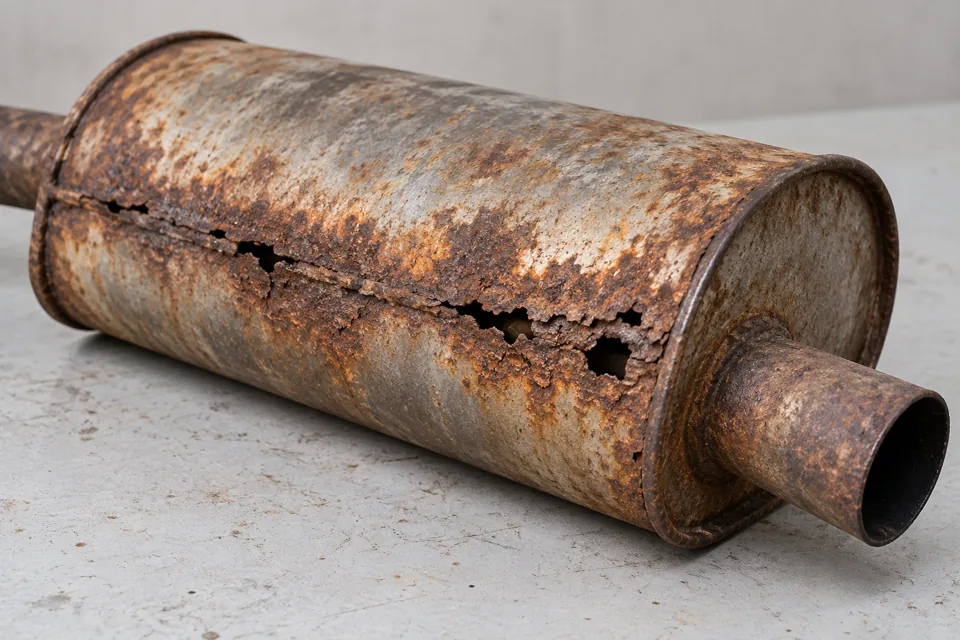
A failed clamp, gasket, hanger, or heat-shield fixing may be repairable while retaining sound surrounding components. A localized pipe repair depends on material condition, access, and an appropriate joining procedure. A repair should restore sealing, support, and clearance rather than simply quiet the noise.
Extensive corrosion, major impact damage, or confirmed internal failure may justify replacing the affected section. A rattle alone does not establish those conditions. For a fault confined to the rear silencer, compare muffler repair and replacement based on the shell, mountings and internal condition.
For replacement parts, request the manufacturer and exact part number. Compare fitment, sensor connections, emissions specification, supplied hardware, and written warranty terms. “OEM quality” is not a part identity. A compatible alternative should be assessed on its specification, not rejected or accepted solely because it is aftermarket.
How to assess an exhaust repair estimate in Dubai
A quote should separate diagnosis from the repair being proposed. A support repair, oxygen-sensor replacement, filter cleaning, and complete after-treatment assembly involve different parts and labor. Broad price ranges cannot establish which job your vehicle needs.
Ask for the diagnosed fault, part number and supplier, labor, gaskets or clamps, and any additional testing in writing. Confirm the total in AED and whether VAT is included or added. Recovery, further dismantling, and unrelated engine work should be identified separately where applicable. Do not assume a diagnostic charge includes all subsequent work.
Approve a defined repair scope after the cause and estimate are explained. If further dismantling is needed before the fault can be confirmed, agree on that diagnostic stage and its cost separately.
Maintenance that supports the fitted exhaust system
- Follow the vehicle's maintenance schedule and specified fuel, oil, and fluids. A premium fuel label does not repair an exhaust fault.
- Address warning messages and engine-running problems rather than repeatedly clearing codes.
- Report underbody impacts, new rattles, or symptoms following repairs. Use the manufacturer's cleaning instructions after off-road use.
- On diesel vehicles, follow applicable DPF guidance and distinguish filter warnings from DEF messages. Never add DEF to the fuel tank.
- Do not prescribe sensor replacement, filter cleaning, or forced regeneration solely from a generic mileage interval.
These actions support appropriate maintenance; they do not guarantee a particular component lifespan. Tailpipe cleanliness, quiet running, and the absence of a warning light are not substitutes for investigating a reported fault.
Range Rover exhaust diagnosis questions
Can an exhaust warning appear without a loud exhaust?
Yes. Monitoring or treatment faults can occur without a noticeable sound change. The exact message, stored faults, and relevant tests determine what needs attention.
Should a returning code lead to the same part being replaced again?
Not automatically. Review the first diagnosis, part compatibility, wiring, leaks, and underlying operating conditions. Ask what new finding supports another replacement.
Can topping up AdBlue clear a DPF warning?
AdBlue belongs to the SCR system where fitted. It does not clean the DPF. Identify the message before adding fluid or approving work.
Does a clean tailpipe mean the emissions system is healthy?
No. Appearance cannot confirm catalyst efficiency, sensor operation, filter integrity, or a sealed exhaust route.
Is every exhaust problem caused by Dubai's heat?
No. Usage and environment are useful context, but the diagnosis still needs a specific cause. Age, impact, engine condition, prior repairs, and installed parts also deserve review.
Useful technical references
- DPF and DEF system operation from Land Rover. Market guidance must be checked against the individual vehicle.
- Exhaust-gas sensor functions from Bosch.
- Testing for exhaust restrictions from Walker Exhaust. Vehicle-specific limits remain necessary.
- DPF soot removal and ash cleaning from Donaldson. This explains the distinction, not a Range Rover service interval.
Approve the repair that addresses the confirmed cause
Keep usable parts when a local repair resolves the fault. Replace sensors or exhaust assemblies when appropriate testing supports that decision, and address any underlying engine problem. Cabin fumes require stopping, exiting safely, and arranging recovery. A useful diagnosis explains both what needs repair and why the proposed work should resolve the original complaint.
Arrange an exhaust diagnosis
Share the model, model year, engine or fuel type, warning text, and when the noise or power change occurs with our Al Quoz 4, Dubai workshop. Mention recent engine or exhaust work. If fumes enter the cabin, stop safely and arrange recovery.