

A new roar, a rattle over bumps, or a loose tailpipe does not automatically mean your Range Rover needs a new muffler. A failed hanger or an isolated joint fault may be repaired while retaining a sound muffler. Widespread corrosion, an unsound casing, or confirmed internal failure usually makes replacement the better option. The decision depends on the source of the fault and the condition of the surrounding metal, not the noise alone.
If you suspect exhaust fumes are entering the cabin, stop safely, switch off, move occupants to fresh air away from traffic, and arrange recovery. Do not continue driving to test whether the smell disappears.
What a Range Rover muffler does
The muffler, also called a silencer, reduces exhaust noise. Depending on the fitted system, a resonator may also control particular sound frequencies. Pipes and joints carry exhaust gases toward the designed outlet; hangers and rubber isolators support the assembly and limit unwanted movement.
Silencing and emissions treatment are different jobs. Catalytic converters treat particular exhaust pollutants. A diesel particulate filter, where fitted, traps soot and uses a controlled regeneration process. A rear muffler is not a substitute for either component, even when several components are supplied as part of a larger exhaust assembly.
Replacing a damaged muffler can restore sound control and repair the affected gas path. It does not guarantee lower fuel consumption, lower emissions, or a passed emissions test. Engine-running faults, leaks near sensors, and restrictions elsewhere require their own diagnosis.
When exhaust symptoms mean you should stop driving
Cabin fumes are a stop-driving concern. Carbon monoxide in exhaust is odorless, so the absence of a smell does not prove the cabin is safe. Opening windows is not a repair or a reason to continue the journey. If anyone develops headache, dizziness, nausea, confusion, or other illness after suspected exposure, get to fresh air and seek urgent medical help. An affected person should not drive.
Also stop safely for an exhaust section dragging on the road, smoke or burning near the underbody, severe power loss, or a flashing engine warning with rough running. Arrange recovery appropriate to the vehicle and explain the symptoms to the operator.
A small rattle without those warning signs still needs assessment. It could be a loose shield, a support problem, or internal damage. A video cannot establish that the exhaust is secure or leak-free, so a safe driving distance cannot be promised remotely.
Never idle the vehicle in an enclosed space to investigate a noise. Do not crawl underneath a vehicle supported only by a jack or its raised air suspension. Exhaust components can remain hot after the engine is switched off.
Separate muffler symptoms from other exhaust faults
Note when the symptom occurs: at cold start, after warming up, over bumps, or during acceleration. These observations guide inspection but do not identify a failed part by themselves.
| What you notice | Possible explanation | Useful next step |
|---|---|---|
| A new roar or blowing sound | A leaking joint, split pipe, damaged muffler casing, or another leak along the exhaust. | Arrange a leak inspection. Stop using the vehicle if fumes enter the cabin or another stop-driving sign appears. |
| A metallic rattle over bumps | A hanger, heat shield, body contact point, exhaust valve where fitted, or loose internal component. | Have support and clearance checked before authorizing a muffler. |
| Rust staining or flaky metal | Surface oxidation or deeper corrosion. Appearance alone does not establish remaining strength. | Ask whether the metal and seams remain sound and whether any leak is present. |
| A low or crooked tailpipe | A failed support, impact damage, or a shifted joint. | Do not drive if it is loose, dragging, or could detach. Arrange inspection or recovery. |
| Poor acceleration or increased fuel use | Many possible engine, air, fuel, or exhaust causes. A restriction must be demonstrated. | Request diagnosis rather than assuming a muffler replacement will solve it. |
| Water droplets at startup | Normal combustion moisture can condense in a cool exhaust. | Water alone does not justify replacement. Persistent smoke, coolant loss, or rough running needs separate assessment. |
Do not plug or drill a suspected drain hole. Some mufflers have designed drainage openings; a technician should distinguish these from damage. Persistent smoke needs a separate assessment. Record the exhaust smoke color and whether it appears at startup, during acceleration or after the engine warms up.
When muffler repair is reasonable
A failed hanger or loose mounting
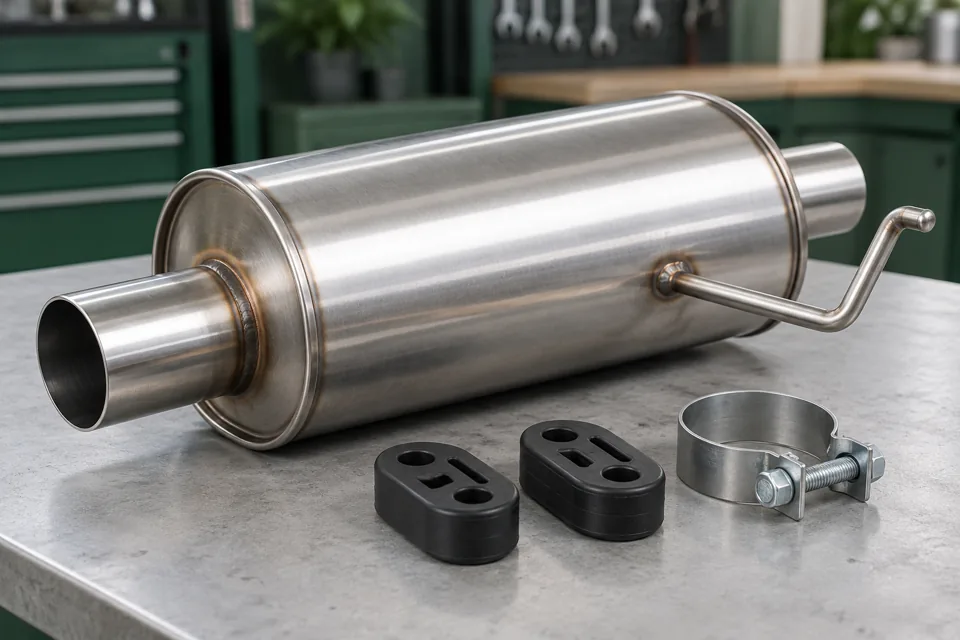
A torn rubber isolator, damaged bracket, or loose fastener may be the only fault. If the muffler and adjoining pipes are sound, renewing the failed support can avoid replacing a usable assembly. The technician should also check alignment and why the mount failed. Installing another hanger without correcting contact or tension may leave the rattle unresolved.
An isolated joint or small area of damage
A clamp or gasket repair may be suitable when the adjoining surfaces can seal correctly. A localized crack may be repairable if the material, access, and surrounding metal allow a durable repair using an appropriate procedure.
A small hole is not automatically a good welding candidate. Corrosion can thin a much larger area than the visible opening. Ask the technician to show whether the surrounding metal is sound and explain why a local repair is expected to hold. A patch over weakened metal can leave the underlying problem unresolved.
Surface discoloration without a confirmed failure
Discoloration or surface oxidation alone does not justify a new muffler. Inspection should establish whether there is leakage, structural weakening, an insecure mounting, or an internal fault. Age and appearance are clues, not a replacement diagnosis.
When replacement is the better choice
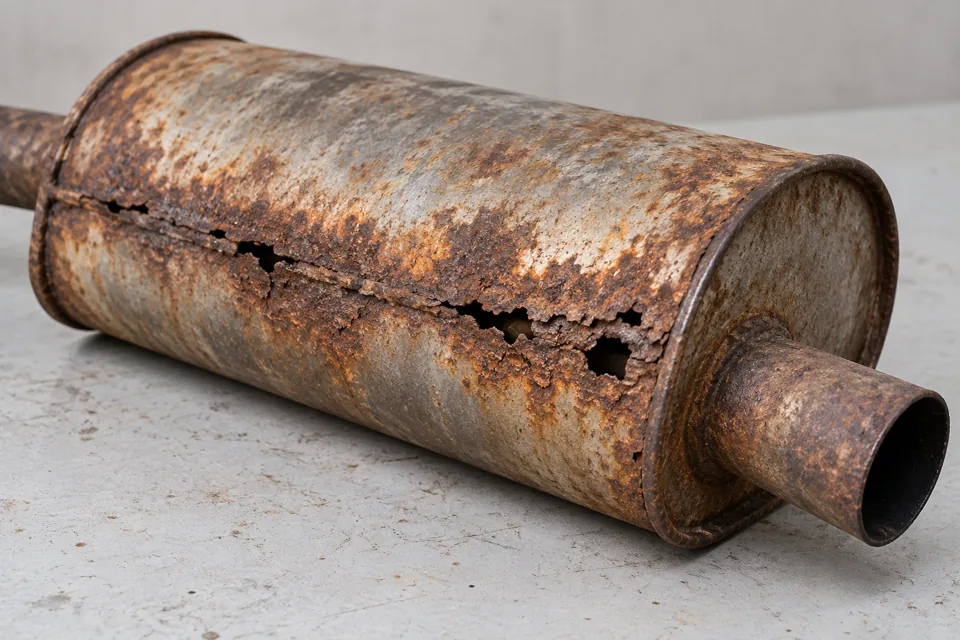
Replacement becomes more appropriate when the affected muffler cannot be restored to a secure, sealed, correctly functioning condition. Typical reasons include:
- Extensive corrosion: several weakened areas, perforated seams, or metal too thin for a dependable repair.
- Major impact damage: distortion that compromises mounting, clearance, sealing, or gas flow.
- Confirmed internal failure: loose or damaged internal components after external shields, supports, and valves have been ruled out.
- A restriction traced to the muffler: testing confirms the affected component instead of assuming every power complaint is a blockage.
- Repeated failures in deteriorated material: further patches are unlikely to address the remaining condition.
Replacing the muffler does not always mean replacing the whole exhaust. Some vehicles allow a separate rear section; others require a larger assembly or a manufacturer-specified joining method. Ask which section the quote covers and why.
| Inspection finding | Likely repair route | What must be confirmed |
|---|---|---|
| Failed hanger with intact silencer | Renew the support and correct alignment. | No hidden damage or continuing contact. |
| Local joint leak or isolated damage | Repair the affected joint or section where technically suitable. | Sound material, suitable procedure, and a sealed result. |
| Widespread corrosion or internal failure | Replace the affected muffler or required assembly. | Correct fitment, boundaries of the assembly, and post-repair checks. |
| Power loss with no confirmed muffler fault | Continue diagnosis before ordering parts. | Actual source of the restriction or engine-running problem. |
What the workshop should check before recommending parts
- Identify the fitted system. Confirm the model year, engine, market specification, part arrangement, and any aftermarket changes.
- Locate the fault. Inspect the exhaust route, joints, seams, pipework, hangers, and heat shields with suitable lifting equipment. A rear noise may originate farther forward.
- Separate leaks from rattles. Check support and clearance, then use an appropriate controlled leak test when needed.
- Investigate running faults separately. If warnings or power loss are present, review fault information and relevant operating data. Use restriction testing when justified. A scan alone does not prove a muffler has failed.
- Explain the repair boundary. Show the affected area, describe repair suitability, and identify any additional work before approval.
At handover, ask what was checked for leakage, mounting security, heat-shield clearance, and the original noise. If a warning light was involved, clearing it alone is not proof that its cause has been repaired. Any remaining concern should be recorded.
Why the exact Range Rover specification matters
Range Rover, Range Rover Sport, Velar, and Evoque do not share one universal rear exhaust assembly. Engine, model year, market, and equipment can change the parts required. Petrol and diesel emissions equipment also differs. Confirm an exhaust valve is actually fitted before diagnosing one.
For a GCC vehicle or an import, match the proposed part to the installed system rather than relying on the badge or registration year. Share VIN details privately with the workshop when needed for identification. Do not post the full VIN in public comments.
For modified systems, establish what is fitted and what outcome you want. Returning an existing system to its intended condition is different from choosing a louder exhaust. Removing a muffler or emissions equipment does not repair the underlying fault.
How to compare Range Rover muffler repair costs in Dubai
A useful estimate starts with the confirmed fault. A hanger repair, localized joint repair, and complete rear assembly replacement are different jobs. A single universal price range can conceal those differences.
Before comparing quotes, request the following in writing:
- The diagnosed fault and the exact component or assembly being repaired or replaced.
- The part manufacturer, part number, and whether it is a genuine branded part or a specified compatible alternative.
- Parts, labor, diagnostic charges, clamps, gaskets, and mounting hardware included in the total.
- Any extra work that would require separate approval.
- The AED total and a clear statement of whether VAT is included or added.
- Parts availability, expected completion timing, and any written warranty terms.
“OEM quality” alone does not identify a part or prove fitment. Ask for the actual supplier and compatibility details. A cheaper patch may offer poor value if surrounding metal is failing; a complete assembly may be unnecessary for an isolated support fault.
An exhaust inspection should establish which section needs attention before a repair is priced. The estimate should match your vehicle and the confirmed damage.
How to care for the exhaust after off-road driving
After off-road use, describe any impact, new noise, mud buildup, or saltwater exposure when arranging an inspection. Follow the underbody cleaning instructions in the Land Rover handbook for your exact vehicle. Underbody cleaning is not permission to pressure-wash every component.
- Allow hot exhaust parts to cool before cleaning nearby.
- Follow the manufacturer’s pressure, distance, and component restrictions. Avoid directing jets into tailpipes or at vulnerable connectors and components.
- Do not apply generic underbody wax, oil, or anti-rust coating to mufflers, catalytic converters, filters, or other hot exhaust parts. Any proposed treatment needs explicit suitability for that component and its operating temperature.
- Have new rattles or damaged supports checked rather than waiting for the next scheduled visit.
- Do not drive an unsafe vehicle or idle it in a garage to “dry out” the muffler. A longer journey is not a repair for corrosion or a leak.
There is no universal muffler replacement interval for every Range Rover. Condition, damage, installed parts, and the vehicle’s applicable maintenance guidance determine when attention is needed.
Range Rover muffler questions
Can a muffler look acceptable outside but fail internally?
Yes. Internal components can loosen while the outer casing still looks intact. The source of a rattle must be isolated because nearby shields, mounts, or valves can sound similar.
Does a muffler rattle mean the catalytic converter has failed?
No. They perform different functions, and noise can travel along the system. Neither component should be replaced solely because a rattle is heard near the rear of the vehicle.
Can I use exhaust repair paste as a permanent fix?
Do not assume a sealing product provides a permanent structural repair. Suitability depends on the product, defect, temperature, and material condition. It cannot restore a failed hanger, extensively corroded casing, or broken internal component. Cabin fumes require recovery and inspection, not an attempted temporary seal.
How long does muffler repair or replacement take?
Timing depends on access, seized fasteners, parts availability, the assembly required, and post-repair testing. Ask for a completion estimate after inspection rather than assuming every vehicle can be repaired the same day.
Should both rear silencers be replaced together?
Where two are fitted, inspect both. A fault on one side does not automatically prove the other has failed. The parts arrangement and condition determine whether separate replacement is possible or a combined assembly is required.
Technical and safety references
- Muffler function and failure symptoms from Walker Exhaust.
- Whole-system exhaust inspection from Walker Exhaust. General principles, not Range Rover-specific test values.
- How catalytic converters work from Walker Exhaust.
- Carbon monoxide symptoms and exposure risks from the CDC.
Choose the repair that matches the actual fault
Retain a sound muffler when a support or suitable local repair resolves the problem. Replace the affected assembly when corrosion, structural damage, or confirmed internal failure makes repair unsuitable. Treat cabin fumes and loose exhaust sections as safety concerns, and approve parts only after the cause and scope are explained.
For an assessment in Al Quoz 4, Dubai, have your model year, engine if known, mileage, symptom timing, and recent repair history ready. A safely recorded video can help describe a noise, but it cannot confirm hidden leaks or replace an inspection. Mention cabin fumes before planning the journey so recovery can be arranged.
Workshop support
Need help with your Range Rover?
Tell us your model, year and what you have noticed. Speak with the workshop about maintenance, an inspection or a repair.