
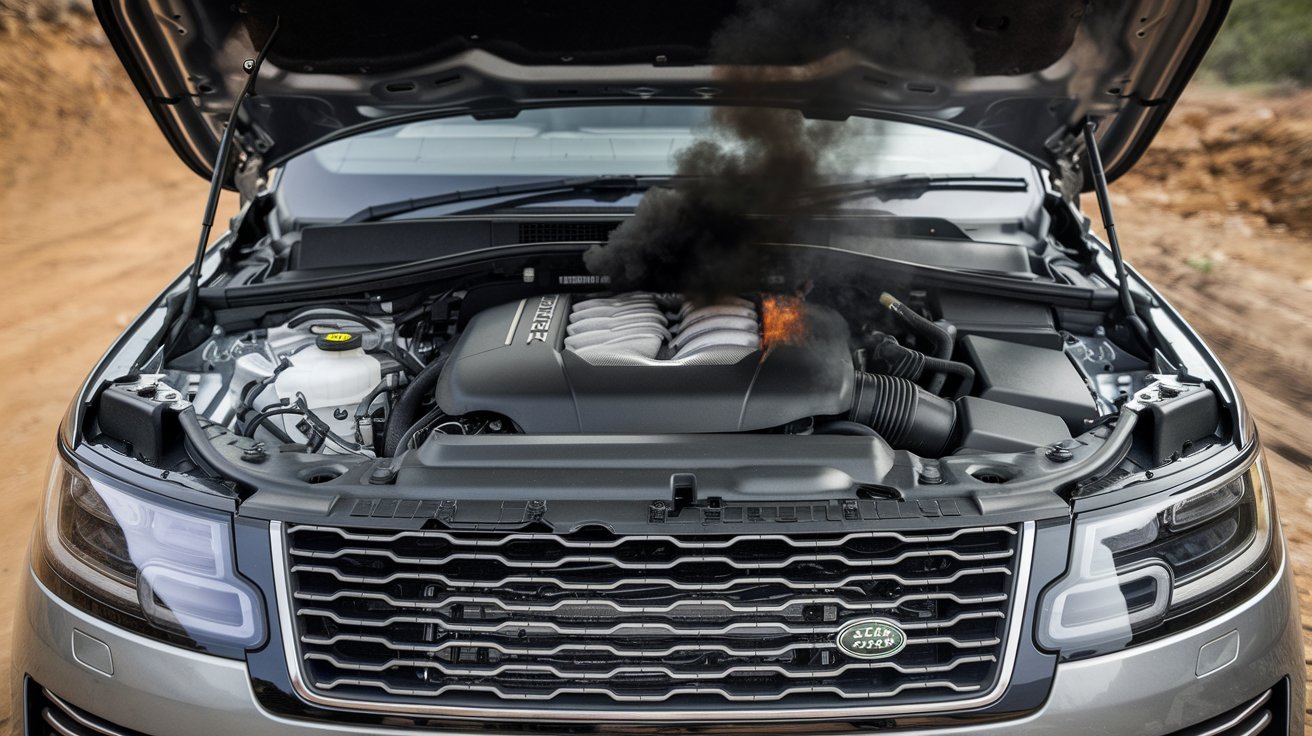
If your Range Rover shows a red temperature warning, the gauge rises abnormally, or steam appears, stop as soon as it is safe and switch the engine off. Do not open the expansion-tank cap while the engine is hot. Low coolant, a leak, restricted flow, lost fan airflow, trapped air, or combustion pressure can all cause overheating, so the failed part should be confirmed before replacement.
When a Range Rover overheats, the warning tells you that temperature control has been lost. It does not identify the failed component. The useful clues are when the temperature rises, whether coolant is disappearing, what warning appeared, and whether the concern began after cooling-system work.
7 signs that a Range Rover is overheating
- Temperature rises abnormallyThe gauge moves above its normal position or a high-temperature message appears.
- Steam appearsSteam or vapour from the engine bay means the vehicle should be stopped safely and switched off.
- A hot or sweet smell developsCoolant reaching a hot surface can produce a distinctive smell even when no puddle is visible.
- A coolant warning appearsA low-coolant or temperature warning needs checking against the actual level and condition when the engine is cold.
- Power is reducedThe vehicle may limit performance when temperature or related engine data moves outside the expected range.
- Coolant is found underneathA puddle, dried residue, damp hose connection or wet undertray can help locate an external leak.
- New mechanical noise appearsA knock, tick or changed engine sound during an overheat is a stop-driving sign, not a diagnosis.
When to stop driving
Stop and arrange assistance if the warning is red, the gauge continues rising, steam is visible, coolant is escaping, or the engine runs roughly or makes a new mechanical noise. Continuing to drive can turn a cooling-system fault into internal engine damage.
Do not remove the coolant cap while the system is hot and pressurised. If the vehicle is not safe to drive, use the Range Rover recovery and workshop pickup service.
What the overheating pattern can reveal
The pattern helps choose the first tests. It does not prove which component has failed.
| When it happens | What deserves testing |
|---|---|
| Mainly in traffic or at idle | Cooling-fan command and operation, airflow through the cooling pack, and radiator heat rejection. |
| During acceleration, hills or sustained load | Coolant volume and circulation, thermostat and pump behaviour, radiator restriction, and combustion pressure where evidence supports the test. |
| After coolant or cooling-system work | Correct filling, trapped air, leak sealing, and the procedure specified for that engine and configuration. |
| Coolant warning with no obvious puddle | A leak that appears only when hot or pressurised, coolant held by the undertray, a small heater-circuit leak, or possible internal loss. |
7 causes of Range Rover overheating
Low coolant level
- Cause: Coolant is essential for keeping the engine at a safe temperature. If there's a leak in any part of the system, such as the radiator, hoses, or water pump, the coolant levels will drop. Without enough coolant, the engine will overheat because there isn’t enough fluid to absorb and transfer the heat.
- Solution: At our workshop, we perform a full inspection of the cooling system to locate any leaks. Once we identify the issue, we repair or replace the faulty part and refill the system with the right coolant mixture. This helps ensure the coolant levels are maintained, preventing further overheating.
Radiator restriction or leak
- Cause: The radiator is responsible for cooling the coolant that circulates through the engine. Over time, it can become clogged with dirt, debris, or rust, which prevents it from cooling efficiently Additionally, a damaged or cracked radiator can leak, reducing its ability to cool down the engine.
- Solution: Our team thoroughly examines the radiator for any signs of blockages, cracks, or leaks. If we find it clogged, we will either clean or flush it to restore the coolant’s proper flow. In cases where the radiator is damaged beyond repair, we recommend replacing it to maintain optimal engine cooling and efficiency.
Thermostat fault
- Cause: The thermostat regulates the flow of coolant through the engine. If it becomes stuck in the closed position, the coolant won’t flow properly, causing the engine to overheat. This is a common issue in many vehicles, including Range Rovers.
- Solution: Our technicians can quickly diagnose a faulty thermostat. If it’s not functioning, we replace it with a new one to restore proper coolant circulation and maintain a safe engine temperature.
Water-pump fault
- Cause: The water pump plays a crucial role in circulating coolant throughout the engine. When the pump malfunctions, the coolant won't flow properly, causing the engine to overheat. A failed water pump can be due to age, wear, or leaks.
- Solution: We inspect the water pump for signs of wear or damage. If the pump is faulty, we replace it to restore the flow of coolant and prevent overheating. The replacement part and coolant specification should match the exact engine and cooling-system configuration.
Cooling-fan or airflow fault
- Cause: The cooling fan helps to maintain airflow over the radiator, ensuring the coolant stays at a safe temperature. If the fan isn’t working due to an electrical issue or blockage, the engine can overheat, especially when the vehicle is idling or driving slowly.
- Solution: We check the cooling fan for any mechanical or electrical issues. If necessary, we repair or replace the fan and clear any obstructions to ensure that air flows freely, helping to cool the engine more effectively.
Air trapped after cooling-system work
- Cause: Air pockets can sometimes form in the cooling system, especially after repairs or when the coolant hasn’t been properly refilled. These air pockets can prevent coolant from flowing smoothly, causing the engine temperature to rise.
- Solution: Our team bleeds the cooling system to remove any trapped air. This process restores the proper flow of coolant, ensuring the engine stays cool and avoids overheating.
Head-gasket or combustion-seal fault
- Cause: A blown head gasket is one of the more serious causes of overheating. It allows coolant to leak into the engine oil or lets combustion gases enter the cooling system, both of which can lead to severe overheating and potential engine damage.
- Solution: At our workshop, we perform thorough diagnostics to detect head gasket issues. If the head gasket is blown, we replace it and flush the cooling system to remove any contamination. This repair is crucial to preventing further damage to the engine.
These seven categories are common starting points. The same temperature warning can result from different failures, so the repair decision should follow testing rather than the most familiar component name.
What repeated overheating can damage
Ignoring Range Rover overheating can lead to serious problems that affect your vehicle’s performance and safety. Acting fast is key to avoiding expensive repairs down the road. Here’s what happens if you don’t fix the issue:- Overheating can warp or crack critical engine parts like the cylinder head or block, which are expensive to repair or replace.
- A blown head gasket is common when an engine overheats. This causes coolant to mix with oil, leading to severe engine damage.
- Overheating weakens the pistons and valves inside your engine, which can cause them to fail and result in poor performance or engine failure.
- Overall, small overheating problems, if ignored, turn into major repairs that cost much more than fixing the initial issue.
A single warning should be treated as a reason to stop and investigate. If the engine has already overheated, the inspection should also check for secondary evidence before the vehicle is returned to normal use.
Reducing the risk of another overheat
Cooling-system care is configuration-specific, but several habits make a developing fault easier to catch before the temperature rises.
- Check coolant only when the engine is cold. Record repeated level changes instead of treating every top-up as normal consumption.
- Use the specified coolant and filling procedure. The correct fluid and bleeding method depend on the engine and model year.
- Investigate residue and hot-coolant smells. A leak may be too small to form a puddle or may appear only when the system is pressurised.
- Recheck after cooling-system work. A returning warning, changing level or unstable cabin heat can justify checking the fill and air-removal procedure.
- Record the conditions. Idle, traffic, highway load, AC use, ambient heat and recent repairs help the workshop choose the first tests.
How the cause is separated
A fault code or temperature warning is evidence, but it is not a failed-part verdict. The test order should follow the vehicle’s model, year, engine and fitted cooling system.
- Record the warning and conditions. Note the message, gauge behaviour, ambient conditions, driving load and whether the heater or AC behaviour changed.
- Inspect the cold system. Check coolant level and condition, dried residue, hose connections, expansion tank, cap area, radiator and visible pump area.
- Test for leaks and airflow. Pressure testing and fan actuation can reveal faults that are not obvious during a cold visual check.
- Compare temperature and circulation evidence. Scan data, fan requests and temperature distribution help separate airflow, thermostat, pump and restriction concerns.
- Escalate only when evidence supports it. Combustion-gas or cylinder-integrity testing is appropriate when coolant loss, repeated pressurisation, smoke, contamination or other findings point toward an internal fault.
Overheating myths that can cause damage
Adding coolant fixes the problem
Topping up may restore the level, but it does not explain where the coolant went. A repeated level drop needs a leak and pressure investigation.
Turning on the heater makes it safe to continue
The heater may move some heat away from the engine, but it does not make an overheating vehicle safe to drive. Treat it as a warning to stop safely, not a route to the workshop.
A normal puddle check rules out a leak
Some leaks appear only when hot or pressurised. Coolant can also collect on the undertray or evaporate from a hot surface before reaching the ground.
Every overheat means a head gasket
A head-gasket or combustion-seal fault is one possible cause. External leaks, fan faults, restricted flow, thermostat faults, pump problems and trapped air should be separated with evidence.
Range Rover overheating questions
1. What causes a Range Rover to overheat?Range Rover overheating can happen due to several reasons. These include low coolant levels, a faulty thermostat, a clogged radiator, or a broken water pump. Other possible causes are damaged cooling fans or a blown head gasket.2. How can I tell if my Range Rover is overheating?You can spot Range Rover overheating by looking for signs such as a rising temperature gauge, steam coming from the engine, a burning smell, or dashboard warning lights. Reduced engine performance and unusual engine noises are also indicators.3. Can I still drive my Range Rover if it’s overheating?No, it’s not safe to drive when your Range Rover is overheating. Driving with an overheated engine can cause significant damage, including a blown head gasket or cracked engine block. It’s best to stop immediately and seek assistance.4. How can I prevent my Range Rover from overheating?To avoid Range Rover overheating, regular maintenance is key. Ensure the coolant levels are topped up, the radiator is functioning properly, and the thermostat and water pump are in good condition. Regular inspections at our workshop will also help catch problems early.5. What should I do if my Range Rover overheats?If your Range Rover overheats, pull over safely and turn off the engine. After it cools down, check the coolant level. However, it’s best to get professional help from our workshop to diagnose and fix the problem as soon as possible.6. What changes the cost of an overheating repair?The cost depends on the confirmed fault, the exact engine and cooling-system configuration, access, parts choice, contamination, and whether overheating has caused secondary damage. A written estimate should follow inspection and testing rather than a universal price range.
Arrange a cooling-system inspection
If your Range Rover is losing coolant, showing a temperature warning or has overheated, send the model, year, warning message and what happened just before the temperature changed. For the commercial repair scope, see the Range Rover engine-overheating service.