
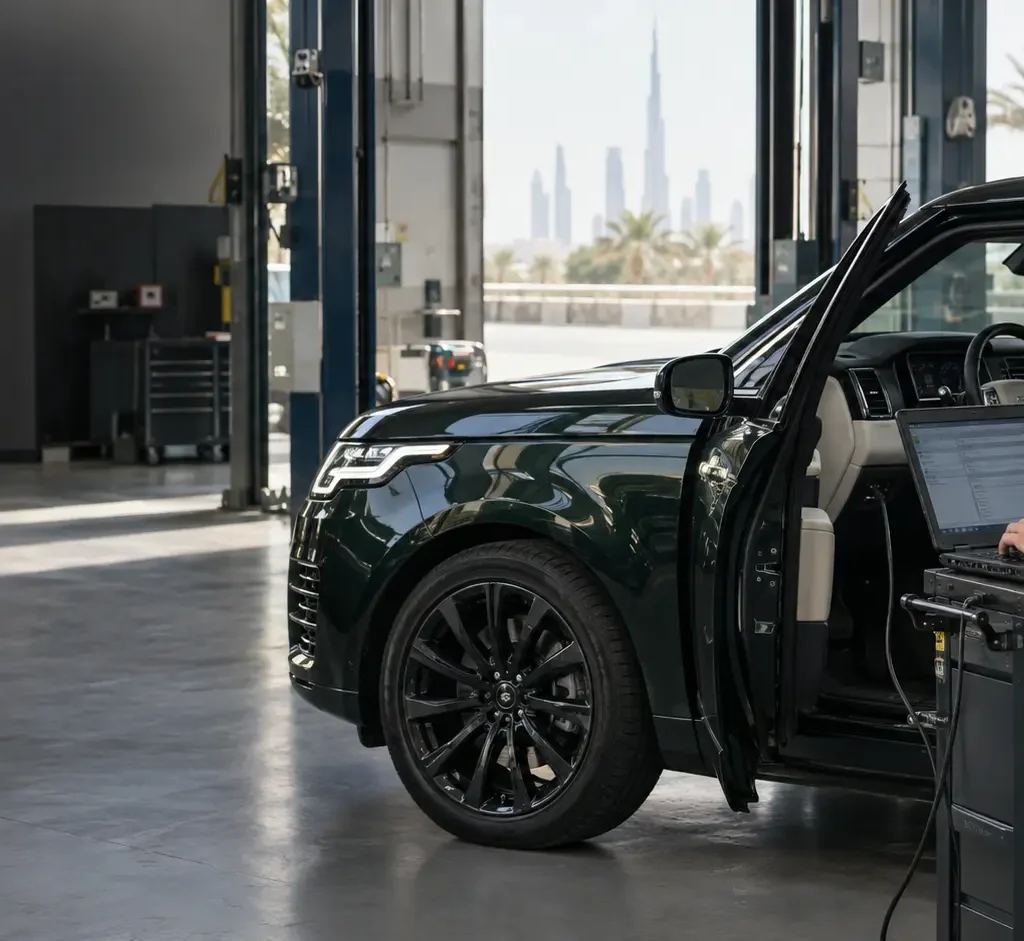
Flickering lights, repeated battery trouble or several warning messages do not automatically mean your Range Rover needs a new control module. Mechanics diagnose electrical faults by recording the symptoms, checking the power supply, scanning the relevant systems with JLR-capable equipment and testing the affected circuit. A repair should follow a confirmed finding, then be checked under the conditions that caused the problem.
A fault code is a starting point. It records a condition detected by a control unit, but does not prove which part failed. This guide explains what happens between the scan and the repair, what each tool can establish, and what you should ask before approving work.
Decide whether the vehicle is safe to move first
The failed function matters more than the number of codes. Treat changes in braking, steering, engine operation or essential lighting as safety concerns. Read the exact warning instructions for your vehicle in Land Rover iGuide; do not dismiss a warning as a battery glitch without assessment.
| What you notice | Immediate action | What the workshop needs to establish |
|---|---|---|
| Smoke, sparks, a strong burning smell or visibly overheated wiring | Stop safely, switch off when safe, move people away and seek emergency help if there is a fire. Do not restart or handle the wiring. | The damaged circuit and cause before the vehicle is powered again |
| Electrical warnings with loss of steering assistance, abnormal braking, stalling or essential lights failing | Stop in a safe place and arrange recovery rather than testing the vehicle on the road. | Whether a shared supply, network or individual system fault is responsible |
| No crank, repeated resets or a battery that repeatedly goes flat | Avoid repeated starting attempts and improvised jump connections. Arrange an assessment using the vehicle's applicable recovery guidance. | Battery condition, supply connections, charging, start authorization or parked current draw |
| One comfort feature fails, with no other warning or driving change | Record the behavior and arrange a check. Reassess if it affects visibility, access, security or another safety function. | The local switch, command, circuit, mechanism and component response |
What you can record without touching live circuits
Good observations can help reproduce an intermittent fault. While parked safely, photograph the complete warning message and note what still works. A short video of a window stopping or a display restarting can be useful. Do not film or operate a diagnostic app while driving.
- Record whether it happens during starting, after parking, with the vehicle hot, after rain or washing, or only when a particular feature operates.
- List recent battery replacement, jump starts, body repairs, water exposure, software work and aftermarket accessories.
- Bring an existing scan report with complete codes and suffixes. Do not erase it just to see whether the warning returns.
- Provide the model year, powertrain if known and mileage. Share the VIN privately when needed to identify the exact configuration.
Leave connector cleaning, wire repairs, fuse substitution and battery disconnection to someone following the correct procedure. Do not bridge a fuse, fit a higher rating, unplug control modules experimentally or probe airbag connectors. Hybrid and electric models need additional controls; disconnecting a 12-volt battery does not establish that the high-voltage system is safe.
Some diagnostic measurements require a circuit to operate. That does not mean repairs should be performed with it live. Technicians must choose the isolation, power support, test equipment and protective measures required for the particular circuit. JLR's EV safety rules assign high-voltage work to appropriately trained personnel using the specified procedures.
Which diagnostic tools can cover a Range Rover?
A scanner's ability to connect to the diagnostic socket is not proof of full vehicle coverage. Generic OBD functions focus on standardized emissions-related information. Reading an engine code does not establish access to the body, suspension, restraint, infotainment or other manufacturer-specific systems.
Ross-Tech describes VCDS diagnostic software for VW and Audi vehicles. Its generic OBD function may communicate with compatible vehicles from other brands, but that does not make VCDS a Range Rover-specific diagnostic or coding platform.
JLR's diagnostic interface documentation identifies SDD and TOPIx Cloud Diagnostics. It lists TOPIx Cloud coverage from model year 2017 for Range Rover and Range Rover Sport, with different applicability for other vehicles. Older vehicles need their applicable diagnostic route. The technician must confirm the exact vehicle, interface, software and required function rather than use a single year rule for every model.
A professional aftermarket tool can also be useful when its current coverage includes the exact JLR system and task. Module identification, live data, actuator tests and programming are separate capabilities. Support for one does not prove support for all. JLR also distinguishes diagnostic subscriptions from programming and security-related access.
| Tool or information | Useful result | Important limit |
|---|---|---|
| JLR-capable scan equipment | Available module responses, codes, recorded conditions and live data | A named component or an offline module is not automatically defective |
| Wiring diagrams and test procedures | Applicable connections, shared supplies, operating logic and test criteria | A diagram for another configuration can send testing down the wrong path |
| Multimeter and suitable load-testing equipment | Voltage, circuit behavior and voltage loss under defined conditions | An unloaded reading can miss a connection that fails when carrying current |
| Oscilloscope and appropriate probes | How an electrical signal changes over time | Probe setup, sampling, reference data and the reproduced fault determine what the capture means |
| Current clamp or thermal camera, where appropriate | Current behavior or an unusual heat pattern | A high reading or hot area still needs interpretation against the circuit's expected operation |
How the workshop moves from a symptom to a repair
The useful sequence is to narrow the cause, not run every available test. A consistently failed door lock needs a different test plan from several modules resetting after an overnight park. The following workflow explains the purpose of each stage without giving instructions for live-circuit DIY work.
1. Define the fault and preserve the evidence
The technician confirms the failed function, identifies the vehicle and records the circumstances. “The screen restarts after the first start of the day” is more useful than “the electronics are bad.” Evidence from recent repairs and added equipment helps identify what changed.
Before clearing codes, the workshop saves the available report, recording module names, full codes, status and associated operating information. Some vehicles provide more detail than others. Interpret Range Rover fault codes and suffixes alongside the reporting module and code status before choosing the next test.
2. Establish the power-supply condition
Battery state, battery condition, charging behavior and cable or ground losses are different questions. A low reading after parking does not, by itself, prove a worn-out battery. A recently fitted battery can still be undercharged or affected by a supply or drain problem.
The technician uses the appropriate battery specification and procedure, considers starting behavior and assesses the charging system fitted to that vehicle. A hybrid or mild-hybrid model should not be diagnosed using an assumed conventional alternator layout. One universal charging-voltage number is not a reliable test for every operating strategy.
Pico's battery-test explanation shows how starting and charging measurements can be evaluated under operating load. The result still depends on a suitable test setup and interpretation. Stable power matters before further diagnosis and any permitted programming.
3. Read the modules and look for a shared cause
The technician checks which relevant modules respond and how their fault records relate to the complaint. Several warnings may follow one interrupted power supply or communication problem. Conversely, one low-voltage record does not prove that all other faults can be ignored.
A module that does not communicate may lack power or ground, have a wiring or network problem, or be outside the tool's supported coverage. Its absence from a scan is not enough to approve replacement. The workshop checks the applicable circuit and diagnostic access before deciding that a control unit has failed.
4. Test the affected circuit while it is working or failing
A loaded voltage-drop test measures voltage lost across a defined connection or cable while current is flowing. It can reveal excessive resistance that a visual inspection or an unloaded voltage reading misses. Both the supply path and the ground return can matter.
For example, a motor may receive an apparently normal voltage while disconnected, yet lose usable supply when asked to operate. The technician isolates the excessive loss using the correct circuit diagram and compares measurements with the applicable test criteria. That supports repairing a connection before condemning the motor.
Fluke's automotive voltage-drop guidance explains this distinction. It is not permission to apply an arbitrary test load to any wire. Sensor, network and module-driver circuits need their own methods. Resistance or continuity measurements require the specified safe circuit state and do not replace a relevant operating test.
5. Use live data and waveforms to answer the remaining question
Live data shows what a module reports, such as a switch state, a requested output or a sensor value. The technician compares related values under the same conditions. A reported value may be calculated or substituted, and a scan tool's update rate can miss a short interruption.
An oscilloscope displays a signal over time. It can help capture a brief dropout, an unstable supply or a command that arrives without the expected response. Pico's automotive scope documentation describes capture and triggering features for these investigations. The waveform must be compared with the right specification or suitable reference under comparable conditions.
A distorted sensor signal is not always a failed sensor. Pico's signal guidance also explains why an intermittent concern may require capturing both supply and sensor behavior. Wiring, reference voltage, grounding, the measured mechanical condition and test setup can change the result.
A supported actuator test lets a technician request a component action under controlled conditions. No response can still mean missing power, a blocked mechanism, a missing command or a failed component. Thermal imaging can highlight where to investigate, but a warm part alone is not proof of failure. These tools answer specific questions; they do not guarantee a diagnosis merely by being connected.
6. Choose the repair supported by the tests
If testing confirms damaged wiring or a poor terminal, the repair should address the connection and its cause, such as water entry or harness movement. If a sensor or actuator fails its applicable tests despite correct supply and command, replacement may be justified. A confirmed module fault requires compatible part identification and a check of replacement setup requirements.
Coding changes configuration. Programming installs software. An adaptation or initialization establishes a specified learned setting or operating reference. These are different operations, and none repairs a corroded wire. Perform them only when the applicable repair procedure or confirmed software issue calls for them.
A battery replacement may require a battery-management reset or other procedure for that vehicle. It does not justify recoding every control unit. Likewise, an update should have a relevant purpose and supported procedure, not be sold as a general performance upgrade for any electrical complaint.
7. Repeat the original conditions and document the outcome
After repair, the workshop checks the original function and relevant related systems, then reviews the scan results as appropriate. A test may need starting cycles, electrical load, heat exposure or a parking period, depending on the complaint. A road test should only follow a safety assessment.
Clearing a code and seeing no immediate warning is not enough if the fault originally appeared only after an overnight park. If it cannot be reproduced during the agreed test period, the report should say so and explain the next monitoring step. It should not describe an unproven part replacement as a confirmed cure.
What should justify a repair recommendation?
Ask for the link between your complaint, the test finding and the proposed work. These are example decision paths, not completed workshop jobs or fixed diagnoses for every vehicle.
| Complaint | Finding to establish | What it changes |
|---|---|---|
| A window works slowly or stops | Whether the motor has suitable supply and ground under operation, receives its command and has a free mechanism | Separates circuit loss or mechanical binding from a motor or control fault |
| Several warnings follow starting | Supply behavior during the event and the relationship between module records | Checks a shared cause before approving several unrelated components |
| The battery is flat after parking | Battery condition, charging performance and current behavior through the applicable sleep period | Separates insufficient capacity from undercharging or excessive parked draw |
An intermittent parked drain can need extended logging. Opening doors, leaving equipment connected or waking the vehicle can change the conditions being measured. The technician needs the model's sleep strategy rather than a universal waiting time or current limit.
Agree on the diagnostic scope before approving parts
A scan-only fee and a full intermittent-fault investigation are different services. Ask what the first stage includes, when the workshop will report back and what further testing needs your approval. Diagnostic time, access, water damage, wiring repair, parts and programming should be distinguishable in the quotation.
There is no defensible fixed percentage for reliability improvement, repair-time savings or extra performance from electrical diagnosis. The benefit depends on finding and correcting the actual fault. Do not buy a module because a code names it, or a software update because the first scan found nothing.
Monthly scans are not a universal maintenance requirement. Follow the vehicle's maintenance guidance and investigate new symptoms, warnings or relevant post-repair concerns. Dubai heat, dust and water exposure can help explain when a fault appears, but they do not prove which part is defective.
Before you approve work, ask: What failed? Which test supports that conclusion? What is included in the repair and any required setup? How will you check the original symptom afterward? A clear answer helps you understand the decision without needing to operate the equipment yourself.
Questions about Range Rover electrical diagnosis
My inexpensive OBD reader shows no codes. Can there still be a fault?
Yes. The reader may not access the affected module, the fault may be intermittent, or the failed function may not have met the conditions for storing a code. Tell the workshop what happens and when, even if the app reports no faults.
Can the workshop guarantee a same-day diagnosis?
A constant, accessible fault can be easier to assess than an intermittent problem that occurs after heat or overnight parking. Agree on an initial test scope and update point. A guaranteed duration without understanding the symptom is not a useful commitment.
Should I disconnect the battery to reset everything?
Do not use disconnection as a general troubleshooting shortcut. It may remove useful evidence or create initialization needs, and different powertrains have different safety requirements. Record the symptom and use the applicable handbook or workshop procedure.
Why did the warning return after codes were cleared?
Clearing codes does not correct the underlying condition. The warning may reappear when the vehicle runs the relevant check or the fault occurs again. Further diagnosis should use the original and returning records alongside the symptom.
Does a new battery rule out an electrical supply problem?
No. Correct specification, charge level, connections, charging behavior and parked drain may still need checking. Battery replacement history is useful evidence, but it does not replace those tests.
Can the same diagnostic procedure be used for every Range Rover?
No. Model year, powertrain, electrical architecture, fitted equipment and software affect the test route. The workshop should identify the vehicle before choosing diagrams, component specifications or programming functions.
Book Range Rover electrical diagnosis in Al Quoz 4
Share the model year, mileage, warning photos, when the fault appears and recent repairs or added accessories. Our Al Quoz 4, Dubai workshop can review the concern and confirm the next assessment step. Report any burning smell, stalling, braking or steering change before arranging the vehicle's journey.