
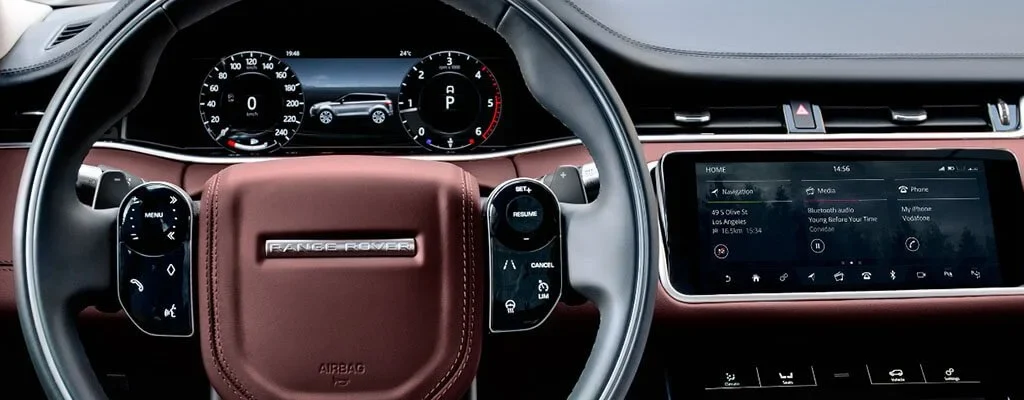
The best Range Rover music system upgrade depends on the factory equipment fitted and what you want to hear differently. If sound has disappeared, started crackling, or become uneven, diagnose that change before buying speakers or an amplifier. If the system works normally, start with its settings, define a listening goal, and compare compatible upgrade options. Confirm the VIN, infotainment version, factory audio specification, and exact proposed parts before approving work.
Electrical safety comes first. Stop using an audio system that produces smoke, a burning smell, or visible wiring damage. If this happens while driving, pull over safely, switch off the vehicle, and arrange professional assistance. Leave the vehicle and move to safety if smoke or fire is present. Do not keep replacing a blown fuse, fit a larger fuse, or handle exposed wiring.
Is your audio faulty or do you want a different sound?
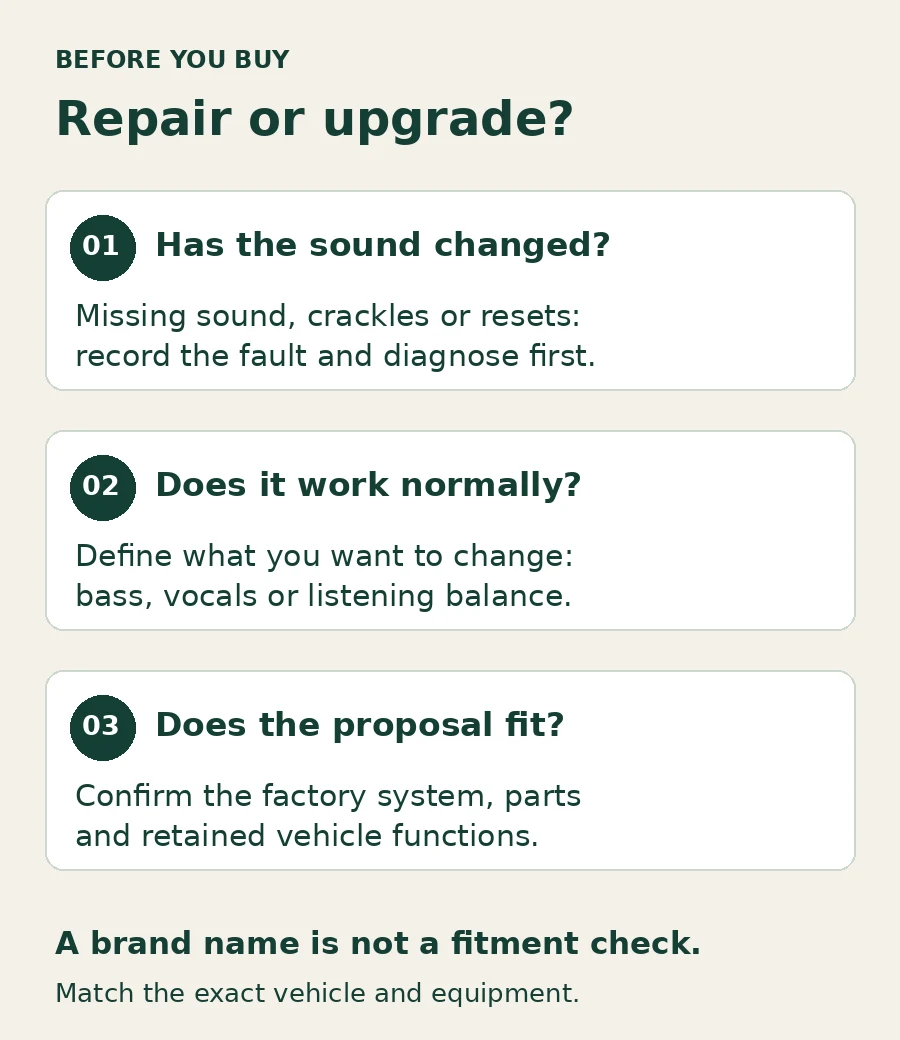
A repair aims to restore a function that has stopped working correctly. An upgrade changes the performance or features of a working system. These can involve different parts, tests, and costs. Replacing an amplifier because the music sounds disappointing can leave an unrelated connection or speaker fault unresolved.
Describe what changed and when it happens. Does one door buzz, does every source go silent, or does only your phone connection drop? Did the problem start after a battery replacement, software update, water leak, or previous accessory installation? A recording made while safely parked can help reproduce an intermittent complaint.
If the system has always worked consistently but you prefer fuller bass at a moderate volume, that is a useful upgrade goal. “Better sound” is harder to price and verify. Choose a specific improvement and identify the seats where it matters most.
Before spending, compare familiar recordings using the same source and a comfortable volume. Check the available balance, fader, bass, treble, subwoofer, and sound-mode settings in your handbook. Not every Range Rover offers the same controls. Make adjustments while parked and avoid turning everything to its maximum.
Match the symptom to the next check
| What you notice | Useful next check | What it does not prove |
|---|---|---|
| Only Bluetooth playback cuts out | Compare another supported source and phone, then check connection and software behavior. | That the speakers or amplifier need upgrading. |
| One speaker crackles or a door buzzes | Separate speaker distortion from trim vibration; inspect that channel, mounting, and wiring. | That every speaker is worn out. |
| All audio disappears but the screen works | Check mute state, audio routing, amplifier supplies, and network communication as applicable. | That the touchscreen is the failed part. |
| Sound stops after extended use | Reproduce the condition and assess temperature, ventilation, power, and fault records. | That fitting a larger amplifier will cure it. |
| The system works but bass feels insufficient | Check settings and source quality, then assess a compatible bass upgrade against a listening target. | That the factory equipment is defective. |
If sound cuts out, the screen reboots or media functions become unreliable, arrange infotainment fault diagnosis before buying upgrade parts. Restore a reliable baseline so you can judge what actually needs improving.
Identify the factory audio and infotainment before choosing parts
Model name and registration year are not enough to establish compatibility. Range Rover, Sport, Velar, and Evoque vehicles can have different audio packages, infotainment hardware, and market specifications. A previous owner may also have changed parts.
Use the VIN to obtain the vehicle specification, then have the installer confirm what is physically fitted. Land Rover iGuide recommends VIN entry for owner information aligned to the vehicle's market and specification. A handbook selected only by model and year can include optional equipment your vehicle does not have.
- Vehicle identity: VIN, model year, market, body configuration, and any previous modifications.
- Infotainment: system name, hardware or module identification, and installed software version.
- Factory audio: exact audio package and amplifier and speaker part numbers where relevant.
- Signal path: the actual connections between the source, processing, amplifier, and speakers.
- Shared functions: warning sounds, phone microphone, steering controls, cameras, and vehicle menus that must remain operational.
A grille badge is a clue, not a complete parts specification. Meridian's 2022 Range Rover Sport system overview, for example, describes three different factory packages for that launch. It does not establish which equipment is in your vehicle or authorize a retrofit between packages.
DSP means digital signal processing. It can adjust equalization, channel timing, and frequency distribution. An “analog DSP” model-year map does not reliably identify a vehicle's architecture. Likewise, a generic “CAN-bus compatible” label does not prove that an audio interface supports the correct signal path or every factory function.
Choose the smallest upgrade that meets your listening goal
Start with the part of the experience you want to change, then ask what can be retained. A complete replacement is not automatically better value than adjustment, a focused repair, or one compatible addition.
| Your priority | Possible route | Question to resolve first |
|---|---|---|
| Restore original performance | Repair the confirmed fault or replace the failed compatible component. | What test identifies the fault? |
| Different tonal balance | Use supported settings; consider measured tuning if additional processing is justified. | Can the existing controls achieve your goal? |
| More low-frequency output | Assess a matched subwoofer, enclosure, amplifier, and integration interface. | How will it receive a suitable signal and fit without losing needed space? |
| Change speaker performance | Consider speakers matched to the existing or proposed amplification and processing. | Are electrical load, mounting, and frequency duties compatible? |
| Add smartphone features | Check factory support or a vehicle-specific interface. | Is the request about connectivity rather than sound quality? |
Speaker replacement needs more than the right diameter
The installer should verify mounting depth, fixing points, connectors, polarity, moisture protection, and clearance to moving windows or other equipment. Electrical impedance and the speaker's intended frequency range must suit the amplifier channel and crossover arrangement. A physically fitting speaker can still be an unsuitable electrical or acoustic match.
Do not choose a universal 4-ohm specification or buy by peak wattage. Ask for the proposed part number, its documented specifications, and the reason it suits this application. Material names such as silk, flax, or beryllium do not establish fitment or guarantee your preferred sound.
Amplifiers and DSP need a compatible input and channel plan
An amplifier must accept the available signal correctly and drive the intended speaker loads within its specifications. The proposal should identify which channels it replaces or supplements, what processing remains active, and how it starts and shuts down with the vehicle.
Factory outputs may already be filtered or processed. Adding another processor without understanding that signal can produce a poor result. Audiotec Fischer's explanation of factory speaker-load diagnostics also shows why an input connection can affect system behavior. This is an integration consideration, not proof that one interface suits every Range Rover.
Ask the installer to compare continuous power ratings under stated test conditions, compatible loads, channel count, and usable output. Total advertised watts and a fixed watts-per-channel target cannot select a complete system on their own.
Subwoofers and door treatment solve different problems
A subwoofer proposal needs a suitable enclosure, secure mounting, matched amplification, and tuning that blends with the existing speakers. Confirm cargo-space loss and access to service items before approving the enclosure. There is no single best mounting corner or crossover setting for every Range Rover cabin.
A trim rattle may need a clip, mounting, or panel repair. Acoustic treatment should have a stated purpose and preserve drains, moisture barriers, airbag operation, and service access. Neither a subwoofer nor added treatment comes with a credible universal percentage reduction in vibration.
How to assess Focal, JL Audio, Harman Kardon, or Meridian proposals
A brand name is not a compatibility certificate. A proposal that lists only “Focal kit,” “Harman Kardon retrofit,” or “Meridian upgrade” leaves important questions unanswered. Ask for the manufacturer's exact product reference, supported vehicle and audio variants, required adapters, and documented limitations.
For an aftermarket system, distinguish the speaker or amplifier from the interface needed to integrate it. For a factory-system retrofit, establish whether different wiring, modules, speakers, configuration, or trim are required. A matching plug does not establish software compatibility or confirm that every function will work.
Also distinguish new genuine replacement parts, used original components, and aftermarket products. “OEM quality” alone does not explain origin, compatibility, condition, or support. Ask who supplies the parts and who will resolve a compatibility problem after installation.
Do not approve a system based on guaranteed “clarity improvement” percentages without a defined measurement and relevant evidence. A useful demonstration uses familiar material at comparable listening levels and explains the trade-offs. Louder playback by itself does not establish better quality.
What a safe installation plan should include
Audio installation is professional electrical work. The following points help an owner assess a proposal; they are not a universal battery-disconnection or wiring procedure. The installer needs the applicable vehicle workshop instructions and the manuals for the exact equipment being fitted.
Procedure-specific isolation and protected power
Wiring work must use the required isolation procedure, including the vehicle's shutdown steps and any additional power sources. Do not keep circuits live throughout installation. Power support required for a defined diagnostic or programming operation is a separate task and does not make cutting, joining, or connecting live wiring safe.
As one equipment-specific example, the Focal FPX installation manual requires battery disconnection before installation and a protected power supply. Its individual cable and fuse specifications must not be copied to a different amplifier or vehicle without checking applicability.
The plan should specify suitable cable size, protected routing, secure terminals, an appropriate approved grounding point, and correctly rated fusing near the supply as required by the design. Cables must avoid moving seats, sharp edges, pedals, and safety equipment. Never increase a fuse rating to overcome repeated blowing.
On hybrid or electrified vehicles, 12-volt accessory work must remain separate from high-voltage or other electrical systems. Do not assume that switching off the ignition or disconnecting one battery isolates every circuit. Any required specialist isolation belongs to personnel trained for that vehicle.
Preserve vehicle functions and access
Record the operation of chimes, parking sounds, cameras, steering controls, calls, voice commands, and relevant menus before work. The finished installation must retain the functions applicable to the vehicle. Camera images appearing once or music playing once is not a complete acceptance test.
Confirm cooling space, dry mounting locations, secure equipment retention, and access to fuses and service components. Added wiring and enclosures must not obstruct airbags, seat mechanisms, or drains. Equipment should operate within its published environmental limits, including in the conditions expected in the UAE.
Compare the full installed quote
There is no verified universal AED price for this article's upgrade options. Compare written proposals for the same vehicle, listening goal, and retained functions. A speaker-only price cannot be compared fairly with a package that includes an amplifier, interface, wiring, tuning, and trim work.
- Exact part numbers, quantities, condition, and evidence of compatibility.
- Interfaces, harnesses, brackets, enclosure, cabling, and circuit protection.
- Labor, diagnosis, configuration, and tuning included in the total.
- Any cutting, drilling, cargo-space change, or irreversible modification.
- Itemized AED charges, whether VAT is included, and the final amount payable.
- Written parts and workmanship terms, exclusions, and responsibility for later integration problems.
Keep diagnosis separate from optional upgrades on the estimate. If the original system needs a repair, ask for that cost and outcome before deciding whether to spend more on a different sound. A healthy system that already meets your listening needs does not require an upgrade because of its age.
Check the finished system before collection
Agree on acceptance checks before installation. Listen while parked using the same familiar recordings used during planning. Assess vocals, bass balance, unwanted noise, and performance at comfortable volumes. Check the seats that matter to you, not just the installer's preferred listening position.
- Test supported sources, phone calls, microphone, volume, balance, and available sound modes.
- Confirm warning sounds, parking aids, cameras, steering controls, and vehicle menus.
- Check startup, shutdown, locking, and reconnection across repeated operating cycles.
- Ask for appropriate post-installation fault checks and confirmation that added equipment sleeps normally.
- Collect the parts list, wiring documentation, tuning backup where available, and written support terms.
Do not make distracting adjustments while driving. Keep playback low enough to hear relevant outside sounds. If a new battery-drain complaint, hot smell, or intermittent shutdown appears, stop testing the system repeatedly and have the installation assessed. Repeated flat batteries need diagnosis, not an automatic larger-battery recommendation.
Keep vents clear as instructed, avoid liquid cleaners entering grilles, and follow the equipment's cleaning guidance. Do not cut ventilation openings or add fans without an installation assessment. Software updates should be selected for the fitted system and its support instructions, not applied on an invented maintenance schedule.
Range Rover music system upgrade FAQs
Will changing only the front speakers upset the sound balance?
It can change the balance between channels, depending on sensitivity, frequency response, and factory processing. Ask how the proposed speakers will be matched and evaluated with the remaining system. A demonstration of an unrelated vehicle cannot confirm the result in yours.
Can used Meridian components be a sensible choice?
Possibly, but check exact part numbers, condition, required configuration, and supplier return terms first. A used component from a different audio package is not automatically compatible. The quote should explain testing and who carries the risk if the part cannot be integrated.
Does a CarPlay upgrade automatically improve speaker quality?
No. CarPlay changes access to compatible phone features and media. It does not itself replace speakers or resolve an amplifier fault. Assess the connection method and audio routing separately from any acoustic improvement you want.
Can an audio upgrade cause battery drain while parked?
Added equipment can contribute if it remains awake or is wired or configured incorrectly. The installer should verify its shutdown behavior with the vehicle. A new drain complaint needs testing of the relevant circuits rather than an assumption that the battery has failed.
Can I keep the factory appearance and reverse camera?
Some designs retain the original display, grilles, and controls, but retention must be confirmed for the exact system. Ask for written camera and control compatibility, including switching behavior. Do not assume an adapter preserves every function just because its connectors fit.
What if I want more bass without losing luggage space?
Ask for enclosure dimensions, location, mounting method, and the actual space or access lost. A compact option may involve output or tuning compromises. Compare those trade-offs before buying, and keep service access and secure luggage storage in the plan.
What should I ask about future vehicle software updates?
Ask who supports the interface after a vehicle or phone update, whether updates are required for the added equipment, and how settings are backed up. Record the installed hardware and software versions. Do not accept a blanket promise that future updates can never affect compatibility.
When should I keep the original audio system?
Keep it when it works reliably and meets your needs after supported settings are adjusted. If one fault is confirmed, a focused repair may be sufficient. Upgrade when there is a specific listening or feature goal, a compatible design, and a clear installed cost.
Choose the system around your vehicle and your ears
A useful audio upgrade starts with a reliable factory system, a clear listening goal and verified compatibility. Before planning a Range Rover audio retrofit, share your model, year, current system and the change you want. Ask how the installation will retain the vehicle's existing functions.
Workshop support
Need help with your Range Rover?
Tell us your model, year and what you have noticed. Speak with the workshop about maintenance, an inspection or a repair.