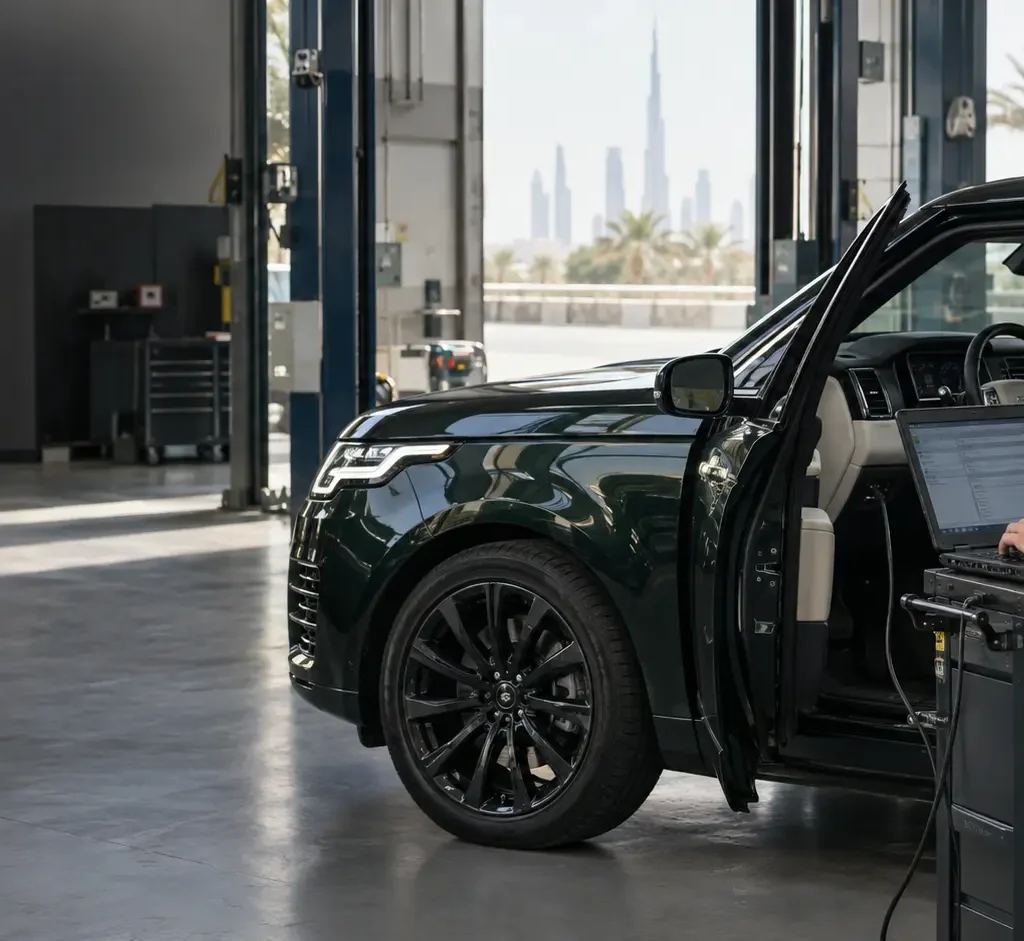
The right Range Rover performance upgrade depends on what you want to change and what your exact vehicle can support. ECU tuning, exhausts, suspension, brakes, and turbocharger or intercooler changes serve different purposes. None is automatically necessary because you drive in Dubai, and buying all five is rarely a sensible starting point.
First establish that the vehicle is healthy. Then compare the expected benefit with comfort, heat management, maintenance, fitment, and approval requirements. This guide helps you decide which category deserves a closer look, when the standard equipment is the better choice, and what to ask before ordering parts.
Repair lost performance before considering upgrades
A vehicle that has become slower, developed a soft brake pedal, started leaning, or begun overheating has a fault to investigate. Tuning cannot repair a boost leak, and a larger brake kit is not a diagnosis for abnormal pedal travel. Restoring the correct original specification may resolve the complaint without a performance modification.
Stop safely and arrange recovery if braking is reduced, the pedal sinks or feels unusually soft, or there is a suspected brake-fluid leak. Do not continue driving to see whether the brakes improve. Severe overheating, heavy smoke, an oil-pressure warning, or sudden power loss that prevents safe progress also requires stopping safely and assistance.
| What has changed | First decision | Why an upgrade is premature |
|---|---|---|
| Lost acceleration or a new engine warning | Record the conditions and arrange engine diagnosis. Stop for severe symptoms. | Software changes can complicate investigation of the original fault. |
| Soft or sinking brake pedal | Stop safely and arrange recovery for brake assessment. | Pad material and disc appearance do not explain a hydraulic or pedal problem. |
| Uneven ride height, pulling, or new suspension noise | Inspect the fitted suspension, tires, and alignment. Recover if control is unsafe. | A lift or lowering kit can leave the underlying defect unresolved. |
| Healthy vehicle with a specific preference | Define the desired change and compare compatible options. | A measurable goal is more useful than a generic upgrade bundle. |
Compare the five performance upgrade categories
These are five choices to investigate, not a ranking that applies to every Range Rover. A daily driver prioritizing quietness may make a different decision from an owner preparing a vehicle for a defined off-road use. Keep public-road speed limits and the vehicle's operating limits unchanged.
| Category | Possible purpose | Main trade-off | Essential compatibility check |
|---|---|---|---|
| ECU tuning | Change the engine's torque delivery on a healthy, suitable powertrain. | Additional thermal or mechanical load, fuel requirements, and coverage implications. | Engine, ECU version, gearbox, emissions equipment, and calibration validation. |
| Exhaust | Change sound or address a measured flow restriction within a planned build. | Cabin drone, noise compliance, clearance, and uncertain power benefit. | Engine variant, sensors, aftertreatment, valves, mounts, and approvals. |
| Suspension | Change damping or handling characteristics for a defined use. | Ride comfort, travel, ground clearance, and electronic integration. | Spring type, adaptive equipment, axle loads, geometry, and wheel clearance. |
| Brakes | Meet a supported thermal or friction requirement beyond a healthy original setup. | Noise, dust, cold behavior, wheel clearance, and replacement costs. | Matched pads, discs, calipers, hydraulics, parking brake, and wheel fitment. |
| Turbocharger and intercooler | Support a defined airflow or charge-temperature target. | Response, pressure loss, packaging, heat rejection, and wider system work. | Exact engine and induction layout, cooling circuits, fuel system, and calibration. |
1. ECU remapping and engine tuning
Tuning may change requested torque, boost, fueling, or ignition behavior, depending on the engine and calibration. It should begin with an identified goal and a healthy baseline. More aggressive accelerator response alone can feel quicker without demonstrating more engine output.
Confirm the engine code, model year, ECU software, transmission, existing modifications, and fuel requirement. Gasoline, diesel, and hybrid applications need different assessments. A tune developed for a similar badge or displacement is not proof of suitability for your vehicle.
Ask for comparable before-and-after results with the fuel, operating temperatures, test conditions, and measurement basis stated. Wheel power must not be presented as directly interchangeable with estimated engine power. A peak dyno figure alone does not establish durability, emissions compliance, or performance during prolonged hot operation.
Retaining factory calibration is a valid choice when the standard performance meets your needs or the proposed package lacks suitable validation. A removable plug-in module is not automatically lease-friendly, warranty-neutral, or undetectable. Obtain the relevant written permissions and coverage position before installation.
Compare Range Rover engine tuning options against the vehicle's condition, your driving needs and the proposed calibration. No single power gain or fuel-economy improvement applies to all five upgrade categories.
2. Exhaust system upgrades
Decide whether your goal is a different sound, replacement of damaged components, or support for a documented engine build. Repairing a leaking exhaust is maintenance. Changing the rear section for tone is a preference. Neither establishes that the engine will make more power.
Ask exactly which components will change. Rear-section replacements and changes near the engine have different effects on installation, sensors, heat shielding, emissions equipment, and software. Confirm the complete configuration for your engine, including any catalyst, particulate filter, and exhaust valves that are fitted.
The everyday drawback may be noise inside the cabin rather than outside it. Ask about cruising drone, cold-start behavior, passenger comfort, towing clearance, and whether the system retains the required shields and mounting arrangements. Stainless steel construction alone does not establish fit, acceptable noise, or a lifetime warranty.
Do not accept removal of required emissions equipment or suppression of its fault monitoring as an ordinary road-car upgrade. Check the actual approval requirements before ordering. A system advertised as suitable for another market does not establish permission for this vehicle in Dubai. Keeping a sound original exhaust can be the better decision when quiet travel is the priority.
3. Suspension changes for a defined driving need
Start by confirming whether the vehicle has coil springs, air suspension, adaptive dampers, or other electronically controlled chassis equipment. Some vehicles already provide selectable modes. Understand their handbook-described operation before paying to replace or bypass a working system.
A firmer setup can change the balance between body control and ride comfort. Raising or lowering the vehicle can affect travel, geometry, clearance, and integration with other systems. A road-focused change may be poorly suited to uneven tracks. A taller stance does not automatically improve stability.
For spring-and-damper combinations, the parts must work together through their intended travel. Bilstein's suspension guidance explains why its lowering applications use matched damper length and spring preload. That is a design principle, not confirmation that a particular Bilstein kit fits your Range Rover.
Require an application-specific parts list, axle-load suitability, alignment specification, and clearance checks. Ask whether ride-height setup, headlamp adjustment, or driver-assistance calibration is required by the exact procedure. Do not assume that every change needs the same calibration, or that clearing a warning makes an incompatible kit acceptable.
If the complaint is a new knock, uneven height, or harshness that appeared recently, diagnose it first. Correct tires, pressures, alignment, and replacement of worn original-specification parts may meet the objective. There is no basis for declaring factory dampers unsuitable simply because the vehicle operates in Dubai.
4. Brake upgrades matched to the whole system
A healthy original braking system is the baseline. An upgrade discussion starts with the intended use and any demonstrated limitation, not a mushy pedal or an assumption that a drilled disc stops every vehicle sooner. Stopping behavior depends on the complete vehicle and operating conditions, including tire grip and the road surface.
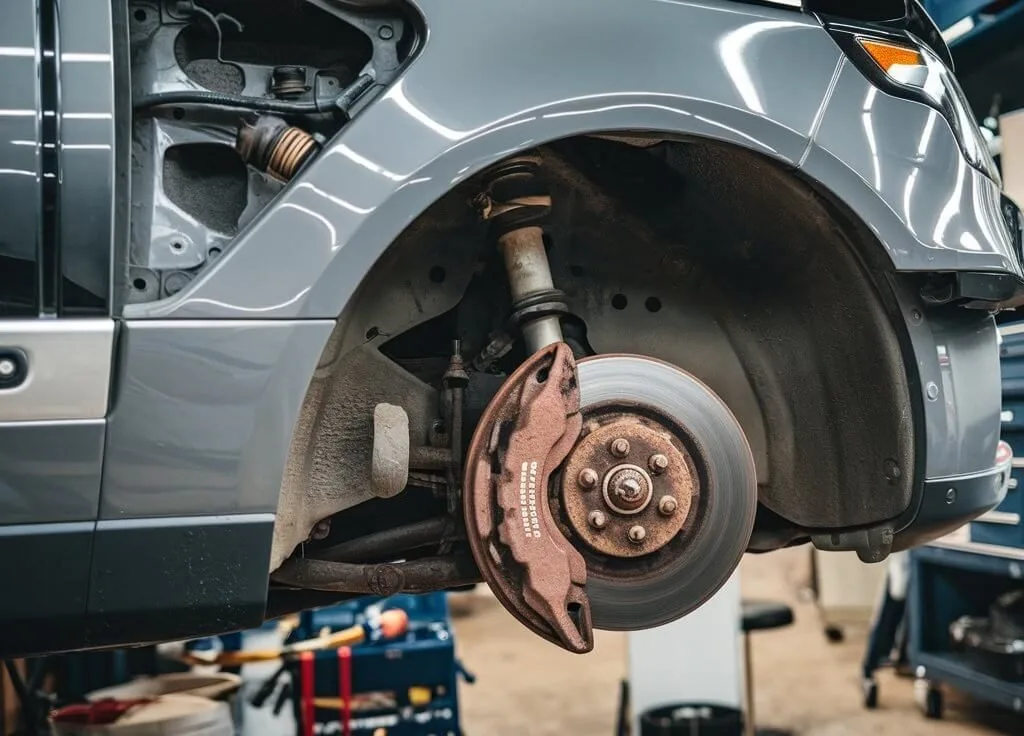
Ceramic describes a pad formulation category; it is not a universal stopping-distance rating. It also does not mean the vehicle has carbon-ceramic discs. Compare the exact compound's intended use, temperature behavior, noise, dust, and compatible disc specification rather than choosing by the label alone.
Drilled, slotted, and plain discs must be evaluated as specific engineered products. The hole pattern alone cannot establish better cooling, durability, or braking on your vehicle. Brembo's pad-and-disc comparison explicitly explains that improvement cannot be quantified universally because vehicle, original system, and use differ.
Confirm disc diameter and thickness, caliper compatibility, wheel clearance, front-to-rear balance, parking-brake operation, and any required system configuration. Use the specified fluid and bleeding procedure. A complete caliper, line, and disc replacement is not automatically necessary when an appropriate like-for-like repair or matched friction package meets the need.
Ask about installation, bedding instructions, inspection, and a controlled verification process. Do not test stopping distances on public roads. If the proposal cannot explain the limitation being addressed and demonstrate a compatible solution, retain the correct original arrangement.
5. Turbocharger and intercooler upgrades
This category only applies after identifying the actual induction system. Not every Range Rover uses the same turbo arrangement, and a supercharged engine is not a turbocharged engine. Hybrid versions also require the complete powertrain's torque and thermal constraints to be considered.
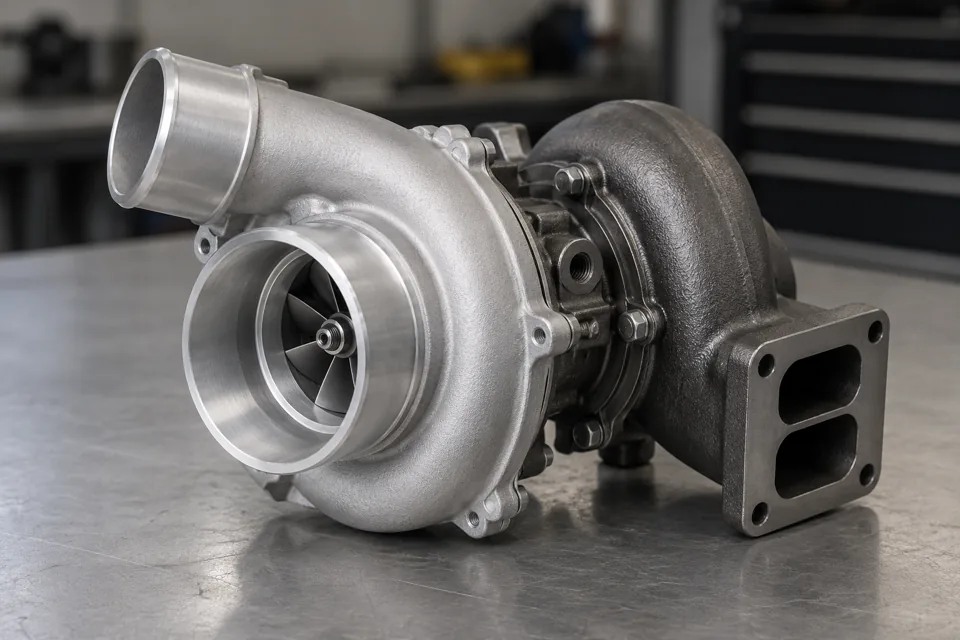
A turbocharger must be matched to the desired airflow and operating range. A larger unit may change response as well as peak output, while supporting fuel, lubrication, cooling, exhaust, and transmission requirements can expand the project. Replacing a worn turbo to restore standard performance is a repair, not evidence that an upgraded unit is needed.
An intercooler manages charge-air temperature. Its value should be assessed using relevant temperature and pressure measurements under comparable load. It is not a substitute for repairing an overheating engine, a coolant leak, or a damaged charge-air connection.
Garrett's turbo-system guidance discusses the balance between charge-air cooling, pressure loss, and system layout. Bigger external dimensions alone do not establish a better result. Confirm air-to-air or liquid-cooled architecture, ducting, mounting, pressure capability, and interaction with the other heat exchangers.
For a road vehicle with healthy standard performance, the extra cost and complexity may offer little useful benefit. Do not approve a turbo-and-intercooler bundle on a promise of guaranteed reliability, economy, or freedom from Dubai heat-related problems.
Fitment and Dubai approval checks before buying parts
The UAE Federal Decree-Law on Traffic Regulation requires licensing-authority approval for substantial modifications including engine power and specified changes to the vehicle's structure or appearance. Confirm the applicable Dubai process and inspection requirements for the proposed work before installation. This guide does not certify a particular kit as approved.
- Vehicle identity: VIN, model year, engine, transmission, original market, and fitted options.
- Product identity: exact manufacturer, part number, revision, application listing, and installation instructions.
- System integration: retained safety and emissions functions, wheel and component clearances, and applicable configuration work.
- Permissions: licensing requirements and written positions from the insurer, warranty provider, and lessor where relevant.
- Follow-up support: maintenance requirements, software support, replacement-part availability, and written parts and labor warranty terms.
Removing a tuning box or reinstalling a standard part does not establish that a lease condition, warranty question, or approval requirement has been resolved. Keep honest installation records. Do not budget on a guaranteed resale premium or assume that every future buyer wants a modified vehicle.
Build a useful upgrade quote
A meaningful price needs a defined vehicle and package. Ask for an itemized quote covering parts, labor, baseline checks, calibration where applicable, testing, consumables, approval or inspection costs, and VAT treatment. Confirm exclusions and follow-up work before comparing totals.
Separate repairs needed now from optional modifications. Also include recurring costs such as a specified fuel grade, replacement friction parts, or additional inspections required by the product instructions. A low installation price can be a poor comparison if another quote includes essential supporting work.
For a healthy daily driver, keeping the vehicle standard may be the most useful outcome. For an approved modification, agree on the desired result and verification method before work starts. Cosmetic trim, wraps, lighting, and general accessories are separate buying decisions and do not belong in the performance package by default.
Choose the change that solves your actual need. Repair faults first, establish the vehicle's baseline, and compare one suitable category at a time. Compatibility, an acceptable trade-off, and the necessary approvals matter more than a bundle name or headline power figure.
Range Rover performance upgrade questions
Which upgrade should I buy first?
Start with the objective and vehicle condition. If there is a fault, repair comes first. If the vehicle is healthy, compare the category that addresses your specific preference. There is no universal first modification or requirement to buy all five.
Will upgrades make my Range Rover more reliable in Dubai?
No blanket improvement can be promised. A modification may add load or maintenance requirements. Correct servicing, fault repair, and use within the vehicle's limits remain essential whether the vehicle is standard or modified.
Are plug-in tuning boxes suitable for leased vehicles?
Only consider a change after checking the lease and obtaining any required written permission. Removability does not establish approval or protect warranty coverage. Discuss the actual product and engine with the relevant providers.
Will ceramic pads fix a soft brake pedal?
A soft or sinking pedal is a fault requiring assessment, not a reason to select a pad category. Stop safely and arrange recovery if pedal feel is abnormal or braking is reduced. The workshop must establish the cause.
Can I use parts from a more powerful Range Rover?
Do not assume interchangeability from appearance or model family. Mounts, dimensions, electronics, hydraulics, cooling, and software can differ. Require a complete application-specific compatibility assessment before purchasing.
Do I need a larger intercooler without a remap?
Only a defined use and supporting measurements can establish a worthwhile reason. Healthy standard equipment may meet your needs. A larger core is not automatically a solution for coolant overheating or lost boost.
What should I receive after installation?
Obtain the itemized invoice, installed part numbers, software details where relevant, applicable approval documents, maintenance instructions, warranty terms, and verification results. Ask how the original goal was assessed and what limitations remain.
Discuss your Range Rover's performance goals
Tell Range Rover Specialist in Al Quoz 4, Dubai, your model, engine, existing modifications, and the result you want. If performance has changed or a warning has appeared, start with a diagnostic inspection before choosing an upgrade.
Workshop support
Need help with your Range Rover?
Tell us your model, year and what you have noticed. Speak with the workshop about maintenance, an inspection or a repair.