
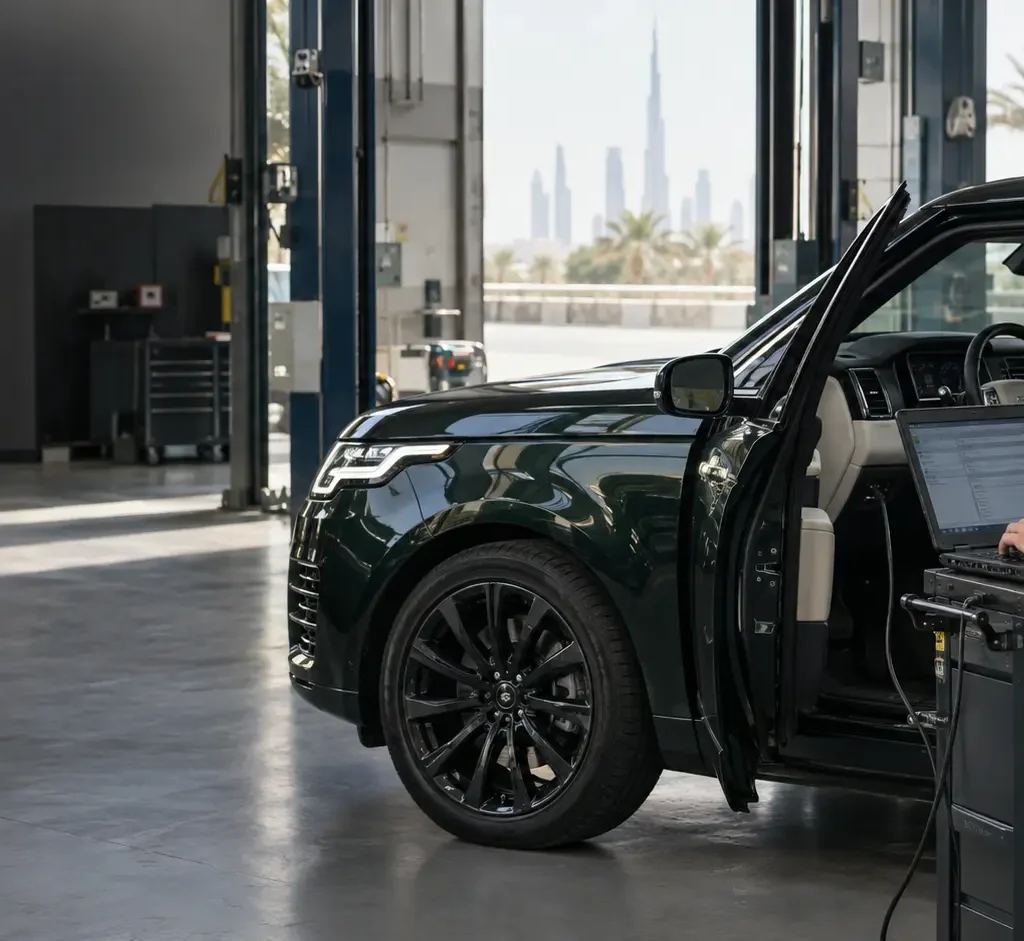
Replace a Range Rover fuel injector when engine-specific testing confirms a defect that an approved cleaning or repair process cannot correct, or when an applicable manufacturer instruction requires replacement. Mileage, rough idle, a warning code, or higher fuel use alone does not establish that an injector has failed.
The useful first question is which injection system your engine uses. Gasoline port injection, gasoline direct injection, and diesel common rail need different tests. This guide explains what should be checked before you approve cleaning, one injector, or a larger fuel-system repair in Dubai.
Raw-fuel leakage needs an immediate stop. If you see liquid fuel, notice a strong raw-fuel smell suggesting a leak, or find fuel spraying or dripping, stop safely, switch off, and do not restart. Keep people away from the vehicle and ignition sources. Arrange recovery and tell the operator there may be a fuel leak. If smoke or fire is present, move away and contact emergency services from a safe location.
Do not touch fuel lines, search for a leak with your hand, or run the engine to watch where fuel appears. A flashing engine warning with severe shaking, heavy smoke, or major power loss also requires stopping safely and assistance.
Identify the engine before choosing an injector test
Use the VIN, model year, engine code, original market, and repair history. The same Range Rover model name can cover different fuel systems. A gasoline hybrid still needs its gasoline-engine injection system identified, along with the appropriate precautions against automatic engine starting.
| System | Where fuel enters | Diagnostic distinction |
|---|---|---|
| Gasoline port injection | Into the intake port, before the intake valve. | Assess fuel delivery together with spark ignition, air supply, and mechanical condition. |
| Gasoline direct injection | Directly into the combustion chamber. | Separate the low-pressure supply from the high-pressure circuit. Spark ignition remains relevant. |
| Diesel common rail | From a shared pressurized rail into each combustion chamber. | Use diesel-specific pressure, electrical, contribution, and return-flow tests where applicable. There are no spark plugs. |
Bosch's port-injection explanation places the injector upstream of the inlet valve. Its gasoline direct-injection guidance describes separate low- and high-pressure circuits. These distinctions matter more than a generic instruction to test every injector the same way.
Diesel engines use compression ignition. Glow plugs can assist starting and combustion management, but they are not spark plugs and are not inspected as if they were gasoline ignition parts. Do not order injectors or testing equipment from a model badge alone.
Symptoms that justify diagnosis rather than automatic replacement
Record when the symptom occurs: first start, hot restart, idle, acceleration, or after refueling. Note the exact warning message and whether the fault is intermittent. A useful history directs the technician toward a test condition without turning the observation into a diagnosis.
| Observation | Other possibilities to consider | Next step |
|---|---|---|
| Rough idle or cylinder misfire | Gasoline ignition faults, air leaks, compression differences, wiring, or fuel delivery. | Identify affected cylinders and compare supported test results. Stop for severe shaking or a flashing warning. |
| Long cranking or difficult hot starting | Supply pressure, pump or control faults, cranking speed, temperature information, or internal leakage. | Test the starting condition. Do not assume an injector flooded a cylinder overnight. |
| Higher fuel consumption | Traffic, idling, route changes, tire condition, brake drag, engine temperature, or other faults. | Compare your own like-for-like usage and investigate a sustained change. |
| Rail-pressure fault or pressure decay | Supply restriction, pump, regulator, sensor information, leakage, or test conditions. | Use the exact engine's diagnostic procedure to locate the cause. |
| Raw-fuel odor or visible leakage | Injector seals, rail, pipes, connections, or another fuel-system source. | Stop, switch off, do not restart, and arrange recovery. |
There is no single km/L figure that proves every Range Rover is healthy. Engine, vehicle mass, route, AC use, and hybrid operating pattern change consumption. A drop relative to comparable trips is worth reporting; it does not identify an injector.
A fuel leak can originate outside the injector itself. For example, JLR's historical N138 recall concerned fuel-rail end-cap leakage on certain 2018 US-market Evoque and Velar vehicles. It does not establish a current UAE recall for your vehicle; campaign eligibility must be checked by VIN and market.
What wiring checks and fault codes can tell you
Save the scan report before clearing faults. Record the complete code, suffix where available, status, reporting module, and associated operating data. A basic reader may provide a starting point, but the workshop needs diagnostic coverage appropriate to the vehicle and test.
An injector-circuit code directs attention to the electrical circuit. Possible causes include the injector's electrical element, connector contact, damaged wiring, supply, or control-side faults. It does not prove that the nozzle is blocked or that the named injector must be replaced.
Similarly, a misfire code identifies a detected combustion problem, while a mixture or rail-pressure code describes another monitored condition. Their timing and relationship matter. Interpret misfire, mixture and rail-pressure fault codes in that context before ordering parts.
The technician should check connector condition, terminal contact, harness routing, and relevant electrical measurements using the correct circuit information. Solenoid and piezo injectors must not be treated as interchangeable electrical loads. Delphi's electrical testing guidance describes dedicated solenoid-injector measurements, with results judged against the application.
A click only indicates an audible event, not correct fuel quantity, spray quality, or sealing. Do not apply battery voltage directly to an injector, unplug it while the engine runs, or attempt a homemade electrical test.
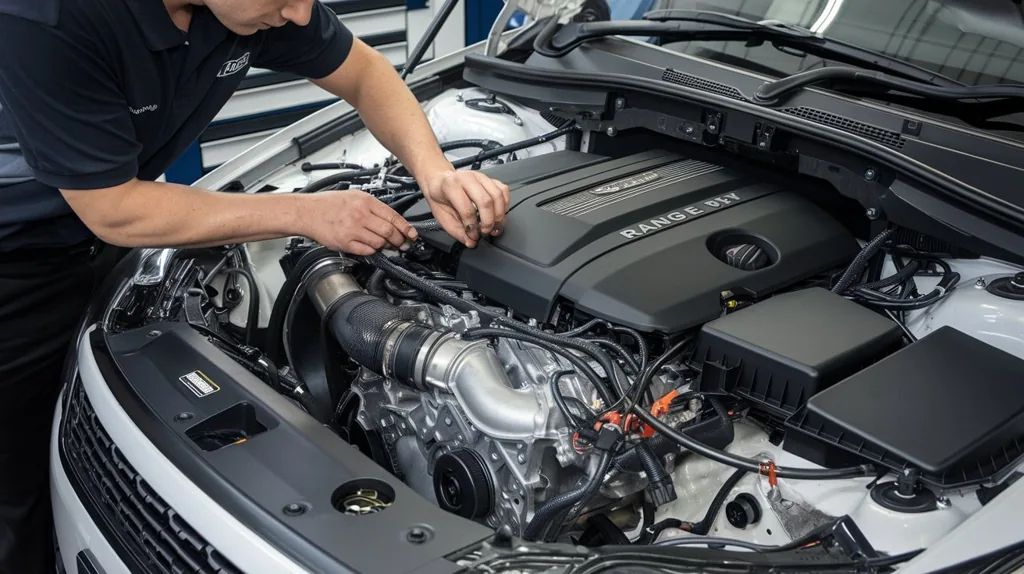
The pressure and cylinder tests a workshop may use
Fuel-pressure testing, injector removal, return-flow measurement, and live electrical work are trained-technician tasks. Gasoline direct injection and diesel common rail involve hazardous pressure. Switching off does not establish that pressure has dissipated. Never loosen a running engine's fuel line or attach an ordinary gauge to a high-pressure circuit.
The workshop must use the specified depressurization, isolation, cleanliness, adapters, and test procedure. Delphi's high-pressure service guidance emphasizes trained operators and correct connection practices. Exact JLR instructions govern which pipes, seals, and fasteners must be renewed on your application.
Gasoline port and direct injection
For a gasoline misfire, ignition checks belong alongside fuel and mechanical diagnosis. A wet spark plug can result from fuel reaching a cylinder that is not igniting properly. A pale or dry plug does not prove a blocked injector. Plug condition is one observation, interpreted with ignition performance, cylinder behavior, and the operating history.
Where supported, a controlled injector balance or delivery test compares response under specified conditions. Direct-injection testing must also distinguish adequate low-pressure supply from high-pressure pump and rail behavior. A pressure drop after shutdown may involve several components, so the technician must isolate the path rather than blame one injector from the gauge reading.
Diesel common rail
Compare requested and actual rail pressure under the prescribed starting or running conditions. Check the supply side and fuel filter where relevant before assuming that the high-pressure pump or injectors have failed. Return-flow testing can help identify excessive internal leakage when performed with the correct equipment and limits.
Injector correction or cylinder-contribution values describe how the system is responding. They can be influenced by combustion or mechanical differences and do not independently prove injector failure. Delphi's common-rail diagnostic overview treats injector leakage, pump performance, and electrical integrity as distinct checks. Its general lifespan discussion is not a Range Rover replacement schedule.
When necessary, a specialist bench test can assess a removed injector against a supported test plan. Ask which result failed, under what conditions, and whether the unit was correctly identified. A test label without the relevant part number and acceptance criteria is not a complete explanation.
Clean, repair, or replace the injector
Cleaning can be useful when deposits are the supported concern and the injector manufacturer permits an appropriate process. It cannot repair damaged wiring, a failed electrical element, physical wear, or a leaking fuel rail. A temporary improvement after an additive also does not establish a permanent repair.
| Finding | Possible route | What should support the decision |
|---|---|---|
| Deposit-related performance issue on a serviceable injector | Approved cleaning followed by retesting. | Suitable process for that injector and acceptable post-cleaning results. |
| Connector or harness defect | Repair the circuit as specified. | The injector itself passes the relevant checks after circuit repair. |
| Serviceable external sealing fault | Specified seal or connection repair where allowed. | The actual leakage source is confirmed and the repair passes leak checks. |
| Confirmed internal wear, damage, or unsupported electrical repair | Compatible replacement or approved remanufactured unit where available. | Failed application-specific test and traceable part specification. |
| Contamination affecting the fuel system | Assess the full affected circuit before fitting parts. | Documented contamination findings and a manufacturer-supported repair scope. |
Bosch provides specific procedures for cleaning certain gasoline high-pressure injectors. That does not mean every direct injector, diesel injector, or electrical design can be treated with the same solvent or ultrasonic method. Ask the workshop to identify the supported method and show the before-and-after result.
Replacing one confirmed faulty injector may be appropriate if the others pass and the manufacturer permits it. A complete set needs its own reason, such as multiple failed units, a compatibility requirement, or a contamination repair plan. Shared age alone is not proof that all injectors have failed.
Replacement timing follows the application and findings
Do not schedule every diesel injector for replacement at a fixed distance or arrange a fuel-system flush simply because another mileage threshold has passed. Check the maintenance requirements and technical information for the exact engine, model year, and market. A generic supplier lifespan estimate is not a factory service interval.
If a workshop recommends preventive replacement, ask for the applicable instruction or the condition that justifies it. If no replacement is due and the vehicle has no symptoms, routine maintenance does not automatically require dismantling the injectors or performing a pressure test.
Dubai heat, traffic, and idling belong in the operating history, but they do not establish a percentage reduction in injector life. Nor does a regional comparison prove that local fuel has inferior detergent content. Where contamination is suspected, properly collected fuel and filter findings are more useful than an assumption about a country or filling station.
Use the fuel type and grade specified for your engine. Higher gasoline octane is not a universal injector-cleaning treatment, and gasoline advice must never be applied to a diesel vehicle. Follow the applicable fuel-filter schedule and product restrictions. Do not add a cleaner to an actively leaking system or use additives as a substitute for diagnosis.
What the replacement quote and handover should include
Ask for the engine and injector identification, affected cylinder, failed test, and proposed part number. The quote should separate diagnosis, parts, labor, required seals or pipes, any supported coding or adaptation, and post-repair testing. Confirm VAT treatment, exclusions, and written warranty terms before authorizing work.
New, remanufactured, and used parts are different choices. A brand label or the word OEM alone does not establish compatibility or condition. Where remanufacture is supported, request traceability and the relevant test documentation. Confirm any part-revision or calibration-code requirements against the vehicle.
Some applications require injector correction codes or specific adaptation routines. Others use different procedures. The workshop should perform what the exact system requires rather than promise universal recoding or a generic ECU reset.
Verification should include the prescribed leak checks, relevant pressure and cylinder results, and the original cold-start, hot-start, or running condition where safe. If over-fueling or contamination may have affected engine oil or other components, assess that before returning the vehicle. A cleared warning light by itself is not a completed repair.
The replacement decision: identify the system, preserve the fault information, test wiring and fuel delivery, and distinguish deposits from damage. Approve the smallest supported repair scope, then verify it. Suspected raw-fuel leakage takes priority over every diagnostic or cost comparison.
Range Rover fuel injector questions
Can I drive with a suspected leaking injector?
Do not drive or restart if raw-fuel leakage is visible or strongly suspected. Stop safely, switch off, and arrange recovery. Fuel odor does not identify the injector as the source, so the rail, connections, and other components must also be assessed.
Do diesel Range Rovers have spark plugs to inspect?
No. Diesel engines use compression ignition. Glow plugs have a different role and are not a substitute for spark-plug inspection. Diesel starting or rough-running diagnosis must follow the fitted engine's procedures.
Does an injector-circuit code mean I need a new injector?
No. It identifies an electrical condition that needs testing. Wiring, connector contact, supply or control faults, and the injector itself may be involved. Keep the complete code and its status before clearing anything.
Can cleaning save an injector?
Possibly, if deposits are the supported cause and an approved cleaning process exists for that unit. Cleaning cannot correct physical wear or an electrical failure. A successful outcome needs an appropriate retest, not just smoother running immediately afterward.
Should all injectors be replaced together?
Not automatically. Ask for individual results and any manufacturer requirement. Wider replacement may be justified by multiple failures or contamination, but one suspect cylinder is not proof that every injector needs replacing.
Should I flush the fuel system at every major service?
Follow the exact vehicle's requirements. There is no universal flushing interval in this guide. A specific deposit concern needs a supported treatment; routine additives or flushing should not replace normal diagnosis and fuel-system maintenance.
What information should I send before booking?
Send the model, year, engine or VIN, fuel type, mileage, warning message, and when the symptom occurs. Include recent refueling or repair history and previous test reports. Report suspected fuel leakage before arranging transport.
Get a clear injector repair recommendation
Contact Range Rover Specialist in Al Quoz 4, Dubai, with your engine details and symptoms. Ask for diagnosis before approving injector cleaning or replacement. If fuel is leaking, arrange recovery rather than driving to the workshop.
Workshop support
Need help with your Range Rover?
Tell us your model, year and what you have noticed. Speak with the workshop about maintenance, an inspection or a repair.