

New Defender · L663 · 2020 onward · Dubai
Defender L663 Repair and Service Dubai
Modern Defender faults can cross electrical, software, suspension and powertrain systems, so the warning on the dash is only the starting point. We diagnose Defender 90, 110 and 130 models in Dubai using the vehicle’s exact powertrain, fitted equipment and fault evidence before any repair is approved.
The message is only one clue
Record the event before the Defender is restarted
A modern Defender can display several warnings because systems share power, network communication, wheel-speed information, cameras, configuration and control requests. One interruption may influence multiple modules, but several simultaneous messages do not prove one cause. The order, conditions and vehicle specification matter.
Photograph the first message and any that follow. Record start quality, road speed, steering or braking input, selected terrain or height mode, towing connection, recent charging, rainfall, washing, impact and previous battery or repair work. If the concern disappears after restart, preserve the evidence anyway. A cleared display can leave useful stored data.
Confirm the exact model year, body length, engine or electrified variant and fitted equipment. L663 vehicles can differ in suspension, driver assistance, infotainment, towing and powertrain configuration. Diagnosis should begin with what is installed, not what another Defender of the same appearance contains.
Follow the warning through time
4 moments can separate power, software and physical faults
Before start
How long was the vehicle parked? Was it recently charged, washed, repaired or exposed to unusual heat?
First message
Capture wording, colour, start quality, display behaviour and which other functions changed.
During movement
Note speed, terrain mode, height request, steering, braking, noise, vibration and power response.
After restart
Record what cleared and what remained. Do not treat a reset as proof of repair or safety.
The L663 system map
Test the layer that can produce the evidence
Power and communication
Battery capacity, terminals, grounds, charging response, power distribution and network availability should be established before modules are condemned. Resting voltage alone does not describe battery capacity or sleep behaviour.
Software and configuration
Confirm installed modules, calibration context and the exact vehicle build. Defender’s EVA 2.0 architecture supports software-over-the-air updates on supported control modules, so update history belongs in the repair record. An update may be relevant when evidence supports it, but software cannot repair a leaking hose, damaged wire, misaligned sensor or worn joint.
Physical system condition
Inspect leaks, impact, connector condition, tyre differences, brake wear, mechanical play, air lines, heat damage and water entry. A code description does not replace inspection and circuit testing.
Verification and handover
Repeat the original condition safely, confirm communication, calibration and scan status, and explain what caused the concern, what changed and what remains advisory.
Electrical stability comes first
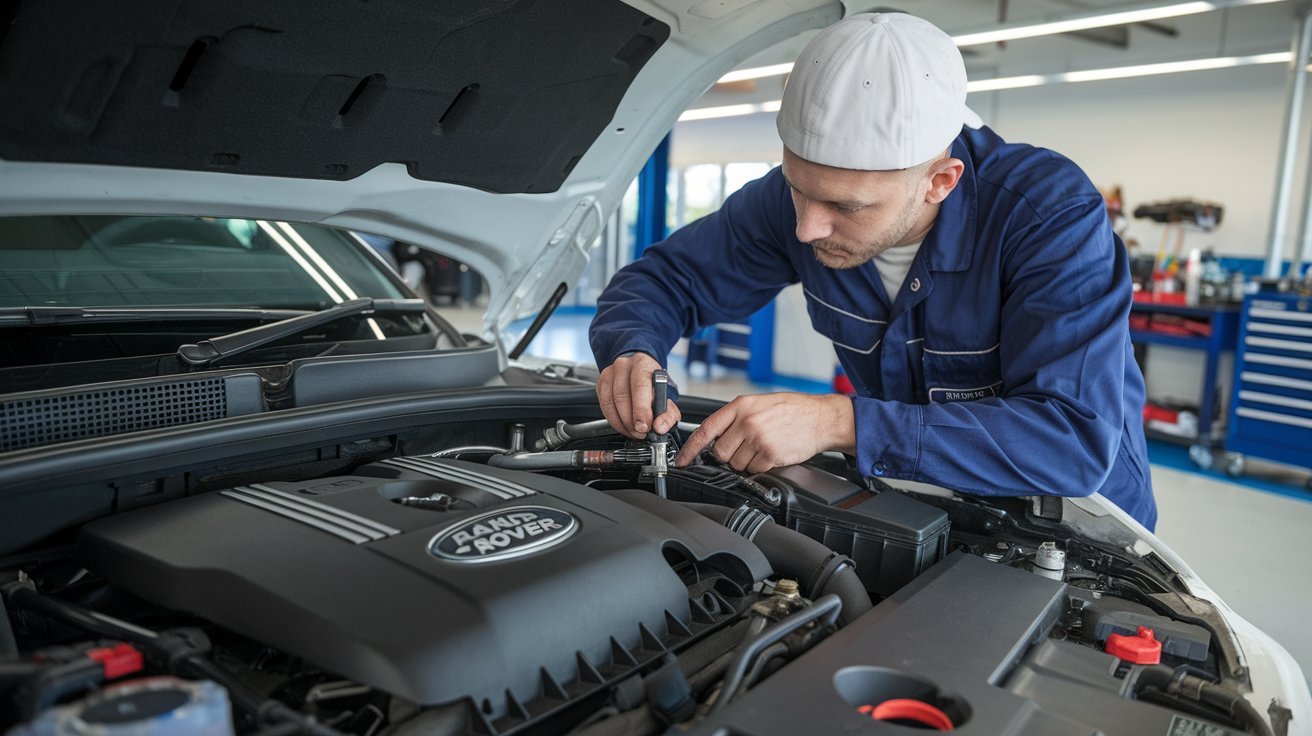
A low-voltage event can look like several failed systems
Slow cranking, repeated start-up warnings, lost communication, screen resets or faults after storage can justify a complete low-voltage assessment. Test battery capacity, terminal condition, grounds, charging behaviour and sleep current where the symptom requires it. If a battery was replaced, verify the correct specification and any required vehicle procedure.
A module that reports a lost message may not be the failed part. The cause can sit with the sending module, power or ground, a shared network route, wiring, connector condition or the physical system generating implausible information. Compare current, pending, historic and communication codes with live data and the owner’s event sequence.
Accessory installation deserves attention. Additional lighting, tracking, cameras, chargers or off-road equipment can alter wiring, power use and sleep behaviour if integrated poorly. The timing of the symptom after installation is evidence, not proof. Inspect the actual work and measure the system before assigning responsibility.
MHEV electrical architecture
12V and 48V evidence should be separated on mild-hybrid Defenders
The L663 range includes conventional petrol and diesel variants, 48V mild-hybrid powertrains and plug-in hybrid configurations. On a mild-hybrid Defender, the normal 12V network and the 48V energy-recovery system have different jobs. A weak 12V foundation can disturb module start-up and communication, while a 48V-related concern can involve the belt-integrated starter generator, energy storage or its control path. The vehicle identity therefore needs to be confirmed before a general battery warning is turned into a parts decision.
Start-up and module stability
Test battery capacity, terminals, grounds, power distribution and sleep behaviour when the complaint involves slow cranking, repeated start-up warnings, screen resets or lost communication. Resting voltage alone does not prove usable capacity.
Energy recovery and engine assistance
Applicable MHEV variants use a 48V battery and belt-integrated starter generator to recover energy and assist the engine. Diagnose this layer from vehicle-specific faults and measured system behaviour rather than assuming that every electrical warning belongs to the 12V battery.
Do not apply one Defender diagram to every L663
Body style, model year and powertrain change the electrical architecture. Defender 90, 110 and 130 applications, PHEV derivatives and newer performance models should be identified by VIN and installed equipment before charging, software or module replacement is approved.
If measured voltage drop, battery drain, power distribution or communication faults remain after the mechanical condition is separated, an auto electrical diagnosis can follow the circuit evidence without treating every stored module code as a failed control unit.
Ride height and terrain response
Separate a mode request from a suspension failure
If the Defender will not raise, sits unevenly, lowers after parking or displays a suspension message, record the selected mode, vehicle load, surface and time parked. Compare corner heights and inspect physical components, air lines, height sensing, compressor control, power supply and network evidence as appropriate.
Off-road use adds context. Mud, sand, water exposure, underbody contact and recovery can affect connectors, cooling paths, sensors, wheels, tyres and protective components. After an impact, do not repeatedly command ride-height changes or continue driving when control, tyre condition or a mechanical noise has changed.
Tyre size, pressure, construction and rolling circumference can affect stability and all-wheel-drive information. If warnings followed tyre replacement, puncture repair, wheel impact or alignment, inspect all four corners before assuming a control module has failed. Mechanical condition must be suitable before calibration or software is treated as the solution.
If the vehicle continues to sit low, raises slowly or shows corner-specific height evidence after tyre, load and electrical causes are separated, a focused air suspension diagnosis can then measure leakage, compressor duty, height sensing and the affected mechanical corner before parts are approved.
Powertrain routes differ
Identify the engine or electrified variant before testing
Engine and cooling
Reduced power, smoke, rough running, coolant loss or a temperature warning needs engine-specific testing. Trace leakage to its source and compare scan, pressure, temperature and mechanical evidence. Do not publish one failure interval for every L663.
Transmission and driveline
A clunk, vibration or hesitation may involve engine output, mounts, tyres, shafts, joints, braking or control inputs as well as transmission hardware. Reproduce it by speed, load, engine speed and direction change before choosing a major assembly.
Electrified systems
Charging concerns can involve the supply, cable, interface, settings, temperature, low-voltage state or high-voltage system. Do not attempt DIY work on orange high-voltage components. Damage, heat, smoke or odour requires qualified assessment.

Cameras and connected features
Inspect the view, mounting and signal path
A blocked camera or dirty sensor is a sensible owner check. A recurring parking, surround-view or driver-assistance warning after cleaning requires more. Note whether it followed windscreen replacement, bumper work, alignment, impact, battery work or software intervention. Inspect mounting, connector and wiring, compare live information and confirm calibration requirements for the fitted system. If the concern begins with damaged glass, a leak or replacement fitment, the Defender windscreen replacement guide explains the glass, sealing and camera checks that belong in that job.
Infotainment concerns should be described by affected functions. A blank display, reboot, audio loss, phone connection issue, missing camera picture and navigation concern do not automatically share one repair. Confirm platform, power, communication, update context and which functions fail together.
Connected features also depend on account, network availability, vehicle configuration and software state. Separate an app or service problem from an in-vehicle electrical fault. Preserve dates, screenshots and whether the in-car function works independently before changing hardware.
Repair scope follows proof
Target the confirmed fault, then complete every required step
A targeted repair fits an isolated failure when surrounding components remain serviceable and the result can be verified. The plan may widen when impact, water entry, contamination, unstable power or previous work affects several connected parts. Widening the plan does not mean replacing everything nearby.
Separate confirmed failure, required supporting items, related damage, monitored wear and optional preventive work. Match parts to VIN and installed configuration. Physical fit may not be enough. Coding, programming, security, calibration, alignment or fluid procedures can be part of completion.
After work, repeat the original start, road, ride-height, terrain, parking, camera or charging condition safely. Confirm scan status, communication, calibration and physical behaviour. A useful handover records the cause, parts or corrections, software context, verification and the observation that should prompt follow-up.
Dubai service planning
Use the official schedule and the vehicle’s actual condition
Land Rover UAE currently states scheduled Defender servicing every 13,000 km or 12 months, whichever comes first. The exact service content still depends on the model year, powertrain, vehicle condition and recorded history. Dubai heat, dust, traffic, short journeys and long storage periods can change what inspection reveals, but they do not justify invented replacement intervals beyond the vehicle-specific requirements.
A baseline assessment for a newly purchased L663 should document tyre specification, battery evidence, fluid condition, cooling performance, scan status, software or calibration records, underbody damage and accessory wiring. If the Defender has been used off road, include water, sand, impact and recovery history. If it has towed, include the fitted equipment and any warning sequence.
Before a long trip, prioritise tyres, brakes, leaks, cooling, battery state, warning history and the equipment that will actually be used. Keep photographs, invoices, measurements and calibration records with the vehicle. A good history helps a later technician distinguish a new concern from an inherited configuration or repair issue.
After recovery, impact or water exposure
Inspect the event path before clearing its warnings
A Defender used beyond paved roads can arrive with more than one affected area. Recovery loading, underbody contact, deep water, sand accumulation or a wheel impact can change mechanical condition and electronic evidence together. Record the exact event, recovery points used, depth or duration of exposure where known, and which warning or behaviour appeared first.
Begin with safety. Inspect tyres, wheels, steering, suspension, brakes, underbody protection, fluid containment and visible high-voltage areas where fitted. Check cooling airflow and connectors in the affected zone. Water exposure may require inspection of breathers, fluids, connectors and interior moisture paths according to the depth and vehicle configuration. Do not repeatedly restart or energise a vehicle when electrical damage, unusual heat, smoke or odour is suspected.
After a tow or recovery, a warning may relate to battery state, wheel-speed information, suspension position, steering angle, driveline load or physical damage. Preserve scan evidence before resets. If a wheel or suspension component was replaced, confirm alignment and any calibration needs only after the physical condition is correct.
Cleanliness is part of inspection, not proof of repair. Removing sand or mud can reveal damaged boots, lines, harness clips, seals and fasteners. The final record should connect the event to findings, repairs and verification so a later warning can be judged against a documented baseline.
Towing and load history should also be documented after an event. Trailer electrics, nose load, cargo position and suspension response can influence what the driver noticed. Inspect the fitted towing equipment, connectors, mounting points and any related warnings rather than assuming the trailer or vehicle alone caused the concern.
Before returning to off-road use, verify the repaired system on-road first, then test selected terrain and height functions in a controlled setting. Check that cameras, parking sensors, low-range or terrain selections, suspension movement and dashboard messages agree with the physical vehicle state. Progressive verification reduces the chance that an unresolved basic fault is hidden by a more demanding test. Record the result for future service decisions.
Questions L663 owners ask
Defender L663 repair FAQs
Why did several warnings appear together?
Systems share power, communication and sensor information. Preserve the first message and test electrical stability, network evidence and the physical symptom before replacing parts.
Can a software update fix my warning?
Only when the exact configuration, symptom and technical evidence support it. Physical faults, wiring, sensors, power supply and calibration still require testing.
Why will my Defender not change ride height?
Load, mode restrictions, air leaks, height sensing, compressor control, power supply or communication may be involved. Record the mode and stance, then test before approving components.
What should I do after an off-road impact?
Stop if steering, braking, tyre condition, fluid loss or mechanical noise changed. Photograph the area and arrange inspection of wheels, tyres, suspension, underbody protection, cooling paths, connectors and related systems.
Why is my camera warning present after windscreen work?
Mounting, wiring, configuration or calibration may have changed. Inspect the installation and confirm the calibration route for the fitted system.
What should I send before booking?
Send model year, engine or electrified variant, warning photos, terrain or height mode, recent battery or software work, accessory history and whether the vehicle remains safe to drive.
Does a mild-hybrid Defender use both 12V and 48V electrical systems?
Applicable MHEV variants use the conventional low-voltage vehicle network alongside a 48V mild-hybrid system. The 12V battery supports module start-up and normal vehicle electronics, while the 48V system supports energy recovery and engine assistance. Diagnosis should identify which layer produced the evidence before a battery, starter-generator or module is approved.
How often should a Defender be serviced in the UAE?
Land Rover UAE currently states scheduled servicing every 13,000 km or 12 months, whichever comes first. The exact work due still depends on the model year, powertrain, vehicle condition and service history.
Book a configuration-aware Defender L663 assessment
Share the exact warning sequence, vehicle configuration, operating conditions and recent work. Diagnosis starts by connecting software, electrical and physical evidence before parts are approved.