

Engine-temperature control in Dubai
Range Rover Thermostat Replacement in Dubai
Overheating, slow warm-up, unstable temperature and weak cabin heating can involve the thermostat, but they can also come from coolant loss, pump circulation, radiator airflow, trapped air or sensor information. We confirm the temperature-control fault before replacing the thermostat or housing.
The thermostat controls a changing flow path
A temperature warning does not identify whether the thermostat is open, closed or uninvolved
The thermostat regulates coolant flow as the engine warms, but its condition must be judged from temperature behaviour across the complete cooling system. A thermostat that does not open as intended can restrict flow toward the radiator and contribute to overheating. A thermostat that remains too open can delay warm-up, reduce cabin-heating performance and keep the engine outside its intended temperature range. A housing, seal or connection can also leak without the thermostat mechanism being the primary fault.
These patterns overlap with low coolant, trapped air, poor pump circulation, radiator restriction, fan problems and inaccurate sensor information. The workshop should therefore compare the owner’s complaint, actual temperature behaviour, coolant condition, module data and physical evidence. Replacing a thermostat because the gauge moved is not a complete diagnosis.
This page owns thermostat and thermostat-housing intent. Broad coolant leak tracing belongs on the coolant-leak page. Pump leakage and circulation belong on the water-pump page.
Two opposite failure patterns
Stuck-open symptoms compared with stuck-closed symptoms
Thermostat not closing as intended
The engine may take longer to warm, the displayed temperature can remain lower than expected and cabin heat may be weak or delayed. Fuel use and engine behaviour can also be influenced when the engine does not reach its intended operating range.
- Slow warm-up from a cold start
- Temperature drops during steady road speed
- Cabin heat is weaker than expected
- Module data shows a persistent low-temperature pattern
These signs still require comparison with ambient conditions, sensor accuracy and the exact vehicle strategy.
Thermostat not opening as intended
The engine temperature may rise rapidly, especially as load increases. The radiator side of the circuit may remain cooler than expected while the engine side becomes hot. Coolant loss, trapped air and pump circulation can create a similar difference.
- Temperature climbs quickly after warm-up begins
- Overheating appears under load or extended driving
- Heater output changes as coolant flow becomes unstable
- Temperature distribution does not match normal circulation
The cooling system should be checked before a stuck-closed conclusion is made.
Read the complete warm-up sequence
Four checkpoints reveal how temperature control is behaving
A thermostat is judged by how the system changes from cold start to stable operation. One reading after the warning appears can miss the earlier evidence.
Baseline temperature
The starting temperature, coolant level, ambient condition and stored fault information establish the baseline before the engine warms.
Rate of temperature rise
The engine should warm in a controlled pattern. A rise that is too slow or too fast must be compared with coolant flow, cabin heat and sensor data.
Thermostat opening behaviour
Temperature distribution across the circuit changes as flow toward the radiator increases. The expected pattern depends on the exact engine and control system.
Control under load
The temperature should remain controlled as fan demand, road speed, air conditioning and engine load change. Instability can point beyond the thermostat.
One complaint can contain several clues
Temperature-control signals that help separate the fault
Gauge or warning pattern
Record whether the display rises steadily, jumps suddenly, falls at road speed or changes only in traffic. The pattern should be compared with actual sensor data rather than used alone.
Cabin-heating pattern
Cabin heat depends on coolant temperature and flow. Weak, delayed or fluctuating heat can support a circulation or thermostat concern, but low coolant and trapped air can produce the same complaint.
Hose and radiator temperature pattern
The relationship between engine-side and radiator-side temperatures can show when heat is moving through the circuit. The test must be performed safely and interpreted for the exact system.
Evidence before thermostat replacement
How the workshop confirms a temperature-control fault
The thermostat is judged from the complete warm-up and stabilisation pattern. The checks below compare what the vehicle reports with what the coolant circuit is physically doing, so a sensor, pump, radiator or trapped-air problem is not mistaken for thermostat failure.
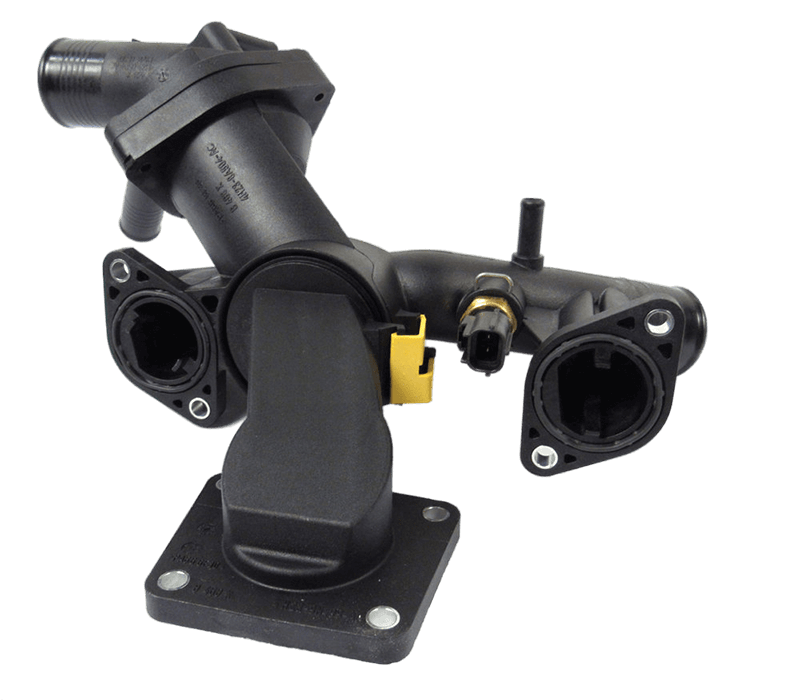
Establish a true cold-start baseline
Ambient condition, cold coolant level, stored fault information, starting temperature and whether the vehicle has recently been driven or topped up.
The warm-up test begins from a valid baseline rather than from a partly warm or air-locked cooling system.
Inspect coolant level, housing and leak evidence
Coolant loss, residue, housing condition, attached pipes, electrical connections and signs that previous work introduced trapped air or an incorrect part.
An external housing or sealing fault is separated from an internal thermostat-control problem.
Track the rate of temperature rise
Live temperature information, cabin-heating response and the time pattern from cold start as the engine warms.
A repeatable slow-warm-up or rapid-temperature-rise pattern exists and is not based only on one gauge reading.
Identify the coolant-flow transition
The relationship between engine-side and radiator-side temperature, coolant circulation and the point at which heat begins moving through the radiator circuit.
The thermostat opens, remains too open or continues restricting flow in a way that matches the complaint.
Separate shared cooling-system causes
Water-pump circulation, radiator heat rejection, fan operation, sensor plausibility, trapped air and any pressure behaviour that does not match a simple thermostat fault.
The thermostat conclusion remains valid after other cooling layers that produce the same symptoms are considered.
Repeat the complete temperature sequence after repair
Cold-start warm-up, flow transition, stable operating temperature, leak status, cabin heat and the original traffic or load condition.
The repaired system warms and stabilises normally without the original warning or low-temperature pattern returning.
The thermostat may be part of a larger assembly
Thermostat, housing, seal and control faults need separate decisions
Thermostat mechanism
Replacement is supported when the opening or closing behaviour is inconsistent with the expected temperature pattern and other cooling layers do not explain the result.
Housing or seal leak
Coolant residue around the thermostat area can come from a housing, gasket, connector or nearby hose. The exact source and sealing surface should be confirmed before parts are selected.
Electrical or control relationship
Some systems use electrical control or module input as part of temperature management. Wiring, connectors, sensor information and stored faults may need to be checked before the assembly is condemned.
Choose the repair that matches the evidence
Thermostat replacement decision matrix
The repair route should follow a repeatable temperature or leak pattern. Each route below shows the evidence that supports thermostat work and the checks that must be completed before replacement is approved.
Slow warm-up and low-temperature pattern
This route applies when the engine warms too slowly, cabin heat remains weak or the temperature falls during steady driving. The complete cold-start sequence should be observed rather than relying on one low reading.
Rapid temperature rise or restricted-flow pattern
This route applies when engine temperature climbs quickly and heat does not move through the radiator circuit as expected. The pattern should be reproduced safely under the condition that created the complaint.
Housing, seal or connection leak
This route applies when fresh coolant is traced to the thermostat housing, seal or an attached connection. A visible wet area nearby is not enough because coolant can travel before it drips.
Replacement rule
Approve the thermostat or housing only when the observed temperature or leak pattern remains tied to that assembly after shared cooling-system causes have been checked.
A correct replacement restores the complete circuit
What the thermostat replacement process should cover
Confirm the vehicle-specific assembly
The VIN and engine establish the correct thermostat, housing, seals, connectors and access route. Similar-looking parts should not be selected by model name alone.
Prepare the cooling system
The vehicle must be cool and the coolant handled safely. Existing coolant condition and contamination are documented before the system is opened.
Remove and inspect the failed area
The thermostat or housing is removed, then connections, sealing surfaces and surrounding components are inspected. Damage that changes the repair scope is explained before assembly.
Install and restore connections
The correct assembly and required sealing components are installed using the procedure suitable for the vehicle. Wiring and hoses are restored without strain or incorrect routing.
Fill and remove trapped air
The cooling circuit is refilled using the coolant and air-removal process appropriate for the exact system. This step matters because trapped air can imitate a continuing thermostat problem.
Verify warm-up and control
The engine is observed from cold start through stabilisation. Leak evidence, module data, cabin heat, fan response and the original complaint are checked after repair.
Avoid replacing the thermostat for every temperature complaint
Thermostat faults commonly confused with other cooling problems
Low coolant or trapped air
Both can create unstable temperature and weak cabin heat. The system must contain the correct coolant volume before thermostat behaviour can be interpreted.
Water-pump circulation
A weak or damaged pump can limit coolant movement and imitate a thermostat that is not opening. Pump leakage and mechanical condition require their own evidence.
Radiator or airflow restriction
The thermostat may open correctly while the radiator cannot reject heat. Fan operation and heat-exchanger airflow matter especially when the concern appears in traffic.
Temperature-sensor information
An implausible sensor signal or communication problem can alter the displayed warning and module strategy. Actual cooling behaviour should be compared with the reported data.
Engine-side pressure concern
Rapid pressure build-up, repeated coolant displacement or unexplained loss may require checks beyond the thermostat. A new thermostat cannot correct an internal pressure source.
Recent repair or incorrect filling
A concern that begins after cooling-system work may involve trapped air, a disturbed connection, wrong part or incomplete final test. The repair sequence should be reviewed first.
Temperature strategy changes across the range
Range Rover thermostat systems vary by engine and generation
Range Rover, Range Rover Sport, Evoque, Velar and Land Rover models use different thermostat locations, housings, coolant paths, electrical controls and access methods. Petrol, diesel and electrified applications can follow different warm-up strategies. The expected temperature pattern and the correct replacement assembly therefore depend on the VIN and engine.
Some assemblies integrate the thermostat with a housing, sensor, pipework or electrical connection. Others require access through surrounding components. Previous overheating, coolant contamination, sealant use or incorrect repairs can affect the condition found during removal. These details should be included in the diagnosis and quotation rather than hidden inside a generic thermostat price.
Full-size Range Rover and L322
Engine generation determines thermostat location, housing design and the temperature pattern used for diagnosis. Older repairs and coolant condition can influence the result.
Range Rover Sport and Discovery
Load, towing history, fan response and layered cooling systems may need to be considered when overheating appears only under particular driving conditions.
Evoque and Velar
Compact packaging and integrated assemblies can make housing leaks and connector concerns less obvious. The source should be traced before replacement.
A quote should explain the control fault
What affects Range Rover thermostat replacement cost
The scope depends on the model, engine, thermostat design, housing arrangement, access, leakage, connector condition, coolant loss and the components that must be removed to reach the assembly. The cost can also change when overheating has affected surrounding parts or when previous repairs must be corrected.
A useful quotation should identify whether the diagnosis supports a stuck-open pattern, stuck-closed pattern, housing leak or electrical-control concern. It should name the exact assembly, required seals, coolant and filling process, then explain the final warm-up test. Fixed prices or completion times should not be copied from another engine without inspecting the vehicle.
- VIN, model year and engine
- Warm-up and operating-temperature evidence
- Housing, seal and connector condition
- Coolant level and contamination findings
- Access and removed-component requirements
- Coolant fill and air-removal process
- Cold-start and operating verification after repair
Dubai conditions can reveal different thermostat patterns
High ambient heat makes control loss more obvious, but it does not prove the thermostat
High outside temperature reduces the cooling margin when coolant flow is restricted. Slow traffic and extended air-conditioning use can add load while natural airflow is limited. A stuck-open concern may be less obvious in hot weather because cabin heating demand is low, while a stuck-closed or restricted-flow concern can become more severe as load rises.
Tell the workshop whether the vehicle warms slowly from a cold start, overheats only in traffic, rises under acceleration, cools at road speed or changes after the air conditioning is switched on. Also report recent coolant work and any need to top up the expansion tank. This sequence helps distinguish thermostat control from pump, fan, radiator and leak-related causes.
Thermostat questions
Frequently asked questions
What happens when a Range Rover thermostat is stuck open?
The engine can warm more slowly, run cooler than intended and provide weaker cabin heat. The pattern should be confirmed from cold start and compared with sensor accuracy and ambient conditions.
What happens when the thermostat is stuck closed?
Coolant flow toward the radiator can be restricted and engine temperature can rise quickly. Low coolant, trapped air, pump circulation and radiator problems can create similar symptoms, so testing is required.
Can a thermostat housing leak without the thermostat failing?
Yes. A housing, seal or nearby connection can leak while the thermostat mechanism still controls flow. The exact origin and assembly design determine the repair scope.
Can I drive with a suspected thermostat fault?
Stop driving if a red temperature warning appears, steam is visible, coolant is escaping or the engine runs poorly while hot. A slow-warm-up concern should also be inspected because it can affect temperature control and efficiency.
Why does a new thermostat sometimes fail to solve overheating?
The original cause may be coolant loss, trapped air, weak pump circulation, radiator restriction, fan operation, sensor information or an engine-side concern. The complete cooling circuit must be verified.
How is the correct thermostat selected?
Use the VIN, engine and fitted cooling arrangement. Thermostat temperature strategy, housing, electrical control, connections and access can vary across model generations.
What information should I send before booking?
Send the model, year, VIN when available, warning photo, cold-start warm-up pattern, cabin-heating behaviour, coolant-loss history and details of recent cooling-system work.
Book thermostat diagnosis in Dubai
Confirm the warm-up and flow-control fault before replacing the thermostat
Send the model, year, warning photo, coolant-loss history and a description of how the temperature changes from cold start to normal driving. We will advise what needs to be tested before the repair decision.