
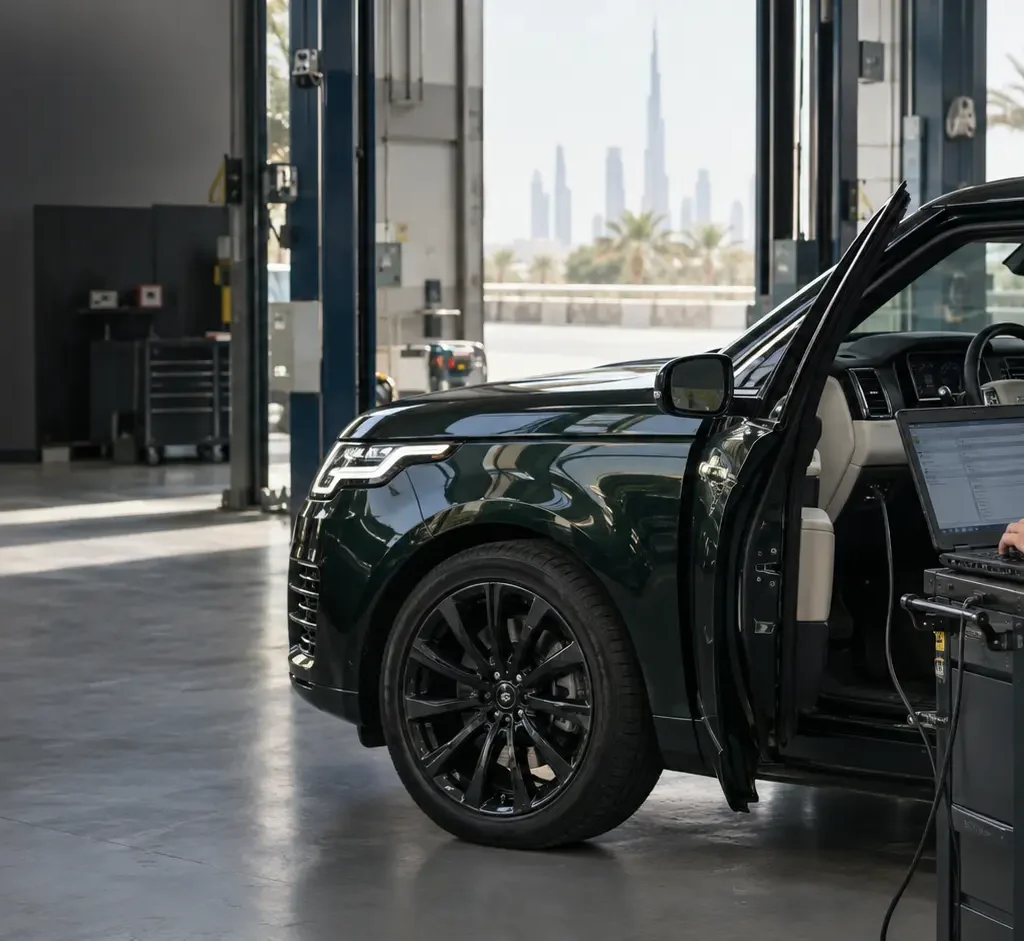
A Range Rover that jerks when accelerating may have uneven engine output, a gear-change problem, driveline movement, or a vibration linked to road speed. The timing of the jerk matters more than a list of possible replacement parts. First check for urgent warning signs. Then record whether it happens at idle, during a shift, under engine load, or at a particular speed so the workshop can choose the right tests.
When jerking means stop driving and arrange recovery
Stop safely, switch off when safe, and arrange recovery if the jerking comes with a flashing engine light, severe shaking or misfire, loss of drive, repeated stalling, a strong fuel smell, overheating, or a red oil-pressure warning. Do not keep accelerating to see whether it clears or attempt an overtaking maneuver to test the power.
If you suspect a fuel leak, do not restart the engine. Keep people away from the vehicle and ignition sources. If there is smoke, fire, or immediate danger, move to safety and seek emergency assistance.
A flashing engine light while the engine runs can indicate a severe misfire with a risk of catalytic converter damage. The EPA's on-board diagnostics guidance explains that risk. Jerking combined with the warning warrants stopping and recovery rather than continuing an ordinary journey.
A steady warning or the absence of a light does not establish that driving is safe. If power delivery is unpredictable, the vehicle cannot maintain safe progress, or the vibration affects control, arrange recovery. Follow the exact dashboard message and the Land Rover handbook selected by VIN or model year. There is no universal safe distance for driving with this symptom.
Match the jerk to idle, gear change, load, or road speed
Describe the event before naming a component. Several faults can feel similar from the driver's seat, and a single fault can appear in more than one condition. This comparison helps organize the first inspection; it does not diagnose the vehicle remotely.
| When it happens | What needs separating | Useful workshop checks |
|---|---|---|
| Roughness while stationary at idle | Uneven combustion versus vibration transmitted through mounts | Engine running data, cylinder contribution or misfire information where available, air/fuel checks, and mount inspection. |
| A thump during one gear change or Drive/Reverse engagement | Transmission control or hydraulic behavior versus abnormal engine torque and driveline movement | Commanded gear, relevant shaft speeds, fluid level by the correct procedure, engine data, mounts, and connected driveline. |
| Stumbling under load or on a climb | Ignition, fuel delivery, airflow, boost, or exhaust restriction where applicable | Record the event against misfire data, requested and measured fuel pressure, airflow, boost, and fault context. |
| Vibration around a particular road speed | Wheel/tire or driveline vibration versus engine or converter-related shudder | Wheel condition and fitment, shafts and joints, engine behavior, and converter data on equipped transmissions. |
| A single knock as power is applied or released | Mount movement, joint wear, or driveline clearance versus a combustion interruption | Safe physical inspection and a controlled comparison with torque application, only when the vehicle is fit for testing. |
Road speed, engine speed, and gear are different clues. A workshop can compare their relationships during an appropriate controlled test. Owners should not coast in Neutral, disable stability control, or repeatedly provoke the fault to separate them.
Rough idle points the investigation toward engine running
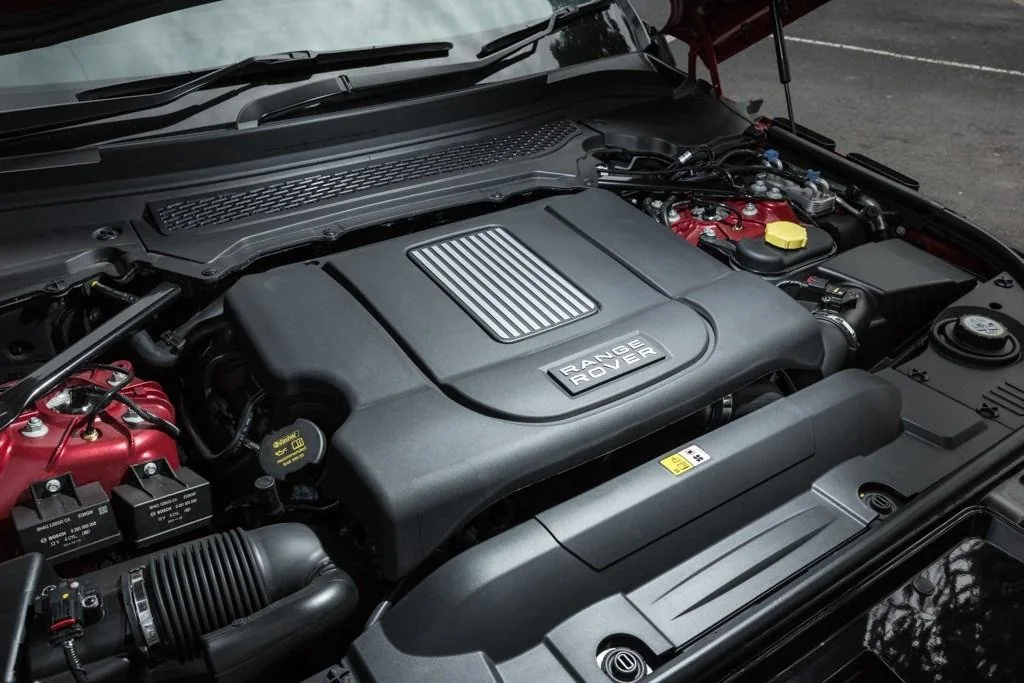
If the vehicle shakes while stationary, rotating wheels cannot explain that particular event. Uneven combustion, an unstable idle, accessory load, or mounts transmitting normal engine movement may be relevant. That does not rule out an additional problem when the vehicle moves.
Gasoline engines need ignition and combustion checks
Misfire data can help identify a cylinder or operating condition. A cylinder-specific code does not prove an ignition coil has failed. Spark plug condition, wiring, fuel delivery, air leaks, and mechanical condition can require testing. A workshop should explain which finding connects the proposed repair to the rough running.
HELLA's ignition-coil diagnostic guidance includes electrical supply, connections, and operating data, and notes that mechanical faults can affect ignition-test results. Its example values are not specifications for every Range Rover. Do not replace all coils simply because the engine hesitates.
Diesel engines require a different route
Diesels do not use spark plugs and ignition coils to ignite the mixture. Fuel-pressure control, injector behavior, air management, and cylinder condition may instead guide the investigation. The exact engine matters. A glow-system concern during starting is not a universal explanation for jerking under acceleration when warm.
If engine operation is even but vibration reaches the cabin, mounts and attached components need inspection. A damaged mount can amplify movement without being the cause of a recorded misfire. Replacing it may address vibration while leaving an engine fault unresolved.
A jerk during a gear change does not prove gearbox failure
Note whether the event occurs when selecting Drive or Reverse, on a particular upshift, or while slowing down. Also record cold versus fully warm operation. A delayed engagement followed by a bang differs from an engine stumble that happens while the transmission is holding a gear.
The workshop should compare the felt event with transmission commands and relevant speed data. It should also review engine output and the mounts, shafts, and joints that transmit torque. Abnormal engine running can affect how a shift feels, while excessive driveline movement can create a knock without proving an internal transmission fault.
Fluid level must be checked using the procedure for the installed transmission, including the required temperature conditions and fluid specification. ZF's transmission-fluid guidance explains why level and condition require proper assessment. Do not top up with a universal fluid or copy a quantity from another model.
A fluid service can be justified by maintenance needs or findings, but it is not a guaranteed cure for harsh shifts or worn internal parts. Likewise, an adaptation reset or software update should have an applicable procedure and a clear reason. A temporary change in feel after a reset is not proof that the underlying fault was repaired.
On vehicles with a ZF 8HP transmission, distinguish harsh shifts, delayed engagement and torque-converter lock-up symptoms. Not every Range Rover, Sport, Evoque, or Velar uses the same gearbox.
Hesitation under load needs data from the event
A vehicle may idle smoothly but stumble when more torque is requested. The diagnostic plan should match that condition rather than rely only on a scan at idle. Testing under load belongs with the workshop after safety checks, not with the owner repeatedly accelerating on a public road.
Separate fuel supply from ignition and airflow
On a gasoline engine, ignition performance can become inadequate under load. Fuel delivery or mixture problems can produce a similar interruption. On either fuel type, the technician may compare requested and measured pressure and other relevant data using the correct system procedure. A pressure discrepancy alone still needs its cause traced.
Inspect disturbed intake connections, damaged hoses, and filter condition where relevant. On a turbocharged engine, a boost leak or control problem may be investigated. A naturally aspirated or differently charged engine needs a different test path. An airflow fault should not automatically become an order for a mass airflow sensor.
Check restrictions only when findings support them
An exhaust restriction can contribute to poor performance, but low power does not prove a blocked catalytic converter or diesel particulate filter. Test selection depends on the engine, fitted after-treatment, warnings, and measured behavior. Cleaning, replacement, or regeneration should not be prescribed from the word “jerking.”
If the symptom started after refueling, record the station, fuel type, receipt, and timing. That history can justify checking fuel quality or supply, but it does not establish contamination. If the wrong fuel may have been added, do not start or continue driving the vehicle.
Road-speed vibration needs wheels and driveline considered
A repeated shake at a particular speed can feel like jerky acceleration even when combustion is steady. The workshop may need to inspect tire damage, wheel condition, balance, fitment, shafts, joints, and connected driveline components. Recent wheel work or an impact is useful history.
On some automatic transmissions, converter lock-up behavior can produce shudder during light load. It needs comparison with engine running and transmission data. Feeling a vibration through the seat does not, by itself, identify a torque converter, transfer case, or propshaft as the failed part.
Note whether the steering wheel, seat, or whole body shakes and whether turning changes it, without deliberately repeating an unsafe maneuver. Severe vibration, a damaged tire, loose-wheel concerns, or altered steering control require stopping and assessment. Never work beneath a vehicle supported only by its air suspension or a jack.
What throttle and airflow sensors actually do
A throttle-position sensor reports throttle-valve position to the control system. It does not itself move the throttle or directly regulate incoming air. On an electronic throttle system, an actuator moves the valve and the position feedback helps the controller monitor it. The accelerator-pedal position sensor is a separate input representing the driver's request.
HELLA explains the distinction in its guides to throttle-position measurement and accelerator-pedal sensors. Sensor design and serviceability differ, so a throttle-related fault does not always mean there is a separately replaceable sensor.
The mass airflow sensor measures incoming air on systems that use it. Oxygen sensors provide exhaust oxygen information; their roles depend on position and system design. An unusual reading may reflect a real airflow, combustion, or exhaust problem rather than a defective sensor.
Diagnosis should check signal plausibility, power supply, grounds, wiring, connectors, and relevant leaks or mechanical conditions. Compare requested and actual operation where the system supports it. Do not spray cleaner into a sensor or force an electronic throttle plate open as a general home remedy.
What to record before the diagnostic appointment
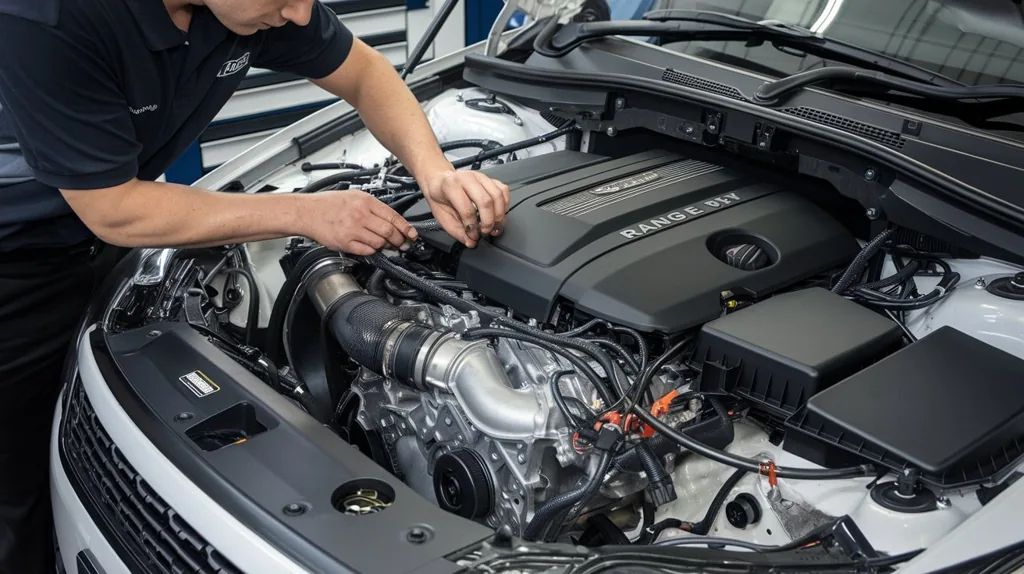
Give the workshop a short sequence rather than a guessed diagnosis. “It idles smoothly but hesitates during a warm uphill acceleration” is more useful than “it needs a sensor.” Do not collect information while driving or recreate a severe fault for a video.
- Vehicle: model, year, VIN, fuel type, engine if known, mileage, and modifications.
- Event: idle, moving away, exact shift if known, steady-speed vibration, or hesitation under load.
- Conditions: cold start, fully warm, after traffic, after refueling, or immediately after repair.
- Warnings: exact wording, whether a light flashed or stayed on, and the order in which messages appeared.
- History: recent ignition, intake, battery, software, transmission, or wheel work, including what changed afterward.
Save any existing scan report. Do not clear codes or disconnect the battery solely to remove a warning before inspection. A restart that improves the symptom does not prove a repair or make further driving safe.
For a plug-in hybrid, note whether the event coincides with the gasoline engine starting or a change in operating mode. Record it without assuming that every noticeable transition is normal. High-voltage checks require qualified personnel; do not touch orange cables or attempt isolation yourself.
Approve a repair that explains the symptom
Ask what was confirmed, which test supports it, and how the result will be checked. A useful recommendation connects the original event to measured or observed findings. An unrelated stored code or worn item may deserve separate attention without explaining the acceleration complaint.
- Targeted repair: a confirmed connector, hose, ignition, fuel-control, or mount fault may need a limited repair.
- Component replacement: choose the correct application only after the failed function is established.
- Rebuild or major replacement: engine or gearbox work needs evidence of internal damage and a scope explaining associated work.
- Further diagnosis: when the fault is intermittent, agree on the next test and its purpose instead of replacing several guesses.
The estimate should separate diagnosis, parts, labor, fluids, programming or relearning where applicable, VAT, and exclusions. There is no meaningful single repair price for “jerking” before the cause is known. A diagnostic inspection at our Al Quoz 4 workshop can establish the fault and the work to include in the estimate.
After repair, verification should revisit the original conditions safely and check relevant data and returning warnings. If the fault could not be reproduced, the handover should say so and explain the follow-up plan. A clear scan alone does not establish that a mechanical vibration has disappeared.
Maintenance should follow the vehicle and its use
Use the applicable service schedule and specifications for the exact vehicle. Oil, filters, spark plugs on gasoline engines, and transmission maintenance have different requirements. A blanket six-month service rule does not diagnose or prevent every acceleration fault.
Report changes early, retain service records, and investigate leaks or recurring warnings. Dust exposure, towing, short trips, and operating conditions may affect the applicable maintenance plan. They do not justify routine sensor replacement, injector cleaning, or a universal transmission flush. An active fault needs diagnosis even if a routine service is due.
Range Rover Jerking When Accelerating FAQs
Can it be a misfire if the engine light is off?
Yes, uneven combustion can require investigation without an illuminated light. Mechanical and driveline faults may also produce no warning. A clear dashboard does not identify the cause or establish safe driving.
Will replacing the MAF or oxygen sensor stop the jerking?
Only if testing confirms that the sensor fault causes the complaint. Wiring, leaks, mixture problems, or another component can affect the reading. Replacing a sensor from symptoms or a code alone can leave the real fault unresolved.
Does smooth idling rule out an engine problem?
No. Some faults appear only under load, at a particular temperature, or during a change in torque demand. The test needs to match the reported condition when it is safe to do so.
Is one hard gear change a reason to replace the transmission?
No. It requires investigation of the exact shift, engine output, fluid procedure, controls, mounts, and driveline. Major replacement needs supporting findings, not shift feel alone.
Should I reset adaptations or disconnect the battery first?
No. Preserve fault information before resets. Adaptation clearing, relearning, or programming should follow an applicable diagnostic or repair procedure rather than serve as a general cure.
What if the jerk started after a service?
Tell the workshop exactly what was done and when the symptom began. Disturbed connections, incorrect parts or fluid procedures, and unrelated faults all need consideration. Timing alone does not establish responsibility.
Can I drive a short distance with a flashing engine light?
If the vehicle is jerking and the engine light flashes, stop safely and arrange recovery. Do not use a short distance as reassurance. Severe misfire can damage the exhaust after-treatment and make power delivery unreliable.
Identify the event before choosing the repair
First act on the stop-driving signs. Then separate rough idle, a shift-related thump, hesitation under load, and road-speed vibration. Preserve warnings and recent history so the workshop can test the right system. The best next step is a diagnosis that explains your particular event and a repair verified under the same safe conditions.
Workshop support
Need help with your Range Rover?
Tell us your model, year and what you have noticed. Speak with the workshop about maintenance, an inspection or a repair.