
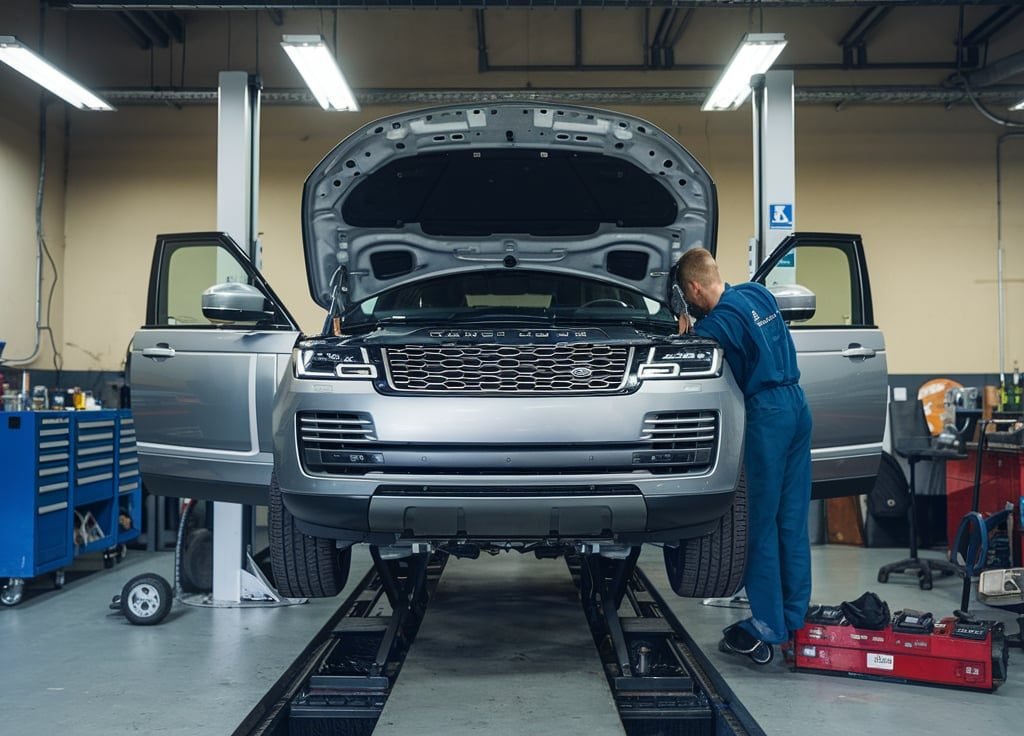
A Range Rover minor service usually centers on the scheduled engine oil and filter change, an agreed condition inspection, and a service-record update. The exact work depends on the VIN, engine, model year, market specification, maintenance schedule, and previous invoices. A package called “minor service” does not automatically include every filter, fluid replacement, wheel alignment, or fault diagnosis.
Use the inclusion checklist below to compare the written scope with what your vehicle actually needs. The useful distinction is between a component being inspected, a scheduled item being replaced, and an additional repair that needs your approval.
When a minor service is due in the UAE
Range Rover UAE servicing guidance currently states every 13,000 km or 12 months, whichever comes first. Confirm how that guidance applies to your exact vehicle, especially an older model or an import with a different market service record. Follow the applicable schedule and any earlier service requirement shown by the vehicle.
On vehicles with Flexible Service, the service indicator considers driving conditions and use. Do not replace its instructions with a blanket six-month rule or a generic distance range. Equally, do not assume that low mileage cancels a time-based requirement. If the dashboard and paperwork disagree, have the VIN-specific schedule and last completed service checked before deciding to wait.
Dust, short trips, extended idling, and frequent off-road use are useful information for the workshop. They can justify closer attention to particular items or application-specific arduous-use requirements. They do not establish one shorter oil interval for every Range Rover in Dubai. Use the maintenance schedule for your model and engine to establish what is due.
One inclusion checklist for the quotation
This is a scope checklist, not a promise that every workshop package contains every row. Ask the service adviser to identify what is included, what is due under your schedule, and what would be charged separately.
| Item | What to confirm | What inspection alone does not include |
|---|---|---|
| Engine oil and oil filter | Replacement when due, with the required oil approval, viscosity, quantity, filter, and applicable seals or drain-plug parts. | Repair of oil leaks, investigation of oil consumption, or an engine flush. |
| Other filters | Air, cabin, and applicable fuel-filter requirements checked against the schedule and condition. | Automatic replacement of all filters at every minor visit. |
| Tires and wheels | Pressure against the vehicle label and load, tread, visible damage, and unusual wear. | Alignment, balancing, puncture repair, or rotation unless agreed and suitable for the tire configuration. |
| Brakes and applicable clutch hydraulics | Accessible pad/disc condition, reported symptoms, leaks, and fluid requirements. Clutch checks apply only where that system is fitted. | Brake-fluid replacement, dismantling, bleeding, or renewal of pads and discs unless specifically included. |
| Lights, glass, mirrors, washers, and wipers | Visible condition and an agreed functional check. | Replacement bulbs, glass repair, camera calibration, or repair of a failed mechanism. |
| 12-volt battery and connections | Visible condition and whether an appropriate battery test is included. | Proof of the cause of overnight discharge, a full charging diagnosis, or high-voltage battery assessment. |
| Exhaust and accessible underbody | Visible damage, loose supports, and signs of leakage within the agreed inspection access. | Confirmation of catalyst efficiency, emissions compliance, or hidden internal condition. |
| Steering and suspension | Accessible joints, boots, leaks, tires, and reported steering or ride concerns. | Wheel alignment or complete diagnosis of intermittent suspension or steering faults. |
| Coolant and other applicable fluids | Level and visible leaks using the correct procedure. Hydraulic power-steering fluid applies only to a hydraulic system. | A universal fluid flush, a cooling-system pressure test, or a power-steering reservoir on electrically assisted steering. |
| Accessible auxiliary belts and hoses | Visible condition where inspection is possible under the agreed scope. | Certification of a concealed timing belt or chain, or replacement based on appearance alone. |
| Report and service record | Completed work, inspection findings, deferred items, and the next requirement recorded. | A guarantee against future failures or proof that clearing a warning has repaired its cause. |
The correct oil specification is mandatory
Oil is not a choice between a basic product and an optional “better synthetic” upgrade if the basic product fails the engine's requirements. The oil used must meet the specification and approval required for the exact engine and application, as well as the specified viscosity. A familiar brand, a premium label, or the same viscosity on the bottle is not enough by itself.
Ask for the full product identity and required specification on the invoice. Different petrol and diesel engines, emissions systems, and model years may require different oils. Do not copy a specification from another owner's vehicle because both have the same badge or displacement. Land Rover's VIN-based owner information is the starting point for identifying the applicable handbook.
The oil level must also be checked using the vehicle's specified method. An electronic measurement may require particular temperature and waiting conditions. More oil is not additional protection, and an oil-change visit should not be used to conceal an unresolved low-pressure warning, major leak, or rising oil level. Report those concerns before the job begins so they can be assessed separately.
Equipment changes the work
A checklist copied from another generation can add services your vehicle cannot need. Electrically assisted steering has no conventional hydraulic power-steering fluid reservoir to top up. A clutch-fluid inspection belongs only to a vehicle with the applicable clutch hydraulic system, not to every automatic Range Rover. The workshop should identify fitted equipment rather than charge for a generic line.
The same principle applies to hybrid vehicles. A plug-in hybrid still has combustion-engine maintenance, even when many trips use electric drive. Its high-voltage equipment and cooling arrangements require the appropriate trained personnel and procedures. A routine 12-volt battery test does not establish traction-battery health.
Tire rotation is also conditional. Different front and rear sizes, directional designs, and manufacturer instructions can limit the permitted pattern. A package should not promise rotation before identifying the actual tires and wheels. Uneven wear deserves an explanation; moving the tires does not correct worn suspension parts or an alignment fault.

What an inspection can establish
A service inspection is a record of what could be checked at that visit. It can identify a worn wiper, visible leak, damaged boot, or measured brake wear. It cannot guarantee that an inaccessible component is sound or that an intermittent problem will not return. The report should state any access limits, measurements, and concerns that need further testing.
Describe symptoms even if the dashboard is clear. A cold-start noise, vibration at a particular speed, recurring coolant loss, or warning that disappeared yesterday can change the investigation. A routine scan, if included, may reveal useful information, but a code does not identify a failed part by itself. Preserve relevant faults and conditions before clearing anything.
A red oil-pressure warning, overheating, significant fuel leakage, seriously reduced braking, or sudden loss of steering assistance needs an immediate safety assessment. Stop safely and arrange appropriate assistance when the vehicle cannot be driven safely. A future service booking is not permission to continue driving with those symptoms.
Minor service, major service, and extra work
“Minor” and “major” are booking descriptions. The schedule decides when an air filter, spark plugs, brake fluid, or another scheduled item is due. A minor visit may coincide with a time-based replacement, while a vehicle with recently completed major work may not need those parts again.
For a broader quotation, compare what a major service includes with the items already listed. Ask what has changed in the scope rather than relying on the package name. Transmission, transfer-case, and differential work must match the fitted unit and its requirements. A visible belt inspection does not replace an engine-specific timing-drive schedule.
Do not automatically approve flushes, additives, preventive coding, or a battery replacement because they appear on a standard upsell list. Ask what requirement or finding supports each item. Conversely, a confirmed unsafe defect should not be deferred simply to keep the invoice within the minor-service package.
How to compare the price fairly
A meaningful quotation identifies the vehicle, oil product and quantity, filters, labor, inspection scope, consumables, and any separately charged diagnosis. It should distinguish checks already included in the service from extra work. “Brake inspection” and “brake-fluid replacement” are different jobs and should not be compared as if they were interchangeable.
Ask for the total payable in AED, whether VAT is included, and a clear breakdown where tax is shown separately. Confirm whether a diagnostic charge, collection, replacement transport, or additional parts are included before comparing offers. There is no verified item-by-item tariff or universal package price in this guide.
Completion time also depends on parts availability, findings, and the agreed work. An oil service with a clear inspection result is a different booking from the same visit followed by leak diagnosis. Ask when the initial report will be ready and agree to extra work before the workshop proceeds.
What to keep after the visit
Keep an itemized invoice and the condition report, including the oil specification, parts supplied, measurements, and recommendations. Ask which maintenance requirement is next and whether any deferred repair has a safety or time limit. A reset service display is useful administration, but it is not a substitute for that record.
If records are missing, separate work known to be due from items whose history is uncertain. Inspection can establish some conditions; it cannot reconstruct a past fluid change or prove when a hidden belt was replaced. Building a documented baseline is more useful than assuming everything was done or replacing everything without justification.
Minor-service questions
Can I use a cheaper oil with the same viscosity?
Only if it also meets the required specification and approval for your engine. Viscosity alone does not establish suitability. Ask the workshop to identify the exact product before it is used.
Does topping up brake fluid solve a low-level warning?
No. The cause needs assessment, including possible wear or leakage. A warning, soft pedal, or reduced braking should be reported immediately; topping up must not replace diagnosis.
Should a filter be replaced just because it looks dusty?
The decision should follow its application, scheduled requirement, inspection criteria, and condition. An unsupported claim that every filter needs replacement at every visit is not enough.
Do I need a service if I hardly drive?
Time-based requirements can still apply. Check the applicable schedule and service message rather than relying only on distance traveled.
Will a minor service fix a warning light?
Only if the completed work addresses the confirmed cause. Fault diagnosis, repair, and verification may be separate from routine maintenance. Clearing the warning alone is not a repair.
Does independent servicing automatically preserve warranty coverage?
Do not rely on a blanket promise. Check your actual warranty or service-plan terms, documentation requirements, and applicable maintenance instructions before authorizing work.
Technical references: Land Rover servicing and Flexible Service; UAE servicing guidance; VIN-specific owner information. Vehicle-specific instructions determine the final service scope.
Arrange the right service scope
Share your model, model year, engine, mileage, service message, and recent invoices with our Al Quoz 4, Dubai workshop. Ask for scheduled items, included checks, and any proposed extras to be separated on the estimate.
Workshop support
Need help with your Range Rover?
Tell us your model, year and what you have noticed. Speak with the workshop about maintenance, an inspection or a repair.