
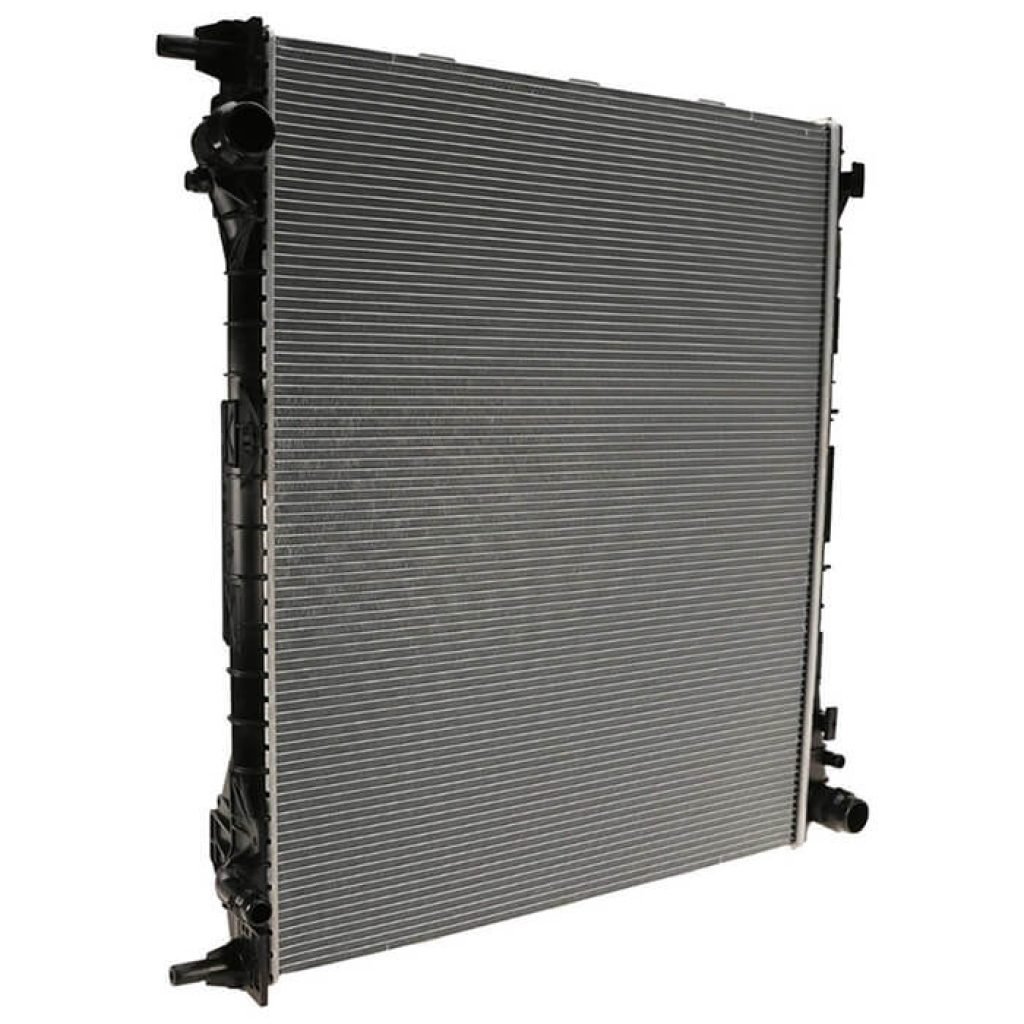
If your Range Rover shows a red temperature warning, the gauge rises abnormally, or steam appears, stop as soon as it is safe and switch the engine off. Do not open the expansion-tank cap while the engine is hot. Low coolant, a leak, restricted flow, lost fan airflow, trapped air, or combustion pressure can all cause overheating, so the failed part should be confirmed before replacement.
When a Range Rover overheats, the warning tells you that temperature control has been lost. It does not identify the failed component. The useful clues are when the temperature rises, whether coolant is disappearing, what warning appeared, and whether the concern began after cooling-system work.
Warning signs and related clues
- Temperature rises abnormally. The gauge moves above its normal position or a high-temperature message appears.
- Steam appears. Steam or vapor from the engine bay means the vehicle should be stopped safely and switched off.
- A hot or sweet smell develops. Coolant reaching a hot surface can produce a distinctive smell even when no puddle is visible.
- A coolant warning appears. A low-coolant warning concerns level; a high-temperature warning concerns heat. A level warning alone does not prove overheating, but repeated loss needs investigation. Follow the displayed instruction and check the level only when cold.
- Power is reduced. The vehicle may limit performance when temperature or related engine data moves outside the expected range.
- Coolant is found underneath. A puddle, dried residue, damp hose connection or wet undertray can help locate an external leak.
- New mechanical noise appears. A knock, tick or changed engine sound during an overheat is a stop-driving sign, not a diagnosis.
When to stop driving
Stop and arrange assistance if the warning is red, the gauge continues rising, steam is visible, coolant is escaping, or the engine runs roughly or makes a new mechanical noise. Continuing to drive can turn a cooling-system fault into internal engine damage.
Do not remove the coolant cap while the system is hot and pressurized. If the vehicle is not safe to drive, use the Range Rover recovery and workshop pickup service.
What the overheating pattern can reveal
The pattern helps choose the first tests. It does not prove which component has failed.
| When it happens | What deserves testing |
|---|---|
| Mainly in traffic or at idle | Cooling-fan command and operation, airflow through the cooling pack, and radiator heat rejection. |
| During acceleration, hills or sustained load | Coolant volume and circulation, thermostat and pump behavior, radiator restriction, and combustion pressure where evidence supports the test. |
| After coolant or cooling-system work | Correct filling, trapped air, leak sealing, and the procedure specified for that engine and configuration. |
| Coolant warning with no obvious puddle | A leak that appears only when hot or pressurized, coolant held by the undertray, a small heater-circuit leak, or possible internal loss. |
Why overheating in traffic needs a fan and airflow check
When a Range Rover is stationary or moving slowly, it has less road-speed airflow through the cooling pack. The fitted fan arrangement becomes particularly important. A temperature rise at idle therefore makes fan operation and airflow useful early checks, but it does not prove that the fan is defective or rule out a leak, circulation problem or another cooling fault.
Record whether the AC was operating and whether its cooling changed before the warning. AC operation can change heat rejection and cooling demand. Warm cabin air alone does not establish engine overheating, and switching the AC off does not make an overheating vehicle safe to keep driving. Do not run comparison tests in traffic or rev the engine in neutral.
In controlled workshop conditions, the technician compares the requested fan operation with the actual response, checks the applicable supply and control circuit, and assesses airflow through the radiator and upstream heat exchangers.
A spinning fan can still provide inadequate airflow, while a fan that is stationary at one moment is not automatically faulty. Separate an electric fan motor fault from its supply or control fault; on a vehicle with a viscous or electronically controlled fan clutch, assess the clutch and its applicable control system instead of assuming an electric motor is fitted.
Fan type, control strategy and available feedback vary with the engine and equipment. Follow the vehicle-specific procedure and keep hands and tools clear because fans may start unexpectedly.
If the vehicle previously cooled down at road speed, record that observation rather than trying to reproduce it. It helps choose tests but is not permission to continue driving. Stop safely and switch off for a red temperature warning, an abnormal continuing temperature rise or steam. Arrange recovery when the vehicle is unsafe to move; never use a fixed waiting time as proof that a coolant cap is safe to open. Do not pour cold water over a hot engine, tighten hot hoses or leave the ignition on as a universal cooling procedure.
7 causes of Range Rover overheating
These are diagnostic categories, not a failure ranking. More than one problem can be present, and similar symptoms do not establish the same repair on every engine.
Low coolant level
A leak or an incomplete fill can leave too little coolant to carry heat away. Hoses, joints, the expansion tank, radiator and pump area are possible external leak locations. A small leak can leave residue without making a puddle.
What testing confirms. A cold inspection and an appropriately controlled pressure test help locate escaping coolant. A falling test pressure does not identify the source by itself, and some leaks appear only under particular conditions. Find the loss before treating repeated top-ups as maintenance.
Radiator restriction or leak
Blocked external fins and restricted internal passages are different faults. Debris can reduce airflow through the cooling pack, while an internal restriction can limit coolant flow. A leaking radiator can also lower the coolant level.
What testing confirms. Inspection checks the air path, fins and joints; temperature and flow evidence help assess heat rejection. Cleaning external debris does not clear an internal restriction. Flushing is not an automatic cure for a damaged or internally obstructed radiator, so the repair choice should follow the findings.
Thermostat fault
A thermostat that fails to open as required can restrict the engine's cooling path. A thermostat stuck open more often causes slow warm-up. Neither conclusion should come from the dashboard gauge alone.
What testing confirms. The technician compares temperature behavior with the specified operation for that engine and checks the relevant control circuit where fitted. An unexpected temperature difference can also reflect trapped air or poor circulation. The result needs context before a thermostat is condemned.
Water pump fault
A pump can leak or fail to circulate coolant adequately. A visible leak and a circulation fault are separate findings, and the absence of leakage does not establish pump performance.
What testing confirms. Inspection assesses leakage and the applicable drive or electrical controls. Further checks establish whether the pump actually circulates coolant as required. Identify the engine and cooling circuit first; a test or part intended for another pump arrangement is not transferable.
Cooling fan or airflow fault
At low road speed, the fitted fan system must provide enough airflow through the cooling pack. The fault may involve the fan, its supply or control, damaged air guides, or an obstruction between heat exchangers.
What testing confirms. Compare the requested fan operation with the actual response and airflow. A fan that spins has not necessarily passed the test. Use the traffic observations above to guide controlled testing, with hands and tools kept clear of moving parts.
Air trapped after cooling system work
An incomplete fill can leave air in a circuit and disrupt circulation. A temperature problem soon after a coolant repair makes the filling procedure worth reviewing, but it does not rule out an unresolved leak or another fault.
What testing confirms. Compare the completed fill and air-removal steps with the procedure for the exact engine and equipment. Check the system for leakage and verify stable operation afterward. Do not substitute a generic cap-off idling or revving routine for the required workshop procedure.
Head gasket or combustion sealing fault
Combustion gases entering the cooling system, or coolant entering a cylinder or oil passage, can accompany an internal sealing fault. The paths differ. Oil and coolant do not have to mix in every failure, and white exhaust vapor alone does not establish a failed head gasket.
What testing confirms. Coolant-loss evidence, combustion-gas testing and cylinder-integrity checks help determine whether an internal leak is plausible and where further investigation belongs. One result does not automatically distinguish a gasket from a damaged head or block. Confirm the cause and assess secondary damage before choosing the repair.
After an overheat
Severe or prolonged overheating can damage sealing surfaces and internal engine components. The extent depends on what happened; a warning does not automatically mean the engine needs replacement. It does mean the vehicle needs assessment before normal use resumes.
- Confirm the original fault. Record the diagnosis and completed repair instead of accepting a refill or a cleared warning as proof.
- Check for secondary damage when indicated. Continuing coolant loss, contamination, misfires, abnormal pressure or mechanical noise can justify further tests.
- Verify the fill and operation. Use the correct coolant, concentration and vehicle-specific filling procedure. Check for leaks, stable temperature control and the final cold level as specified.
- Monitor the result safely. Follow the handbook's cold-level checking conditions, record the date and reading, and report another drop, warning or unusual smell. Never use a test drive to see whether an unresolved overheat becomes serious.
- Follow the applicable maintenance schedule. Replacement intervals and cleaning needs depend on the vehicle and its use. Repeated topping up is not a preventive service plan.
How the cause is separated
A fault code or temperature warning is evidence, but it is not a failed-part verdict. The test order should follow the vehicle’s model, year, engine and fitted cooling system.
- Record the warning and conditions. Note the message, gauge behavior, ambient conditions, driving load and whether the heater or AC behavior changed.
- Inspect the cold system. Check coolant level and condition, dried residue, hose connections, expansion tank, cap area, radiator and visible pump area.
- Test for leaks and airflow. A trained technician should use the applicable pressure-test limit and compatible equipment, and assess fan command and operation. A cold test can miss a temperature-dependent fault; a pressure drop does not identify its source by itself.
- Compare temperature and circulation evidence. Confirm that temperature readings are plausible, then compare scan data, fan requests and temperature distribution. A sensor or wiring fault can misreport temperature; that possibility is not permission to ignore a warning or continue driving.
- Escalate only when evidence supports it. Combustion-gas or cylinder-integrity testing is appropriate when coolant loss, repeated pressurization, smoke, contamination or other findings point toward an internal fault.
Check the cap separately from the cooling circuit
The expansion-tank or radiator cap must match the specified application and pressure rating. With the system fully cold, the technician checks its seals and the tank or filler-neck condition, then tests cap operation using suitable equipment and the applicable instructions. Gates' cap-testing guidance explains why visual inspection and a professional pressure test serve different purposes.
Opening a cold cap is not a pressure test. A hiss, residue or the absence of a hiss cannot establish the cap's opening pressure or prove system integrity. Never remove a hot cap, fit a higher-pressure cap as an overheating cure, or assume replacing the cap resolves a separate leak.
Inspect airflow through the fitted cooling pack
Inspect the radiator and any upstream heat exchangers, not only the visible grille. Debris between components, obstructed fins or damaged air guides can affect airflow. HELLA's cooling-system diagnostic guidance includes contamination of the radiator and upstream condenser among the checks.
The exact cooling-pack layout varies by engine and equipment. Access and cleaning must follow the vehicle procedure without damaging fins, wiring or refrigerant lines. Fan testing is controlled workshop work with hands and tools kept clear. A clean-looking front face does not prove unrestricted airflow or coolant flow; assess it with fan-operation and temperature evidence.
Overheating myths that can cause damage
Adding coolant fixes the problem
Topping up may restore the level, but it does not explain where the coolant went. A repeated level drop needs a leak and pressure investigation.
Turning on the heater makes it safe to continue
The heater may move some heat away from the engine, but it does not make an overheating vehicle safe to drive. Treat it as a warning to stop safely, not a route to the workshop.
A normal puddle check rules out a leak
Some leaks appear only when hot or pressurized. Coolant can also collect on the undertray or evaporate from a hot surface before reaching the ground.
Every overheat means a head gasket
A head-gasket or combustion-seal fault is one possible cause. External leaks, fan faults, restricted flow, thermostat faults, pump problems and trapped air should be separated with evidence.
Match the cooling instructions to your vehicle
Use the VIN, model year, engine and market specification to select Land Rover's vehicle-specific iGuide and coolant instructions. Read the applicable coolant-level, topping-up, fluid-specification and warning-message sections. A familiar model badge or coolant color is not enough to select a fluid or procedure.
For the repair, the technician also needs current service information for the fitted cooling circuit, cap rating, pump and fan controls, and filling or bleeding sequence. Petrol, diesel and hybrid versions must not inherit one generic hardware description. On a hybrid, identify which circuit and warning are involved; leave high-voltage equipment and its cooling work to appropriately trained personnel.
The owner handbook supports safe checks. It does not replace the workshop procedure for pressure testing, dismantling or filling a particular circuit.
Range Rover overheating questions
Does overheating only in traffic prove the fan has failed?
No. Fan operation and cooling-pack airflow deserve early checks, but coolant loss, circulation and control faults remain possible. Compare the requested fan operation with its actual response before recommending a part.
Can I drive if the temperature drops after switching the AC off?
A falling reading does not establish that the fault is repaired or the vehicle is safe. After a red warning, steam or abnormal temperature rise, stop safely and arrange assistance. Do not use road speed or revving to manage an overheating engine.
How long should I wait before opening the coolant cap?
There is no universal safe waiting time. Never remove the cap while the system is hot or pressurized. Follow the exact handbook and leave the system unopened if you cannot establish that it is safe.
Does a coolant warning always mean the engine is overheating?
No. A level warning and a high-temperature warning describe different conditions. Follow the displayed instruction and check the applicable handbook. Repeated coolant loss needs investigation even when the temperature appears normal.
What changes the cost of an overheating repair?
The confirmed fault, engine configuration, access, parts, contamination and any secondary engine damage determine the scope. Ask for a written estimate with inclusions, exclusions and VAT treatment after testing.
Arrange a cooling-system inspection
If your Range Rover is losing coolant, showing a temperature warning or has overheated, send the model, year, warning message and what happened just before the temperature changed. For the commercial repair scope, see the Range Rover engine-overheating service.