
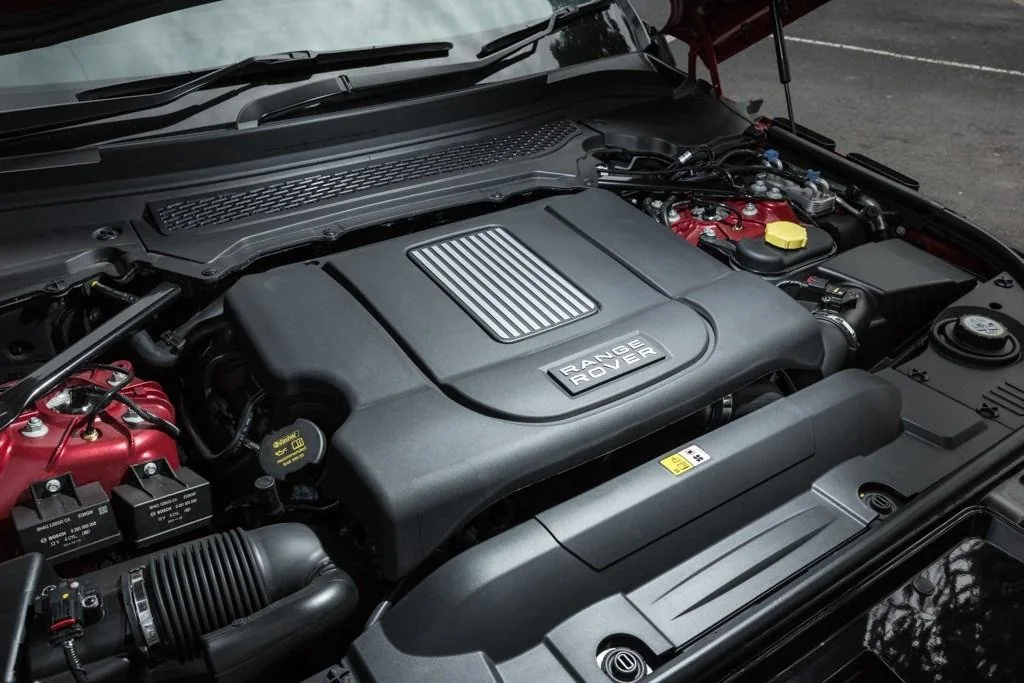
A Range Rover that stays weak when accelerating needs a diagnosis matched to when the power loss happens. Start with the warning messages, engine temperature, recent work and driving conditions, then preserve fault codes and available freeze-frame data. Air or boost leaks, fuel delivery, ignition on gasoline engines, exhaust restrictions and mechanical faults require different tests. A service, sensor replacement or software update should follow the findings, rather than a promise to restore a fixed percentage of power.
When power loss means stop driving
Stop safely and arrange recovery if power loss comes with a flashing engine warning, severe shaking, an oil-pressure warning, overheating, heavy smoke, a strong fuel smell, loud mechanical knocking or loss of drive. Follow the vehicle's warning instructions. Switch off once safely stopped when engine damage or a fuel leak is suspected. Do not keep restarting, revving or driving uphill to reproduce the problem.
If you cannot maintain a safe speed in traffic, recovery is the safer next step even without a red warning. Keep clear of traffic while waiting. Do not open a hot coolant cap or work beneath an unsupported vehicle.
A restricted-performance message does not identify the failed part. If there are no severe symptoms, check the exact message against the VIN-specific Land Rover owner information and seek advice before continuing. This guide explains what to record and what a workshop should establish; it is not an instruction to conduct your own load test.
Describe the weakness before choosing a repair
“Losing power” can describe several different problems. Sustained weak acceleration differs from a single hesitation during a gear change. An engine that runs unevenly at idle also needs a different investigation from one that sounds smooth while engine speed rises without a matching increase in road speed.
| What you notice | What needs separating | Useful workshop evidence |
|---|---|---|
| Weak acceleration whenever the engine is working hard | Air or boost delivery, fuel supply, exhaust restriction or engine protection | Requested and actual operating data captured under safe, relevant conditions |
| Power fades after traffic or a long drive | Temperature-related protection, cooling faults or a component that fails when hot | Temperature readings, fault timing and comparison with the same vehicle when the symptom is absent |
| Engine speed rises but the vehicle does not accelerate normally | A normal downshift versus transmission or driveline slip | Gear, input/output speed and drivetrain fault information |
| Shaking at idle with little evidence of weak acceleration | Uneven combustion versus vibration transmitted through mounts | Misfire data, engine running checks and a separate mount inspection |
| A hybrid feels different when electric assistance changes | Expected operating strategy versus an engine or electrified-system fault | Battery state, temperature, drive mode, warnings and model-specific system data |
These patterns direct testing; none proves a particular failure. If your Range Rover jerks during acceleration, record when the jolt occurs and whether it coincides with a gear change or uneven engine running.
Keep a useful record of load and timing
Once parked safely, write down what happened before the fault. Do not photograph the dashboard or watch a scan tool while driving. A passenger's observation or a note made after stopping is enough. Useful details include:
- Vehicle identity: model, year, engine, mileage and VIN for the workshop. Mention whether it is a UAE-market vehicle or an import.
- When it started: suddenly, gradually, after refueling, after maintenance or after another repair.
- Conditions: cold start, fully warm, stationary traffic, steady cruising or climbing a gradient.
- Load: passengers, luggage or towing within the vehicle's limits, and whether air conditioning was operating.
- The event: warning wording, approximate road speed, selected gear if known, unusual noise, vibration or visible smoke.
- What changed afterward: whether the warning remained and whether the symptom disappeared after stopping. That change does not establish that the fault is harmless.
Bring the service history and invoices for recent plugs, filters, cooling work or software changes. Tell the technician about modifications and any codes already cleared. That information can prevent a second workshop from repeating an ineffective repair.
Preserve fault data before clearing anything
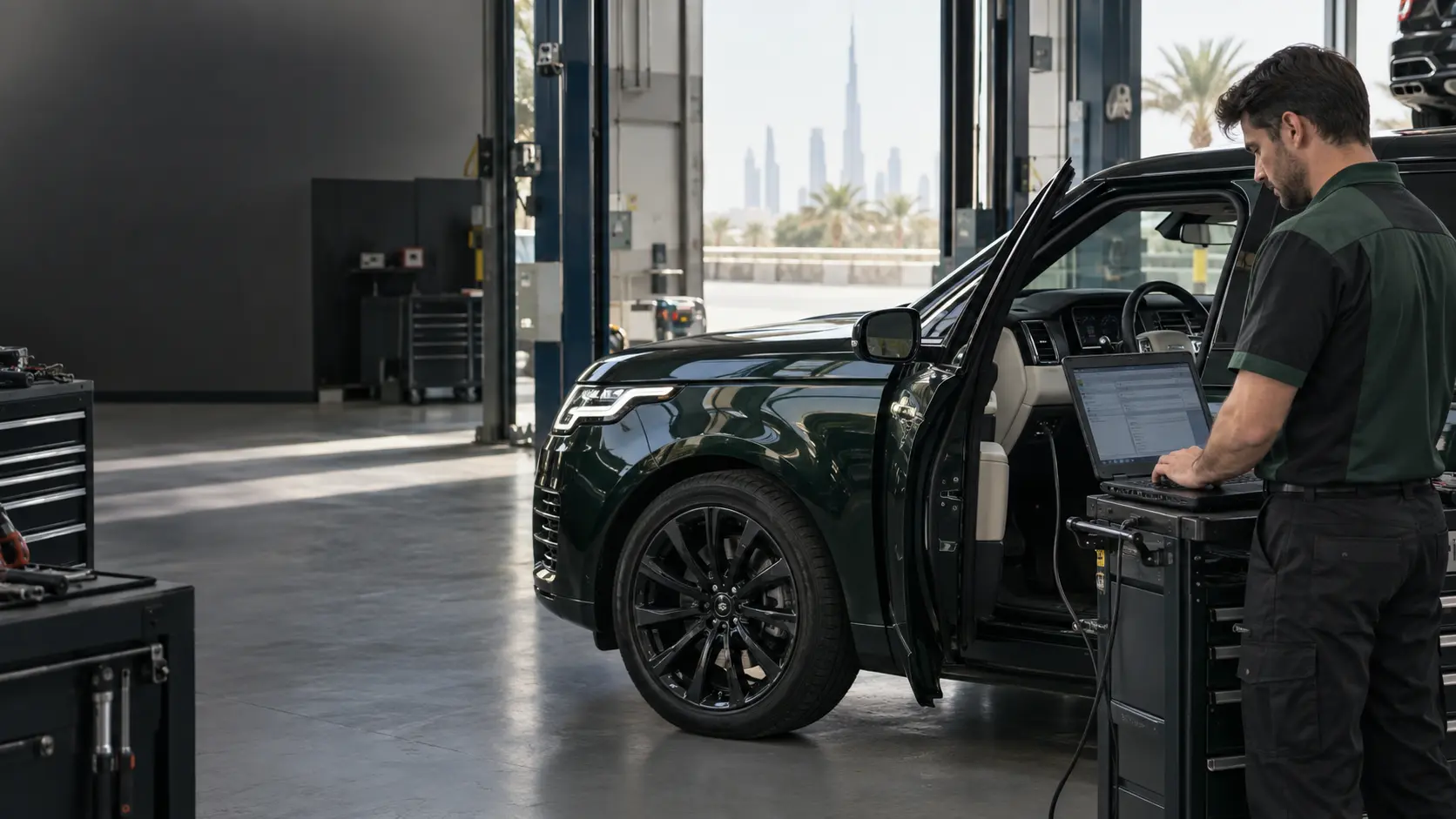
Identify the exact engine and fitted systems before interpreting a scan. A gasoline turbo engine, a supercharged engine and a diesel do not share every test. Mild-hybrid and plug-in hybrid vehicles also need their electrified systems considered. High-voltage components require appropriately trained personnel and the specified isolation procedure.
Request the full scan report before code clearing or adaptation resets. It should retain the reporting module, complete code, status and available freeze-frame or event data. Freeze frame is a stored snapshot associated with a fault, not a recording of the entire journey. Some events have limited data or no useful snapshot.
A misfire code identifies a combustion problem; it does not automatically condemn a coil. An underboost code does not automatically condemn a turbocharger. The next test must distinguish the component from its wiring, supply, control and connected systems.
Snap-on's explanation of OBD-II service modes distinguishes stored diagnostic information from clearing it. Save the evidence first. A successful code clear or a warning-free restart is not a completed repair.
What the inspection should establish
A sensible test plan starts with the complaint and accessible checks, then becomes more specific as evidence develops. It should not automatically include every procedure below. Any road or loaded test must be justified, conducted by the workshop under safe conditions and stopped if serious symptoms appear.
Physical condition, connections and recent work
With the vehicle made safe under its service procedure, inspect intake ducting, hose joints, filter installation, fluid leaks and disturbed connections. Look for damaged wiring or an insecure ground connection where the symptoms justify it. Power and ground checks can rule out electrical supply problems before an expensive control module is blamed.
A loose connection after recent work may be relevant, but appearance alone is not proof. The report should explain what was found and how testing connects it to the complaint. Mount damage may explain vibration or excessive movement; it should not be sold as a general cure for reduced engine output.
Air supply, boost control and airflow readings
Check the air filter and intake path for restriction, damage or poor sealing. On a boosted engine, inspect the relevant charge-air hoses and intercooler connections, then compare requested boost with measured boost under appropriate conditions. Any leak or pressure test needs the correct equipment and the manufacturer's limits, not a generic pressure applied to every engine.
Low boost may involve a leak, control problem, restriction or turbocharger fault. Garrett recommends diagnosis before turbo replacement and restricts vehicle trials to a drivable vehicle. A noise or oily hose alone is insufficient evidence for a new turbocharger.
For a mass airflow sensor, assess the electrical supply, connections, intake integrity and plausibility of the reading. HELLA's airflow-sensor guidance includes connection, damage, supply and electronic checks. There is no routine “Dubai MAF recalibration” in this guide. Cleaning, replacement or adaptation must suit the exact part and repair procedure.
Fuel delivery and combustion
Compare the fuel system's requested and actual delivery using the correct engine data. Investigate a pressure shortfall before deciding whether a pump, its supply, a control fault or an injector is responsible. The relevant test may differ between gasoline direct injection and diesel systems.
Injector cleaning is not a compulsory first step. Injector design, measured leakage or delivery, electrical condition and the manufacturer's repair limits determine whether testing, cleaning or replacement is appropriate. Coding or adaptation applies only where the engine's procedure requires it. Never loosen high-pressure fuel lines as an owner check.
On gasoline engines, misfire investigation can include plug condition, correct fitment, coil operation and wiring, alongside fuel and mechanical checks. Use the specified plugs and installation procedure. Replacing plugs or coils does not create a universal requirement to reset ignition timing for Dubai. Diesel combustion diagnosis does not use the same spark-plug and ignition-coil routine.
Temperature control and exhaust restriction
If weakness appears after warm-up, compare measured temperatures with the engine's operating strategy and inspect the cooling system as indicated. A thermostat fault needs a vehicle-specific functional diagnosis. Do not treat climate-based thermostat recalibration as a routine service, or assume every thermostat can be adjusted before replacement.
Exhaust restriction can also limit performance, but the test depends on the installed catalyst, particulate filter and sensors. A damaged catalyst is not repaired by compulsory cleaning. For a diesel particulate filter, follow the exact warning and service procedure; forced regeneration is not a universal power-loss treatment.
Any confirmed restriction needs its cause investigated. Replacing an exhaust component without addressing a damaging misfire, excessive oil consumption or another underlying fault can leave the original problem unresolved.
Mechanical evidence before an overhaul
Compression, cylinder leakage, oil pressure or valve-timing checks become relevant when the complaint and earlier results point toward internal engine trouble. Measurements need the specified conditions and limits for that engine. One generic compression threshold cannot decide the condition of every Range Rover engine.
A borescope image can support an assessment, but lighting, viewing angle and the visible area limit what it proves. Persistent leaks or contaminated fluids need a source diagnosis; they do not automatically justify a complete rebuild. Ask what is damaged, which measurements establish it and whether a contained repair remains viable.
Routine engine care follows the vehicle specification
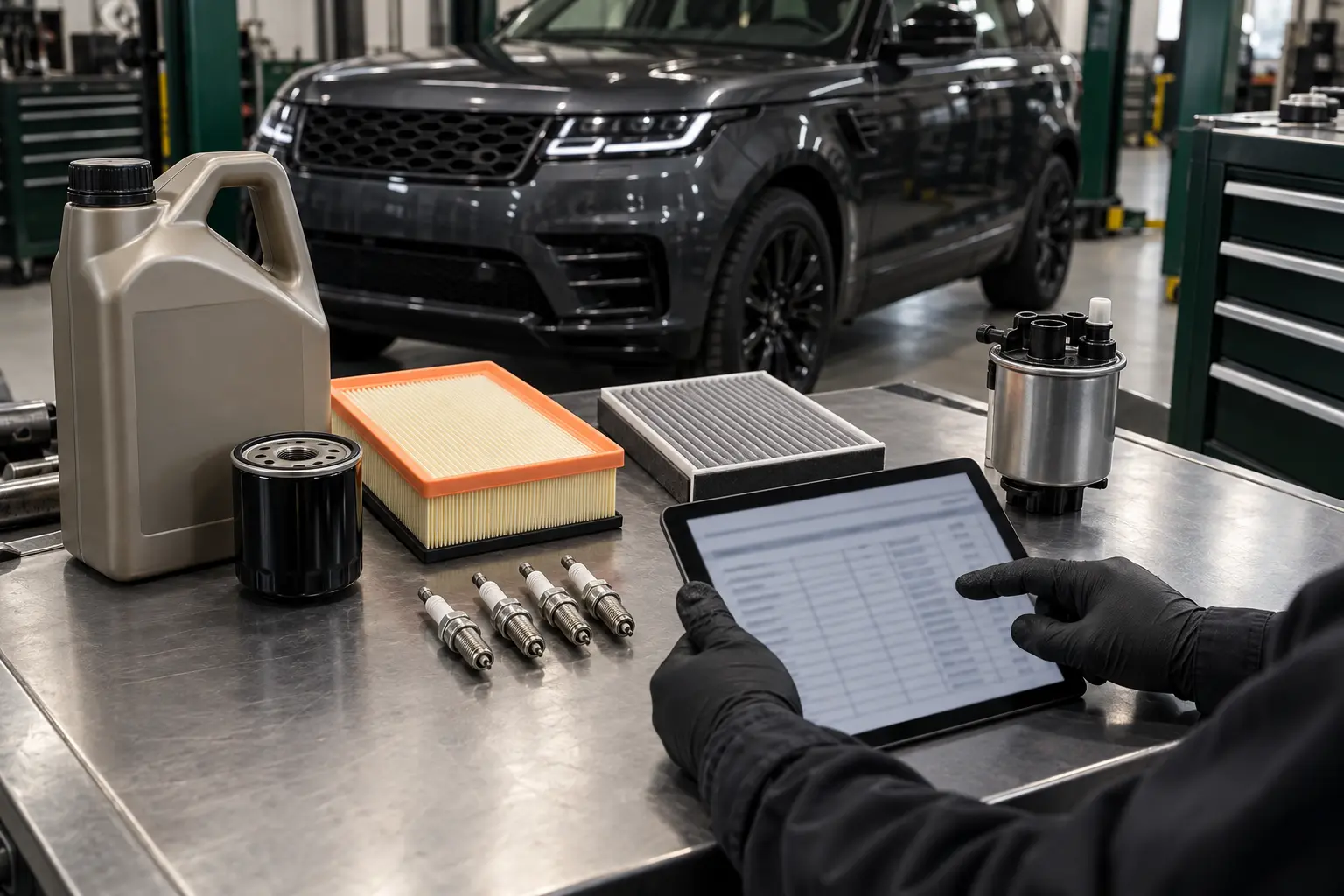
Use engine oil with the required JLR approval and viscosity for the exact engine and model year. “Synthetic,” “desert grade” or viscosity alone does not establish suitability. Ask for the oil product name and approval on the invoice, and check them against the vehicle information. Dubai's weather is not a reason to substitute an arbitrary thicker oil.
Check oil level only using the owner's specified conditions, including any required temperature, waiting time and level ground. Do not inspect the oil while the engine is under load. Oil color alone cannot establish lubricant condition or remaining life. Suspected fuel or coolant contamination needs investigation rather than an automatic engine flush.
The current Range Rover UAE servicing overview states a general interval of 13,000 km or 12 months, whichever comes first. Confirm the schedule, service indicator and any applicable arduous-use requirements for your VIN, engine and market, especially with an imported or older vehicle. This general statement does not mean every service item is due at every visit.
Use the Range Rover maintenance schedule for your vehicle to identify overdue work. A documented overdue filter or oil service deserves attention, but routine maintenance is not a confirmed cure for unexplained sustained power loss.
A factory software update is different from tuning
An applicable factory update addresses a defined software issue or manufacturer requirement. Before recommending it, the workshop should identify the vehicle, installed software and relevant manufacturer instruction. Being an older version does not by itself prove that software caused the complaint.
Performance tuning changes the calibration to pursue a different performance target. It is optional modification work, not routine engine care or a substitute for finding an existing fault. A factory update should not be described as a guaranteed power upgrade, and a remap should not be used to hide warnings or bypass emissions controls.
If the vehicle already has a remap, disclose it before diagnosis. The technician needs to know that expected control behavior may differ. Any programming, adaptation or return to standard software needs the applicable procedure, correct equipment and stable power supply.
What should justify the repair quote
| Proposed work | Evidence to request | What is not enough |
|---|---|---|
| Targeted hose, wiring, sensor or component repair | A confirmed defect and test results connecting it to the complaint | A symptom list or a code naming a circuit |
| Software update or required adaptation | Applicability to the VIN, installed version and repair procedure | A claim that Dubai weather makes factory settings unsuitable |
| Internal repair, rebuild or replacement engine | Mechanical findings, extent of damage and comparison of viable repair options | Age, recurring warning lights or a single unclear inspection image |
Ask for a written AED quote separating diagnostic time, further tests, parts and labor, with VAT treatment stated. Confirm the part number or exact application, proposed part brand, warranty terms and whether extra dismantling requires approval. “OEM” alone is not a complete parts specification, and it does not prove that a component is inferior to a dealer-supplied part.
After repair, ask how the original complaint was checked. Where safe and practical, comparable temperature and load conditions matter more than a stationary idle or cleared warning. The handover should state what was confirmed, which relevant readings changed and whether any concern remains. If the symptom was not reproduced, the report should say so rather than promise a fixed horsepower or fuel-economy gain.
Range Rover power-loss FAQs
Can a Range Rover lose power without a warning light?
Yes. A mechanical restriction, intermittent fault or problem that has not met a warning threshold may affect performance without illuminating a lamp. Stored information may still help, but an empty scan does not rule out a fault. Start with the driving conditions and physical checks.
Should I book a service or a diagnostic appointment?
Describe sustained weak acceleration when booking and request diagnosis of that complaint. Mention any overdue maintenance separately. A routine service follows scheduled tasks; a diagnostic appointment investigates why performance changed. The workshop can combine justified work without promising that servicing alone will solve it.
Does worse performance in hot weather prove a cooling fault?
No. Temperature is a useful clue, but intake conditions, protective control strategies, electrical faults and other causes can produce similar symptoms. Record when the change appears. An overheating warning requires a stop and recovery response, not another drive to compare performance.
Could the transmission be responsible for apparent engine power loss?
Yes. Engine speed rising without the expected acceleration needs comparison with the selected gear and drivetrain data. A normal downshift can also raise engine speed. Sluggishness alone cannot distinguish transmission slip from weak engine output, so describe exactly what the engine and vehicle did.
Do I need all injectors or coils replaced together?
Not automatically. The correct scope depends on test findings, the engine's repair instructions and the condition of the remaining components. Ask why each part is included. A scheduled set of spark plugs and replacement of one failed coil are different decisions.
Why did cleaning a sensor or clearing codes not fix the problem?
The sensor may not have been the cause, or its reading may reflect a problem elsewhere. Clearing a code removes diagnostic information rather than repairing the underlying condition. Provide the earlier report and invoice so the next investigation can test what remains unresolved.
Should I try fuel additives or an engine flush first?
Do not use them as a default treatment for unexplained power loss. Compatibility and usefulness depend on the product, engine and confirmed condition. Contamination, fuel-pressure faults or mechanical wear need diagnosis; a chemical treatment cannot establish or repair every possible cause.
What if the workshop cannot reproduce the power loss?
Request the saved report, the conditions tested and a clear next step. Your event log can identify a missing temperature or load condition. Ask whether further monitored testing is justified and safe. “Not reproduced” should not become either a guaranteed all-clear or an automatic parts order.
The takeaway before authorizing engine work
A useful diagnosis links the conditions of power loss to test results and a specific repair. Preserve the evidence, use the vehicle's oil and maintenance requirements, and keep optional tuning separate. Neither Dubai heat nor a fault code justifies a package of calibration, cleaning and replacement work.
When arranging engine diagnostics, share the VIN, warning wording, service history and event notes so the initial checks address the actual complaint. If the stop-driving conditions above apply, arrange recovery rather than driving to the workshop.
Workshop support
Need help with your Range Rover?
Tell us your model, year and what you have noticed. Speak with the workshop about maintenance, an inspection or a repair.